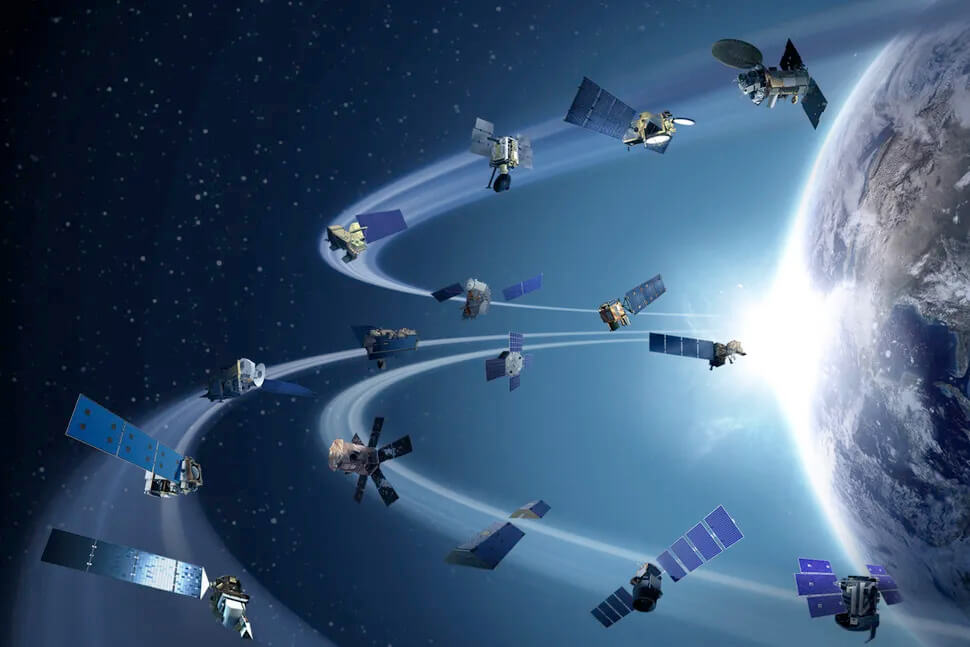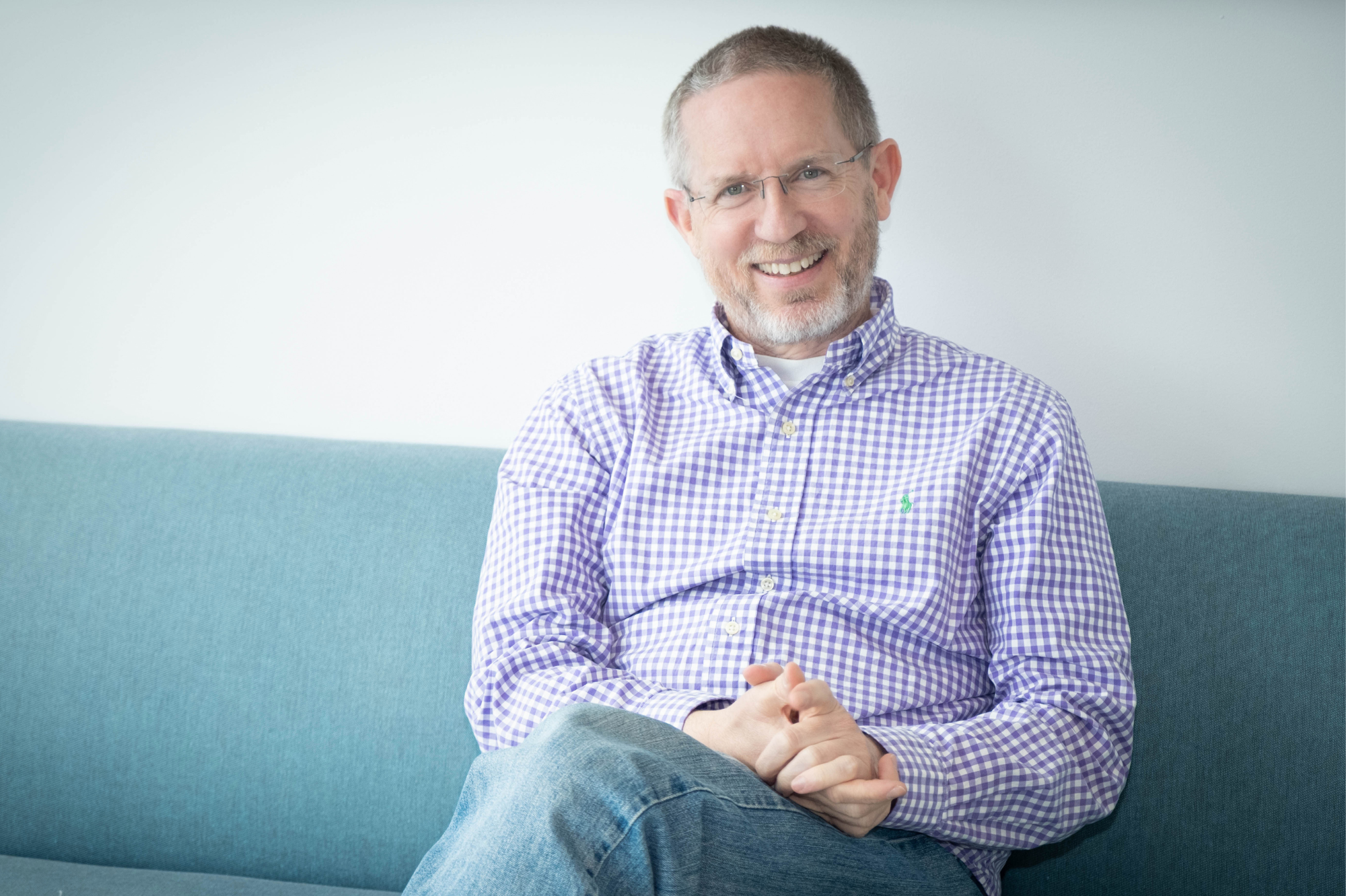
Sean Brady uses computational biology and synthetic chemistry to speed up the search for new drug candidates hidden in the natural world. (Credit: Lori Chertoff)
For his entire career, Sean Brady has been on the hunt for medically useful molecules hidden in the natural world. He knows that, beneath our feet, soil bacteria are manufacturing a vast, untapped arsenal of antibiotics. The problem: these molecules are incredibly difficult to access and study. Most soil bacteria can't be grown in the lab, and those that do rarely produce their key defensive molecules when multiplying alone in culture dishes. The same is true of bacteria found in places as diverse as the deep ocean or a sandy desert.
But Brady, the Evnin Professor and head of the Laboratory of Genetically Encoded Small Molecules at Rockefeller University, has paved another route toward finding and studying these drug candidates. Over the last two decades, his lab has developed an increasingly powerful methodology for isolating DNA from soil and scanning those bacterial genomes for patterns associated with useful molecules. Then, they synthesize the predicted molecules in the lab and test their abilities to kill other types of bacteria.
Already, this approach has begun to point toward new types of antibiotics that could ward off some of the most dangerous pathogens that exist. Brady has discovered potential drugs in dirt from New York City parks and rural forests. But with the advent of better gene sequencing technologies and new lab tools-and the promise of improved AI modelling-Brady says what he's found thus far represents just the tip of the iceberg. His platform now has the potential to unearth not just antibiotics, but also antifungals, anti-cancer drugs, and antivirals from any environment on the planet.
We spoke to Brady about how his computational biology is changing drug discovery and why AI could speed up-and ultimately reshape-the search for new medicines.
Why is soil such a rich place to look for antibiotics?
Soil is the most ecologically rich environment on earth, as far as microbes go. There are a huge amount of nutrients constantly being turned over, which means a lot of food for bacteria to fight over and a lot of different places for them to live. While we don't know exactly why bacteria evolved to produce antibiotics, scientists believe that it's because germs are competing so intensely for those resources, they've evolved these chemical weapons to use against each other. That's where antibiotics likely come from: one bacterium trying to kill another.
What's interesting is that this is likely true of all dirt, everywhere in the world. We have actually found more antibiotics in desert soils than in organically rich soils like the kind in your backyard. We believe this may be because in harsher environments, where resources may be more scarce, bacteria have had to fight each other more intensely. And that competition has pushed them to produce more potent and diverse chemical weapons.
What have the challenges been in going from a scoop of dirt to new antibiotics?
The fundamental problem is that we can't grow most soil bacteria in the lab; they simply won't survive outside their natural environment using the methods available today. Even when we can culture a bacterium, it doesn't just produce antibiotic compounds willy-nilly. In the lab, only about 10% of their pathways end up being turned on. A lot of energy goes into making these molecules, so bacteria only switch on their antibiotic-making genes under specific conditions-which unfortunately we don't know how to replicate at in the lab.
So my lab developed a pipeline that sidesteps those challenges altogether. We take a spoonful of dirt, break open all the bacteria in it, and pull out all the DNA. Then we sequence it directly. The beauty of this system is that we don't try to grow anything. We just read off the genetic instructions and let a computer predict what molecules those bacteria are encoded to make. Many of the things that look potentially interesting we can synthesize in our lab to conduct addtional testing.
What's exciting is that our method isn't limited to dirt. In principle it could work on bacteria from any natural environment.
What have the limits of this approach been?
Until recently, we could only sequence short fragments of DNA out of soil-enough to get glimpses of what was out there, but not enough to assemble complete pictures of everything that bacteria were producing. As sequencing technology has advanced, we have figured out how to extract and read much larger fragments of DNA from dirt than we could before. In a recent paper, my lab showed that, with the latest technology, we could extract hundreds of complete genomes-most of them entirely new to science-from a single forest soil sample. So for the first time, we can see instructions for the full chemical library of what's out there.
What role do you foresee artificial intelligence playing as you keep refining your method?
We currently use advanced computational algorithms to scan those genomes for genes that look like they might encode useful molecules. In some cases, computational algorithms can predict the chemical structures produced by bacteria directly from the gene sequence. When this is this case, my team of chemists can recreate that molecule in the lab to test.
And predictions will keep improving as the field's knowledge grows. Every new bacterial genome sequenced and every gene cluster characterized adds to the library of patterns the algorithms can draw on.
Larger datasets are crucial for advancing artificial intelligence in the biomedical sciences. As AI tools improve more broadly, which they're doing rapidly, they'll get better at spotting useful molecules in gene clusters we've never seen before, opening up an even larger universe of potential molecules to explore.
You've described this as a process that could be scaled up and completely automated. What are the implications of that?
I genuinely believe this can get to the point where you put dirt in one end and candidate antibiotics come out the other. The sequencing, the prediction, the synthesis-all of it is moving toward automation. I sometimes compare it to where molecular biology was in the 1980s, when you could first start cutting genes and piecing them back together. That seemed remarkable at the time, and then it just kept getting better and better until you could sequence whole genomes and edit them with precision. I think we're at the beginning of a similar trajectory with this new approach of letting a computer decode biology.
Theoretically, you could go around the world collecting samples from every environment-rainforests, deserts, ocean sediments, the human gut-feed the DNA into the pipeline, and continuously generate new drug candidates to test. Eventually, even the synthesis step could be automated with robotic chemistry systems.
What has this pipeline turned up so far?
We have several compounds that we're excited about. A class of antibiotics called malacidins shows activity against MRSA and other drug-resistant pathogens, for instance. Cilagicin, which we've been developing for several years, targets two molecules that bacteria need to build their cell walls-something no existing antibiotic has done-making it very hard for bacteria to evolve resistance. Our latest study turned up two new candidate drugs that we've only begun to explore.
Taken together, these discoveries tell us that our platform can find completely new chemistry. Each compound hits a different target and works by a different mechanism. We're consistently finding types of molecules no one has characterized before. Finding truly novel antibiotics will be crucial in the fight against drug resistance.
But I think this is just the beginning. The same platform can look at any natural sample and find antifungals, anti-cancer agents, and antivirals. When we think about drug discovery more broadly, it seems nearly limitless.
Are you optimistic that this kind of work will eventually help solve our antibiotic crisis?
I am. Antimicrobial resistance is one of the handful of truly urgent biomedical problems facing humanity and you hear a lot of doom and gloom about the antibiotic crisis. But I think there should also be real recognition that scientists are pushing forward and finding solutions. The leaps that science has made on this problem, not just in our lab but across the field, have been remarkable. There is this tremendous natural reservoir that we're only beginning to dig into. I have no doubt we're going to find what we need in it.