
Researchers at the University of Kentucky Sanders-Brown Center on Aging have uncovered evidence that a single genetic variant may influence the risk of two of the diseases people fear most - dementia and cancer - but in opposite ways.
The findings, recently published in the Journal of Neuropathology & Experimental Neurology, indicate that a particular variation in the GRN gene is associated with an increased risk of LATE, a common form of age-related dementia, while also being linked to a lower risk of cancer.
The discovery could help explain a long-observed scientific mystery: why dementia and cancer occur together less often than expected.
"For years, researchers around the world have observed that individuals with dementia seem less likely to develop cancer, while people with cancer appear less likely to develop dementia," said Yuriko Katsumata, Ph.D., associate professor in the UK College of Medicine and investigator at the Sanders-Brown Center on Aging. "Our findings suggest there may be a biological explanation for that relationship and that the GRN gene could be one important piece of the puzzle."
The study builds on previous work by Sanders-Brown researchers, including Erin L. Abner, Ph.D., and David W. Fardo, Ph.D., who have helped investigate the inverse relationship between cancer and Alzheimer's disease. Earlier research using autopsy data from the University of Kentucky Alzheimer's Disease Research Center found that cancer history was associated with lower levels of Alzheimer's disease-related brain pathology, even after accounting for survival differences.
In the new study, researchers focused on the GRN gene, which encodes a protein called progranulin. Progranulin plays important roles throughout the body and has been linked to both cancer and neurodegenerative diseases.
Higher levels of progranulin have been associated with cancer growth, while lower levels have been linked to the buildup of abnormal proteins associated with LATE, short for limbic-predominant age-related TDP-43 encephalopathy.
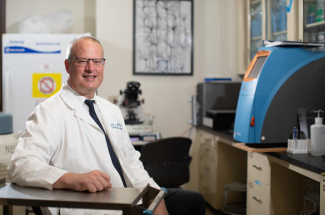
LATE was first defined by an international working group led by Pete Nelson, M.D., Ph.D., professor of pathology and director of the neuropathology core at Sanders-Brown. LATE affects an estimated one in four adults older than 85 and often the symptoms closely resemble Alzheimer's disease, making it difficult to diagnose during life.
The research team found that a common GRN genetic variant known as rs5848 was associated with increased risk for LATE dementia, but the exact same genetic mutation is associated with decreased risk for cancer. Notably, researchers did not observe the same pattern in several other well-known dementia-related genes.
"What makes this finding particularly exciting is that we identified a specific genetic factor that appears to connect these two major age-related diseases in opposite ways," said Khine Zin Aung, Ph.D., postdoctoral researcher at Sanders-Brown and first author of the study. "This moves the field beyond simply observing the relationship and begins to shed light on the biology that may be driving it."
The findings also revealed significant differences in how frequently the genetic variant occurs among different populations. Researchers found the dementia-associated version of the variant is more much more common among Black Americans, while the cancer-associated version is more common among white Americans.

"These differences highlight the importance of conducting research in diverse populations," Aung said. "Understanding how genetic risk factors vary across ancestry groups may help us better understand disparities in dementia and cancer risk and ultimately support more personalized approaches to prevention and treatment."
Investigators say the findings could have important implications for future therapies. Researchers are currently exploring treatments designed to increase progranulin levels to protect against neurodegenerative disease. However, because progranulin has also been linked to cancer biology, researchers say it will be important to better understand any potential trade-offs.
"One of the most important lessons from this work is that genes are rarely simply 'good' or 'bad,'" Katsumata said. "The same genetic pathway may have beneficial effects in one disease and harmful effects in another. Understanding those complexities is critical as we develop future treatments."
The study highlights the collaborative strengths of Sanders-Brown, bringing together expertise in biostatistics, bioinformatics, genetics, pathology and epidemiology.
"The Sanders-Brown Center on Aging has built an extraordinary team of researchers who are working together to tackle some of the biggest questions in aging research," said Nelson. "Studies like this demonstrate the power of combining different scientific disciplines to uncover connections that might otherwise remain hidden."
Researchers say the work is part of a broader effort at Sanders-Brown and across the National Institutes of Health (NIH) to better understand the biological relationship between dementia and cancer.
The study was supported by NIH awards, the UK McCullers Scholar 2024 award, and used data from major national resources, including the National Alzheimer's Coordinating Center, the Alzheimer's Disease Sequencing Project and the Alzheimer's Disease Genetics Consortium.
Research reported in this publication was supported by the National Institute on Aging of the National Institutes of Health under Award Numbers P30AG072946, P01AG078116, R01AG082339 and R01AG082730. The content is solely the responsibility of the authors and does not necessarily represent the official views of the National Institutes of Health.


