
Researchers have worked out how girls' sweating patterns change as they grow, establishing that the age of 14 is a critical turning point.
A team from the University of Southampton measured girls' sweating habits across different age groups.
Their findings can inform better sportswear designs for teenagers, and be used to encourage more teenage girls to take part in sport.
The study is the first to establish how sweating changes across the body as girls mature. It pinpoints age 14 as the point at which sweating becomes more adult-like, with an increase in sweat from the torso.
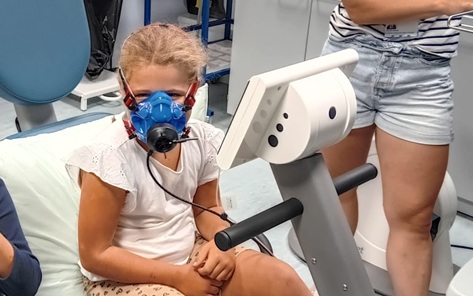
A total of 28 girls aged between eight and 25 took part in the study. They were fitted with absorbent patches before taking part in a 40-minute session on an exercise bike in 36-degree heat in the university's climate chamber. The patches revealed where and how much the girls sweated.
Dr Hannah Blount, postgraduate researcher in thermal physiology, led the research. She said: "We found that at the age of 14, girls begin to sweat across their torso more than from the extremities of hands and feet. Up to that age, children sweat the most from their hands and feet.
"That increase in sweat across the chest, abdomen and back rises linearly with age, likely driven by higher sweat output per gland."
The research by Dr Blount was supported by a PhD studentship co-funded by The Engineering and Physical Sciences Research Council and NIKE, Inc. The findings are published in the journal Experimental Physiology .

"The aim of the work is to help inform better clothing designs for girls' sportswear," explained Dr Blount. "We see quite a heavy dropout rate of girls doing sport in their teenage years, so anything we can do to help reduce the barriers to participation in sport for girls and women of all ages in a warming climate is a positive.
"So, given that our research found an increase in sweat across the torso, at the age of 14 we want to be using fabrics for sport tops that are moisture-wicking, and to design clothes that are more ventilated and allow sweat to evaporate."
Research participant Kiera Habenicht, aged 13, said: "It felt surreal that my results would contribute to something so important but that made it exciting that I was helping with something meaningful - even though I was just cycling. There were moments when it was difficult and even a bit uncomfortable but overall, it was very enjoyable. It was so interesting to see how proper experiments are done with everything so carefully controlled and purposeful."
Nine-year-old Beatrice Filingeri, who also took part in the study, said: "It was a sweaty experiment but real fun to do! It was very fun when the bike went faster and faster. I would definitely do it again because I quite liked wearing the mask and being able to see how fast I was going."
The research also adds to research that informs public health messaging.
Davide Filingeri, Professor of Human Thermal Physiology and co-author of the study, said: "Traditional messaging around vulnerability to heat stress considers children to be more at risk - it is currently believed that they sweat less than adults, so they cannot cool down as well.
"This research has demonstrated there are parts of children's bodies that sweat less, but also parts that sweat more. It adds to our understanding of who is vulnerable to heat stress and why - and at what age."


