
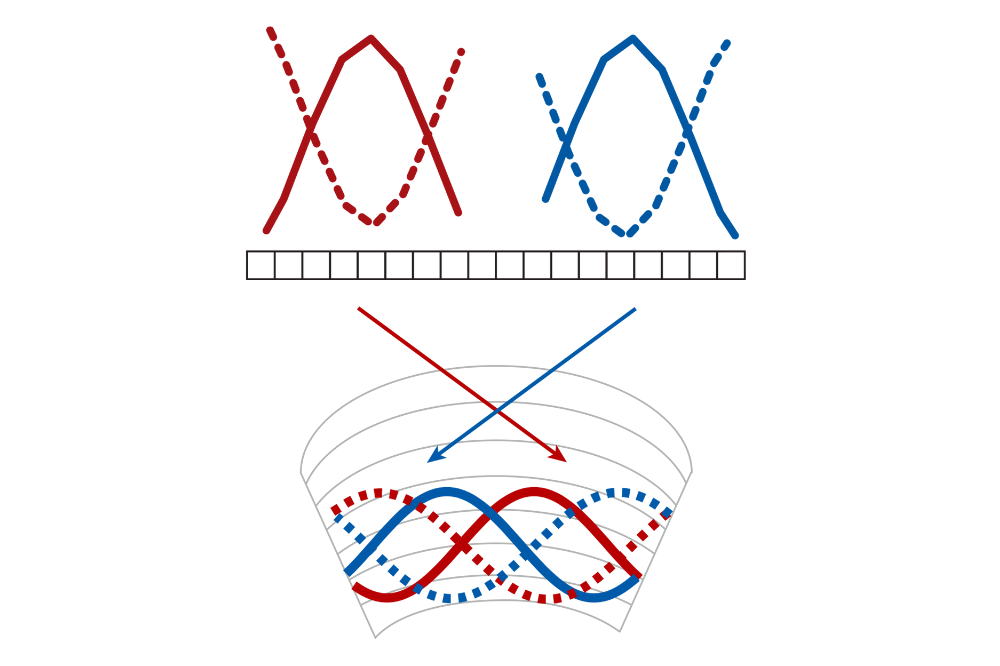
Figure illustrating how populations of neurons can invert vectors, encoded as sinusoids, using dual signaling capabilities. (Credit: Maimon lab)
Navigating the world is no mean feat-especially when the world pushes back. For instance, airflow hitting a fly on its right side can, after a turn, become a headwind. To stay on course, the fly's brain must interpret sensations that constantly shift with each turn of its body. Indeed, transforming changing sensory inputs into a more stable, map-like understanding of the world is intimately connected to an animal's ability to survive and navigate within its environment. How do flies make it look so easy?
Now, a study published in Cell shows that the fly brain uses a surprisingly economical strategy. Earlier work demonstrated that flies calculate their direction of travel by combining four neural signals, each encoding motion along a different axis. The new research finds that, when it comes to wind direction, the brain doesn't need four neuronal populations but only two. This is because each population can handle two opposite directions in the wind system.
Each population of neurons can signal airflow in either of two directions by virtue of single neurons within the population switching between firing fast sodium spikes and slower calcium spikes. The findings advance our understanding of how brains compute at a fundamental level.
"We found a new way that the brain can perform vector math," says Gaby Maimon, head of the Laboratory of Integrative Brain Function. "Our work connects the properties of ion channels on the cell membrane through the electrical activity of single neurons to population-level computations. How this system works is really quite amazing."
Doing the math
For flies to navigate through the world, their brains convert body-centered sensations into world-centered signals. The raw sensory input is inherently unstable, changing every time an animal moves. For example, if a fly is walking upwind and turns 90 degrees their bodily airflow sense shifts from frontal to sideward; however, the wind direction in the world has not changed at all. Brains can use changing bodily airflow sensations to calculate stable navigational reference directions. These reference directions allow animals like flies to migrate long distances, remember angles of interest after cues disappear, and maintain a consistent course.
"We see the world with our eyes and navigate it using our bodies, but what we see, or hear, or feel on our skin is all in different units that must be combined somehow," says Itzel Gonzalez Ishida, formerly of the Maimon lab and now a postdoctoral researcher at MIT. "It's the brain's job to perform the transformation that connects those sensations into a more concrete sense of space."
Previous work from Maimon and colleagues showed how flies compute their direction of travel. In a 2021 study published in Nature, the team found that the fly brain combines the activity of four distinct populations of neurons, each encoding motion along a different axis, to calculate where the animal is going-even when its head is pointing one way and its body is moving another. Together, these four basic inputs allow the fly brain to build a signal that tracks its travel direction in world-centered coordinates, which should allow flies to maintain a navigational direction despite shifts in posture or body orientation.
A key insight from that study was that the fly brain performs vector mathematics, literally. Each population of motion-sensitive neurons encodes a two-dimensional vector, with its direction and strength represented by a wave-shaped pattern of activity. These vectors are rotated into a shared, world-centered reference frame and then summed to produce a single output pointing in the fly's direction of travel.
In this system, however, representing all possible travel directions required four separate neural populations encoding four total vectors. Because each vector could point in only one direction, the brain needed separate groups of neurons to represent movement in opposite directions. In principle, the same math could be done with just two populations-one for each dimension-if each encoded vector could reverse direction. High-school level physics teaches us that only two-not four-basic vectors need be added together to build a resultant vector that points in any direction. For the fly brain to employ four vectors thus struck the researchers as overkill.
Might the fly nervous system be able to do this vector calculation more efficiently, they wondered?
Double duty
To find out, Maimon's team began by building a virtual-reality system in which fruit flies walked on an air-supported ball while experiencing controlled airflow from any direction. As the flies braved the wind, the researchers zeroed in on a group of airflow-sensitive neurons known as PFNa cells-a natural target, because earlier studies had shown they respond specifically to airflow stimuli.
As the researchers recorded the neurons' activity, it became clear that PFNa cells behaved in an unexpected way. Instead of producing a single, clean peak of activity to a specific airflow direction, they signaled two opposite directions with similar strength-an odd pattern that didn't fit any existing navigation model. But what initially looked confusing turned out to be a key clue. PFNa neurons were switching between two distinct modes of electrical signaling. When the cells receive a lot of excitatory input, the cells fired fast, conventional sodium spikes. And when they receive a lot of inhibitory input, rather than falling silent like most neurons, they produced slower, atypical, calcium-based spikes. These calcium spikes were evident in electrophysiological recordings made by Sachin Sethi, a postdoctoral researcher in the lab who made notable contributions to this project. Further experiments showed that this switch depends on a single gene, Ca-α1T.
"When we first saw the calcium spikes, that was really intriguing," says Ishida. The spikes oscillated at delta frequencies, best known as the rhythms of deep sleep in humans. Here, however, they appeared in fully awake flies engaged in real-time navigation. Further, the unconventional spikes suggested these cells may be up to something unique. "Our observations raised the possibility that these delta-wave like signals might be empowering the cells to compute in a unique way."
The team soon discovered just what these cells were up to. When airflow arrives to the fly from one direction, the neurons in this circuit become most active and fire their usual sodium spikes. But when airflow arrives from the opposite direction, those same neurons don't fall silent. Instead, they change their signaling style, producing the slower, rhythmic calcium spikes. In this way, populations of PFNa cells can signal both a vector and its inverse, enabling the brain to indicate all possible wind directions by summing only two, rather than four, neuronally encoded vectors.
Taken together, the findings reveal how a single navigational computation unfolds across multiple levels of biology, from molecular to behavioral. At the highest level, the fly's brain converts body-centered sensations, such as wind hitting its side, into a stable, world-centered understanding of its environment. That computation is made efficiently, via neurons that can communicate vectors pointing in opposite directions via an ability to fire both sodium and calcium spikes. Underlying the bidirectional signaling is a single gene, Ca-α1T, which produces the calcium spikes and allows a mathematically sophisticated spatial computation to be implemented by a single, elegant system.
The bidirectional signaling expressed by PFNa cells challenges a long-standing assumption in neuroscience that neurons communicate meaningfully only when they are excited. "Who would have thought that neurons can signal both when excited and when inhibited, and to flip the sign of a vector no less?" Maimon says.
That some neurons can fire calcium spikes in addition to sodium spikes was known before this study, but their purpose was never fully clear. By showing how this hidden capability can be used to perform precise mathematical operations, the work suggests that similar mechanisms may be at play elsewhere in the brain, just waiting to be discovered.
"This work raises the possibility that electrical processes we thought were most relevant to sleep, or unaroused states, are actually engaged during wakefulness, to help animals navigate and think," Maimon says. "This work reminds us that even some of the most basic electrical features of neurons are not fully understood, an encouraging sign that there is much more left to learn."


