
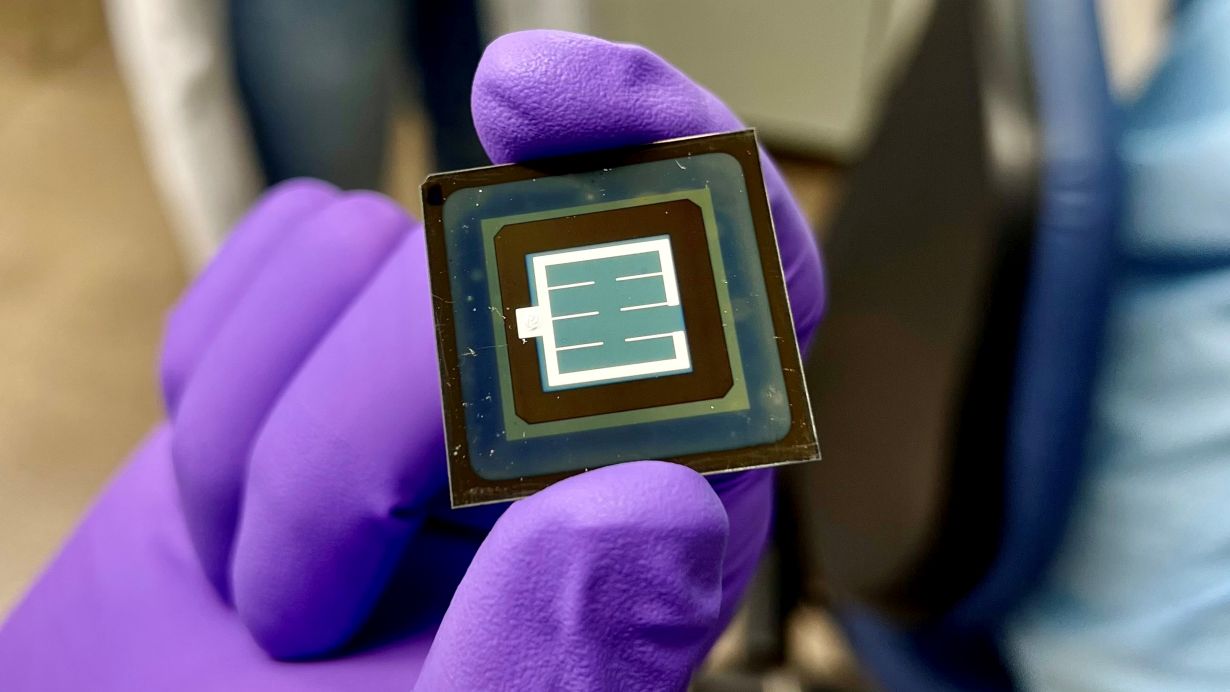
Solar energy is a cornerstone of the energy transition. Tandem solar cells made of perovskite and silicon can achieve higher efficiencies than conventional silicon cells, but their industrial manufacturing remains a challenge. Researchers at Karlsruhe Institute of Technology (KIT) and the University of Valencia have now jointly further developed a fast, solvent-free vacuum process that uniformly deposits perovskite layers at high throughput, even on textured silicon surfaces. Results published in Nature Energy. (DOI: 10.1038/s41560-026-02068-9 )
Perovskite-silicon solar cells combine two semiconductors that utilize different regions of the solar spectrum. The upper perovskite layer primarily absorbs high-energy, i.e., short-wavelength light, while the underlying silicon cell predominantly converts longer-wavelength components. As a result, tandem solar cells can convert more sunlight into electricity than single-junction silicon cells. However, one key challenge is depositing the thin perovskite layer rapidly, uniformly, and over large areas.
"For industrial manufacturing, it is not only efficiency that matters, but also whether a process is fast, robust, and scalable," says Professor Ulrich Paetzold from the KIT's Institute of Microstructure Technology and KIT's Light Technology Institute (LTI). "We were able to demonstrate that an exceptionally fast vacuum process not only produces uniform layers, but also yields efficient perovskite-silicon solar cells."
CSS Process Accelerates Coating
The fast vacuum process is based on close-space sublimation (CSS). In this process, the precursor materials evaporate and impinge on the silicon cell, which is positioned only a few millimeters from the material source. There, they react directly to form a perovskite layer. A key advantage of the CSS process is the low consumption of precursor material per coating cycle and the reusability of the sources. "Using close-space sublimation, we were also able to deposit the demanding organic precursor materials onto silicon without solvents and within a short time," explains co-author Sofia Chozas-Barrientos from the University of Valencia. "In the experiment, the conversion was completed after ten minutes - an important advance for a vacuum-based process."
Material Composition Tunes the Band Gap
In addition to uniform deposition, the top perovskite layer must absorb the appropriate portions of the solar spectrum. This property is governed by the band gap of the material: in the top subcell, it must be larger, acting as a spectral filter that selectively absorbs and transmits specific wavelength ranges, thereby ensuring efficient matching between perovskite and silicon. Because bromine can increase the band gap, the researchers initially tested a bromine-containing inorganic precursor layer. However, during conversion into perovskite, the desired bromine content was not retained in the material.
"The solution was a mixed organic source composed of methylammonium iodide and methylammonium bromide," explains co-author Dr. Alexander Diercks from LTI, who spent six months at the University of Valencia working on his doctoral research in Professor Henk Bolink's group as part of the Horizon Europe project Nexus. "By adjusting the ratio of these two components, we were able to control the bromine content in the final material and achieve a band gap of 1.64 electronvolts."
A Step Toward Industrial Production
For industrial manufacturing, the CSS process must function reliably on different silicon surface morphologies. These include textured surfaces, as they extend the optical path length within the cell and thereby increase absorption. The researchers therefore tested the CSS process on silicon subcells with smooth, nano-structured, and micro-structured surfaces. Comparable perovskite layers formed on all three surface types without the need to adjust process parameters. Scanning electron microscopy and X-ray analyses revealed uniform coverage. The tandem solar cells fabricated using this approach achieved efficiencies of 23.5 percent on smooth, 23.7 percent on nano-structured, and 24.3 percent on micro-structured silicon cells.
"This is extremely important for scaling," explains Professor Bolink. "A process that works only on perfectly smooth surfaces would be of limited use for industrial applications. The fact that close-space sublimation also produces uniform layers on textured silicon cells makes this approach highly relevant for practical deployment." The study emerged from close collaboration between research groups at KIT and the University of Valencia. Additional partners included CONICET-UNL in Argentina and Université Grenoble Alpes/CEA-LITEN in France.
Original publication
Alexander Diercks, Sofía Chozas-Barrientos et al.: Close Space Sublimation as a Versatile Deposition Process for Efficient Perovskite Silicon Tandem Solar Cells. Nature Energy, 2026. DOI: 10.1038/s41560-026-02068-9 .


