A healthy, green lawn can be the envy of any neighborhood, but how does someone cultivate a yard like that? Assistant Professor of Ecosystem Science Amber Churchill has been getting her hands dirty and digging into the science behind it.
Through the Pasture and Lawn Enhanced Diversity Global-change Experiment (PLEDGE), Churchill and her team discovered that lavish lawns depend on the environment: The number of species in an ecosystem affects how the system functions. The PLEDGE research initiative is located at Nuthatch Hollow, the outdoor laboratory and wildlife sanctuary gifted to the University by Robert F. Schumann and the Schumann family.
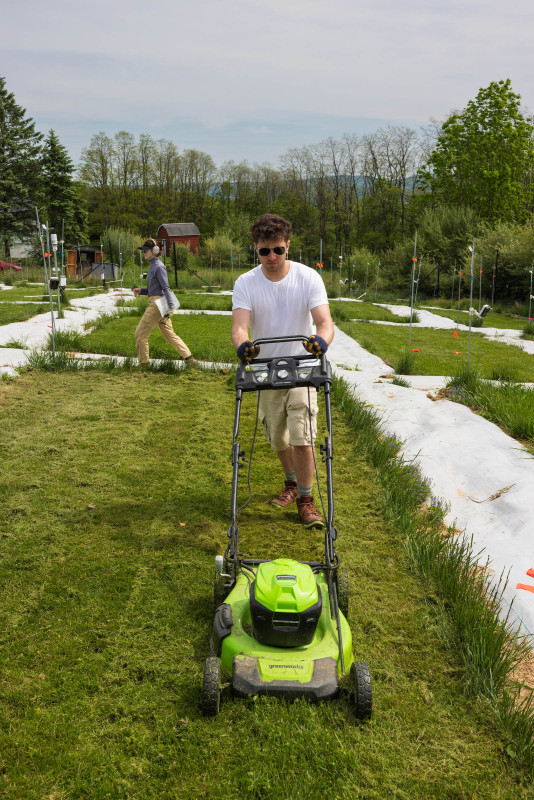
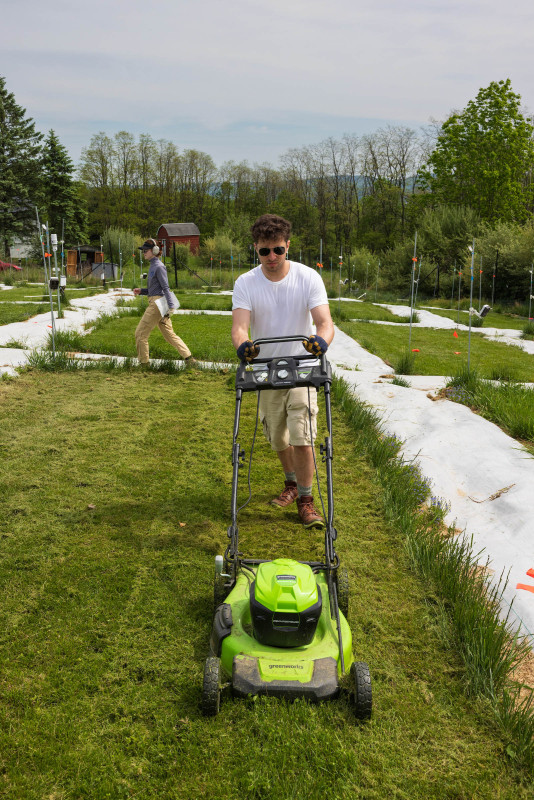
"Lawns are something people actively manage and care about every day," Churchill says. "So, we created 30 experimental plots with different combinations of species, from a typical single species grass lawn to more diverse mixes that include clover and creeping thyme."
This allowed her to directly compare what happens when you increase biodiversity in a familiar setting. It's a way of taking a large-scale ecological theory and applying it to something people see right outside their homes.
"Ultimately, we're trying to understand how small changes can lead to meaningful environmental benefits," she explains.
People tend to have strong opinions about lawns, whether they love maintaining them or would rather not deal with them at all. To Churchill, that's why they provide such an interesting space to study ecological questions, because they sit right at the intersection of human behavior and environmental function.
"In the Northeast, lawns are one of the few ecosystems where we can easily manipulate species composition," she says. "That gives us a unique opportunity to test ideas about biodiversity in a controlled but highly relevant way. It's not just theoretical; it's something that can translate directly to how people manage their own land. That connection between science and everyday life is what makes this work so exciting."
For homeowners asking, "What can I do to make my lawn the pride of the cul-de-sac?": It turns out that simply adding clover significantly increases soil nutrient availability.
"That means homeowners could potentially maintain a greener lawn without relying on synthetic fertilizers," she points out. "What's even more important is that we didn't see an increase in nutrient runoff, which is a major environmental concern. So, you're getting the benefit of more nutrients without the downside of pollution. That result really highlights how powerful biodiversity can be in shaping environmental outcomes."
Here's another interesting result from the experiment: In their controlled environment, more diverse lawns actually grew a bit shorter on average after mowing. This means you may not have to mow as often, which is a practical benefit for homeowners.
"We mow all of our plots the same for consistency, but the data suggest that people with more diverse lawns could stretch out the time between mowing," she says. "That's less work and less fuel use, which is a win on multiple levels. It challenges the idea that a more complex lawn is harder to manage. In reality, it might actually make things easier."
Churchill was surprised by how quickly they started to see differences between the lawn types. Within the first month, it was already clear that biodiversity was having an impact.
"It's one thing to understand the theory behind it, but it's another to see it play out so clearly in real time," she says. "Even more surprising was that adding species didn't increase biomass, which is what we often see in other ecosystems. In a lawn, that's actually a good thing because it means you're not creating more work. It really shows how ecological principles can behave differently depending on the context."
For homeowners looking to improve their lawns, Churchill says it's important to remember that even the smallest changes can make a big difference.
"Adding a species like clover is a simple step that can increase nutrients and reduce the need for fertilizer," she advises. "It can also help fill in gaps and make the lawn more resilient to wear and tear, especially if you have kids using the space. You don't need to completely redesign your yard to see benefits. Just introducing a little more diversity can fundamentally change how your lawn functions. It's about working with nature instead of against it."