
In a study published in Science on January 9, the teams of Jeremy Murray and ZHANG Yu from the Center for Excellence in Molecular Plant Sciences (CEMPS) of the Chinese Academy of Sciences, along with collaborators, have resolved, for the first time, the high-resolution crystal structure of the complex formed between the NodD protein of pea rhizobia and a flavonoid compound (hesperetin). They elucidated how NodD recognizes flavonoids and revealed key structural elements in NodD that determine the specificity of signal recognition.
In nature, root nodules formed through symbiosis between legume plants (such as soybeans and alfalfa) and rhizobia serve as highly efficient natural nitrogen fertilizer factories. Within these organs, plants provide carbon sources to rhizobia, while rhizobia convert atmospheric nitrogen into a usable form of nitrogen fertilizer for the plants. Legume roots exist in complex environments, surrounded by a multitude of rhizobia and other bacteria. How do plants allow only "compatible" rhizobia to enter their roots and form nodules?
For a long time, scientists have known that legume roots secrete a chemical signal called "flavonoids," which is recognized by a transcription factor in the rhizobia named NodD. Although NodD was known to contribute to symbiotic specificity, how it specifically recognizes flavonoid chemical signals has remained an intriguing question.
In this study, the researchers found that the ligand-binding domain of the NodD protein from pea rhizobia recognizes hesperetin through two binding pockets: one located within a monomer of the NodD protein and the other situated at the dimer interface. This binding conformation is the first of its kind to be observed among known transcriptional regulators in the NodD family.
Further analysis indicated that NodD contains three key activation domains, along with specific critical amino acids, which collectively form a "binding pocket" that accommodates flavonoid molecules like hesperetin but not other classes of flavonoids, such as isoflavones or pterocarpans. This provides a structural explanation for why rhizobial NodD is only activated by specific flavonoids.
Furthermore, the researchers compared the NodDs from alfalfa and pea rhizobia. Despite an overall similarity of 80% between the two proteins, their "preferences" for different flavonoids are very different. Pea rhizobial NodD primarily responds to flavanones/flavones, whereas alfalfa rhizobial NodD mainly responds to chalcones.
Through domain-swapping experiments and extensive point mutation studies, the researchers identified several key amino acids located in critical activation regions. They showed that these specific amino acid residues determine the ability of the rhizobia to respond to different types of flavonoids.
So why is this specificity needed in the first place? The researchers suggested that such precise recognition stems from millions of years of co-evolution in overlapping habitats. To ensure successful partnerships, each species accurately identifies its preferred rhizobia strain through a mutual "double-lock and key" system: the bacteria recognize unique flavonoid signals from the plant and the plant recognizes specific signals in return. This prevents mix-ups when multiple species grow nearby.
This study answers the question of how legume plants and rhizobia achieve signal-specific recognition through flavonoids and NodD, and provides a new way to design efficient nitrogen fixation systems. Besides, it paves the way for designing efficient, crop-specific "tailor-made" rhizobia for enhanced nitrogen fixation, and holds the potential to extend nitrogen-fixing symbiosis to non-legume crops such as rice and corn, reducing agriculture's reliance on chemical nitrogen fertilizers.
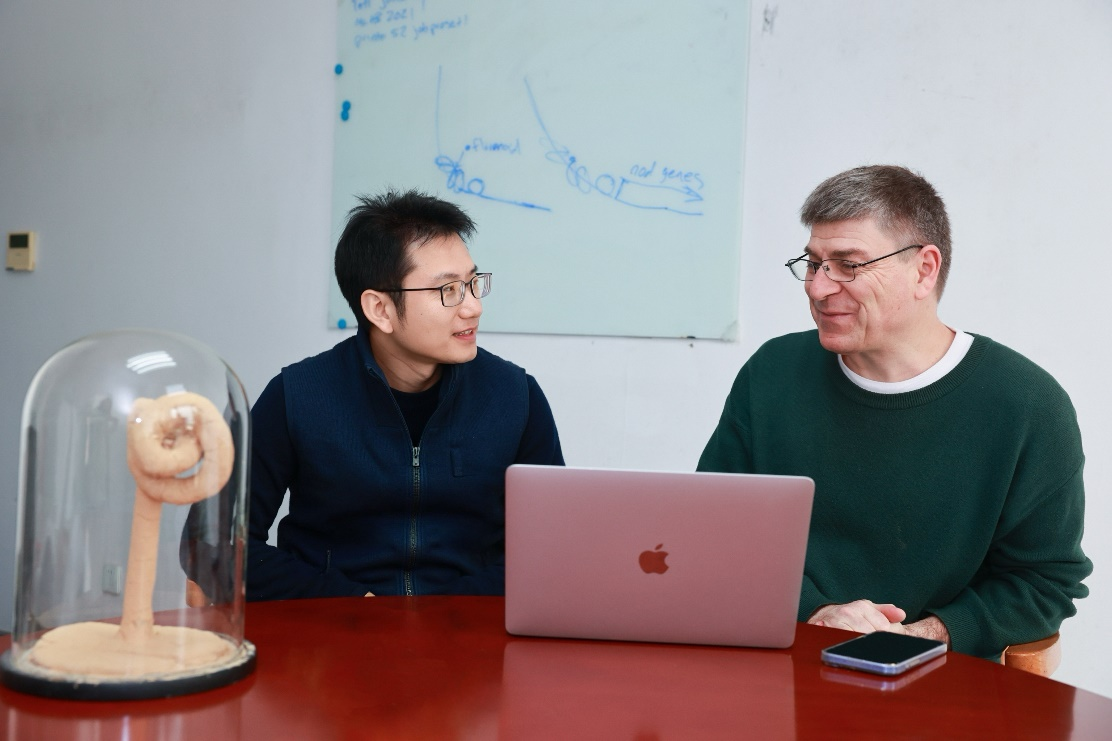
Prof. Jeremy Murray (right) discusses work with Prof. ZHANG Yu (left). (Image by CEMPS)


