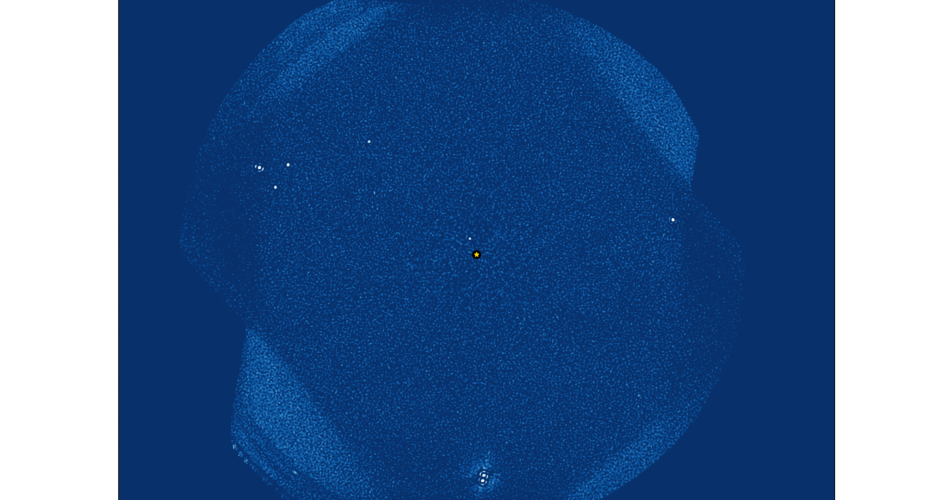
A massive exoplanet orbiting twin stars approximately 500 light-years from Earth has been found by astronomers.
HD 143811 b is a gas giant six times the mass of Jupiter, and orbits its two suns once every 300 Earth years.
Astronomers believe it's relatively young - at most, 20 million years in age - with a surface temperature in excess of 700 degrees Celsius.
It is among just a handful of exoplanets to have been discovered orbiting twin suns, and was found using a technique called Direct Imaging. Pioneered 20 years ago, Direct Imaging involves ultra-high-resolution photos taken through a telescope while blocking out the competing light source of the resident star.
The research was led by Dr Vito Squicciarini, an astronomer with the University of Exeter, but conducted by LESIA - Observatoire de Paris and its COBREX project.
"We know almost nothing about how planets form around binary stars," says Dr Squicciarini, of Exeter's Department of Physics and Astronomy. "Very few have been found orbiting binaries, especially giant ones like this, so our find is something quite rare."
COBREX, funded by the European Research Council and led by Dr. Anne-Marie Lagrange, has, since 2020, been surveying a large database of imagery previously taken using the Very Large Telescope (VLT) and the Gemini South in Chile. This database encompasses the two biggest planet-hunting surveys to date: GPI (600 stars, conducted at Gemini South) and SHINE (400 stars, carried on at the VLT), each of which had previously resulted in the discovery of just a single new exoplanet.
But by processing the images using an advanced algorithm named PACO, the team has been able to 'clean' and enhance them, making it, in theory, easier to identify worlds in distant solar systems. And it was during this process that Dr Squicciarini and colleagues identified what they suspected was a new exoplanet.
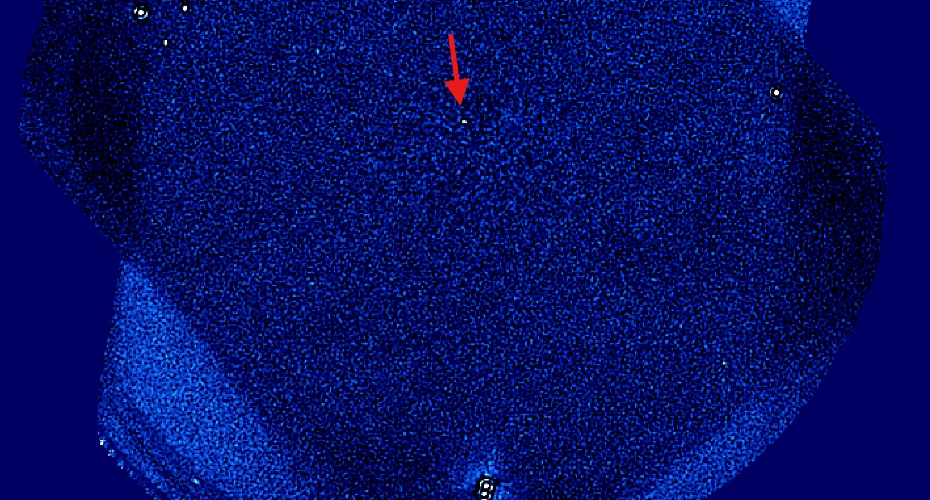
"We could see a previously unidentified source close to the location of the two stars," he said. "But we needed another observation to confirm that it was orbiting the two stars and not just a spurious, farther away source projected in that position by chance. So, we pitched for telescope time in Chile, and in July this year, we obtained further imagery. Within an hour, we had confirmed that it was indeed a new planet - the first to be found through the project."
Dr Squicciarini said that a "surprising amount" was already known about HD 143811 b from its position and its shared characteristics with other gas giants. It is understood to be formed almost entirely of hydrogen and helium, with a temperature around 730 degrees Celsius and a mass six times that of Jupiter.
At 80 astronomical units from its twin stars (where one unit is equivalent to the distance between the Earth and the sun), it's orbiting at a distance greater than that of Pluto, and takes 300 Earth years to complete a single orbit.
Those suns - HD 143811 A and B - sit close to one another and are slightly larger than our own sun. They are also much younger, at around 20 million years old.
Direct Imaging is one of the techniques used by astrophysicists to find exoplanets - the term used to describe planets outside of our solar system. Since its introduction in 2004, it has helped to identify more than 50 exoplanets, out of a total of nearly 6,000.
"The importance of this find is that it could help us establish a benchmark for how such planets are formed," adds Dr Squicciarini. "And following on from this, the question is whether planets like the Earth could be found in this kind of system? We don't yet know the answer to this because we need to understand more about the structure of the discs from which planets form when they're in binary systems. Maybe in a few years, with more discoveries like this, we will be able to answer these fundamental questions."