
Iron rusts on its own, slowly, over months or years. Now, researchers at Tohoku University have found a way to compress the process of metal reacting with water to form oxide, taking mere hours and using nothing more than ultrasound.
Details were published in the journal Ultrason Sonochem on August 27, 2026.
Spinel-type iron oxide nanoparticles are widely used in magnetic materials, adsorbents, catalysts, magnetic separation, and biomedical research. Conventional synthesis methods typically start with soluble iron salts, which are then converted into particles using chemicals such as ammonia or sodium hydroxide. The Tohoku University team took a different approach, generating the nanoparticles directly from iron powder and water, activated by ultrasound.
In the study, 1.0 g of iron powder was dispersed in water and treated with ultrasound at 23 or 43 kHz, with reaction temperature and treatment time varied across trials. The resulting particles were analyzed using X-ray diffraction, electron microscopy, and magnetic measurements. Under one set of conditions the particles averaged about 32 nm in size, with a magnetization of 85.6 emu/g at the maximum applied field.
At 43 kHz over 24 hours, the estimated conversion of iron to spinel-type iron oxide reached 36.1% at 30°C, 68.5% at 40°C, and 63.7% at 60°C. Particle size changed little between 40°C and 60°C, indicating that temperature primarily influences the extent of oxidation rather than the size of the particles formed.
To isolate the role of ultrasound, the researchers also tested mechanical stirring of the same mixture at 40°C for 72 hours. Oxidation still occurred, but the resulting oxide largely remained as submicrometer particles attached to the iron surface. Under ultrasound, by contrast, much smaller particles detached from the surface and dispersed into the surrounding water.
The difference is attributed to acoustic cavitation: the rapid formation and collapse of tiny bubbles under ultrasound. This collapse can generate microjets and shock waves capable of breaking apart and renewing the iron surface, along with brief, localized zones of high temperature, high pressure, and reactive chemical species. These effects are thought to work in combination to drive a reaction between solid iron and water that would otherwise proceed slowly. The precise reaction pathway has not yet been confirmed and remains an area for further study.
"The core finding here is not simply a reagent-free synthesis route," said Yamato Hayashi, Associate Professor at the Graduate School of Engineering, and who helped lead the study. "What we are demonstrating is a direct solid-liquid transformation from metal to oxide - ultrasound activates the interface between metallic iron and water, and nanoscale oxide particles form directly at that boundary."
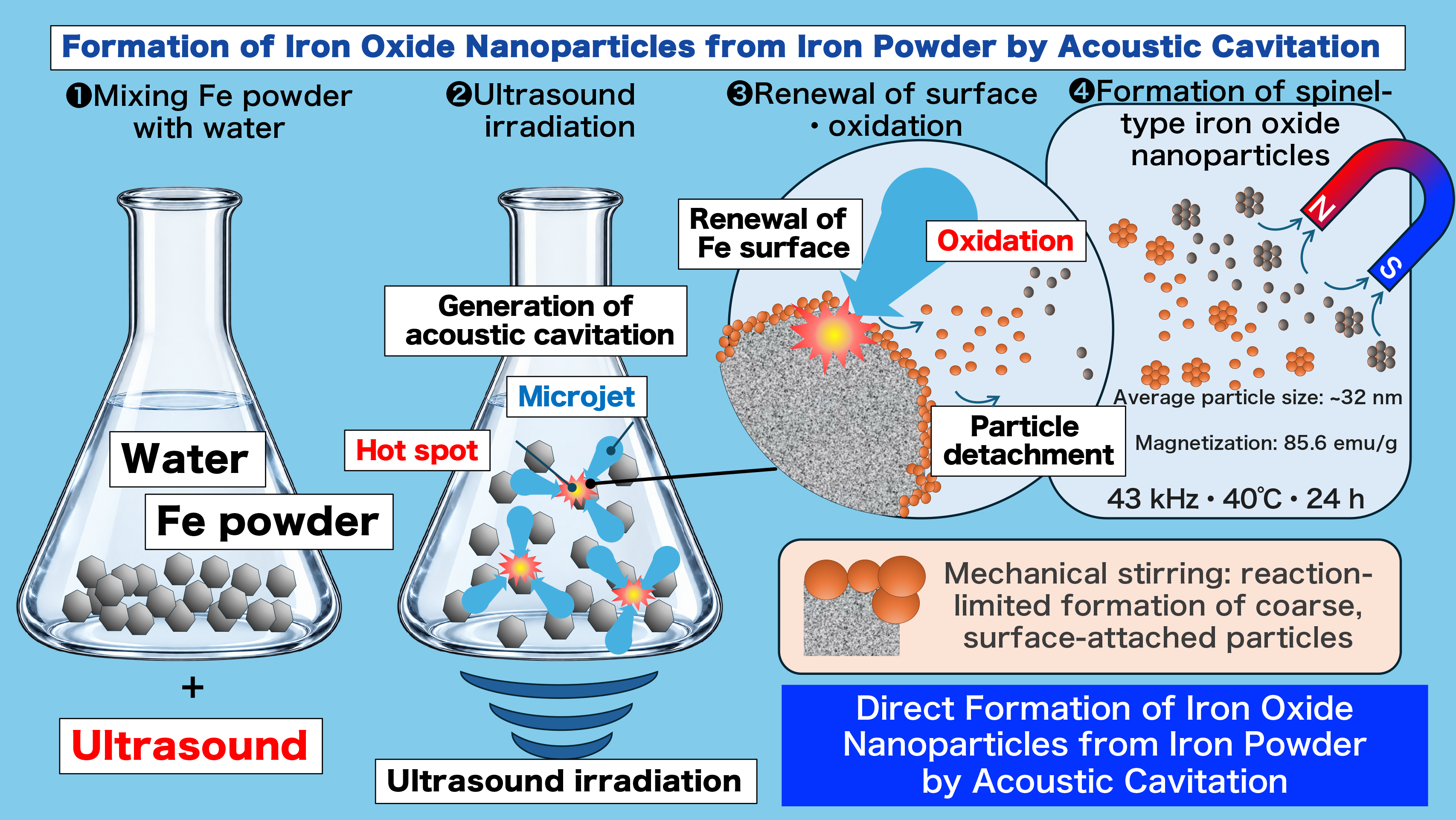
The process requires no soluble iron salts, no precipitation agents, and no chemicals for pH adjustment; no washing step was used in this study. Looking ahead, the approach may offer a route for converting fine iron powders or iron scrap into higher-value oxide materials, and could potentially extend to other metal-oxide systems, though these applications remain to be demonstrated.
Future work will focus on clarifying the reaction mechanism, including measurements of dissolved Fe²⁺ and Fe³⁺, hydroxyl radicals, and hydrogen peroxide over the course of the reaction. Researchers also plan to quantify particle recovery, mass balance, reaction rate, and energy consumption per unit of product, alongside optimization of reactor design, acoustic power density, and transducer configuration, hopefully enabling larger-scale production.
- Publication Details:
Title: Reagent-Free Sonochemical Synthesis of Iron Oxide Nanoparticles from Iron Powder and Water Promoted by Acoustic Cavitation
Authors: Madoka Yoshikawa, Hirotsugu Takizawa, Yamato Hayashi
Journal: Ultrason Sonochem


