
From friendship networks and the internet to connections in the brain and trade relationships between countries: networks are everywhere. Physicists at Leiden study the fundamental principles underlying all these networks, leading to new insights into how they work.
Two of them are Alessio Catanzaro and Francesca Giuffrida, both members of Professor Diego Garlaschelli's research group, who defended their PhD theses on 10 September 2026. We spoke to them to learn more about their perspectives on complex networks.
Understanding an incomplete network
What if… only part of it the network is visible, and therefore you do not have a complete picture of the network? Catanzaro developed new methods for reconstructing incomplete networks, a common challenge in network analysis.
To better understand complex networks, scientists often study their structure at different scales - an approach known as 'renormalisation'. By combining small parts into larger building blocks, broader patterns in a network become visible. Catanzaro used this technique throughout his research.
'We discovered that mathematically 'removing' the unseen parts of a network has the same effect as renormalisation - combining parts of a network into larger units (see box). This showed us that the visible parts of a network often contain valuable clues about the parts that remain hidden.'
A simple model with surprising behaviour
Another important finding from Catanzaro's research is that this process of combining parts of a network naturally produces a remarkably simple network model that still captures many of the characteristics of the real-world network. Catanzaro: 'It was exciting to see that complex structures can emerge from such simple rules.'
In his new 'multi-scale model', among his friends also known as the 'pizza model', tightly connected groups of nodes emerge naturally, without the need to assume geographical or social groupings in advance. These insights could be applied in fields ranging from the social sciences and epidemiology to data analysis.
Two Italians in Leiden
Catanzaro and Giuffrida carried out her PhD research through a cotutelle PhD programme between the IMT School for Advanced Studies Lucca and Leiden University. In a cotutelle, two universities collaborate on a single PhD project.
Giuffrida: 'Moving to the Netherlands for the cotutelle was one of the best choices I could have made for my career. It was great to become part of the Leiden PhD community. Also, I learnt so much from working across different disciplines having a second supervisor - in my case Peter Grunwald from Leiden's Institute of Mathematics. I loved being able to cycle everywhere, and I still miss it.'
Catanzaro: 'I loved to be in a very international place where people from all over the world gather to learn together. It was also fun to see some quirks of Dutch culture, like my colleagues eating a loaf of bread and calling it lunch.' Giuffrida: 'Yes, about food…, I even started to wonder whether having dinner at 6:30 pm might actually be better. Of course, I went back to having dinner after 8 pm as soon as I returned to Italy, cultural pressure is strong!'
Chance or a meaningful pattern?
When is a pattern in data genuinely meaningful, and when does it only appear to be? That question lies at the heart of Francesca Giuffrida's PhD research. Some patterns arise purely by chance.
To distinguish between the two, scientists first need to define what they mean by chance. 'But different ways of defining chance can lead to different conclusions,' Giuffrida explains. 'I wanted to help future researchers choose the right model to tackle this challenge.'
Drawing more reliable conclusions from data
During her PhD, Giuffrida also developed new statistical methods that help researchers draw more reliable conclusions from data. Her work improves how they select the most appropriate model, to evaluate evidence for competing explanations. A key part of her research involves so-called e-values, a new way of evaluating scientific evidence. These can provide more reliable conclusions than many traditional statistical methods and may help improve the reproducibility of scientific research.
From theory to practice
Giuffrida applied her methods to brain imaging data, where she was able to distinguish genuinely connected brain regions from connections likely to have occurred by chance. This proves that her methods can be applied in brain research and far beyond, including biology, social networks and artificial intelligence.
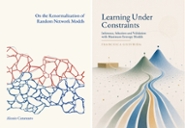
Alessio Catanzaro defended his thesis 'On the Renormalization of Random Network Models' on 10 September.
Supervisors: Diego Garlaschelli and Subodh Patil.
Collaborators: Rajat Hazra (Leiden University), Remco van der Hofstad (Eindhoven University)
His cover of his thesis was designed by Dr. Beatrice Vaienti.
Francesca Giuffrida defended her thesis 'Learning Under Constraints: Inference, Selection and Validation with Maximum Entropy Models' on 10 September.
Supervisors: Diego Garlaschelli and Peter Grünwald.
The cover of her thesis was designed by her, and generated with ChatGPT and Claude.


