
Cancer always seems to break the rules - defying normal biology and finding new ways to survive, grow, and spread.
That ability fascinated Rushika M. Perera , PhD, when she was younger. It's what originally attracted her to cell biology - and ultimately, to discovering how one of the deadliest cancers accomplishes that feat.
Perera, the Deborah Cowan Professor and vice chair of the Department of Anatomy, and chief scientific officer of UCSF's Pancreas Center, shared her insights April 16 when she presented the 2026 Byers Award Lecture in Basic Science. The award, hosted by the Sandler Program for Breakthrough Biomedical Research (PBBR), supports high-risk, high-reward science that can lead to innovative discoveries. It is considered one of UCSF's highest honors for early- and mid-career scientists.
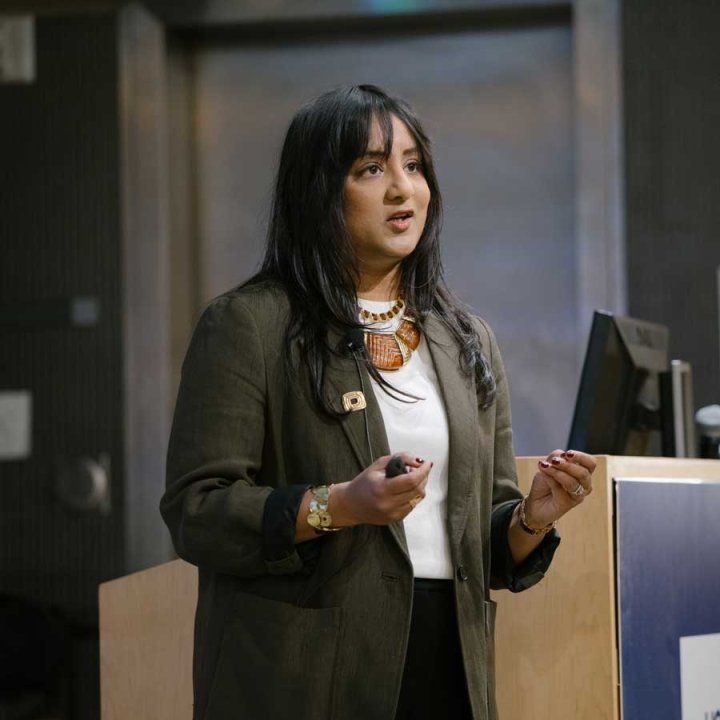
Perera studies pancreatic cancer, a disease known for spreading quickly and evading treatment. She looks deep inside the cell at a structure called the lysosome to understand how the cancer fuels itself.
"Pancreatic cancer cells get their nutrients in very unconventional ways, making them highly adaptable," Perera said. "Understanding how the lysosome drives this adaptability and reshapes metabolism during disease progression could help us uncover its vulnerabilities."
Her work is changing how scientists understand pancreatic cancer and is creating new possibilities for cutting off the disease's fuel supply. Perera found that the lysosome, once thought to simply break down cellular material, is a central hub that also repurposes nutrients, making pancreatic cancer cells professional nutrient scavengers.
A new way to understand pancreatic cancer
Perera's path to UCSF spans four countries and multiple scientific disciplines, guided by her willingness to take risks and pursue answers to difficult questions.
Born in Sri Lanka and raised in Hong Kong and Australia, Perera first came to the United States for a summer research opportunity at Yale University while pursuing her PhD at the University of Melbourne. That experience proved transformative, leading her to a postdoctoral fellowship at Massachusetts General Hospital and Harvard Medical School before joining UCSF in 2015.
Her laboratory seeks to understand why pancreatic cancer is so aggressive, by looking beyond genetics to how cancer cells fuel themselves. One of her most striking findings involves cholesterol.
"Every cell needs cholesterol, so we wanted to understand how cancer growth and spread depend on taking up cholesterol or synthesizing it," Perera said. "While we can't completely block these processes in humans, studying them helps us understand the pathways that drive tumor behavior."
Pancreatic cancer cells preferentially take up cholesterol from their environment but can fall back on producing it themselves if needed, making them more efficient and adaptable. This process is tightly controlled by the lysosome and linked to key growth signals that tell cells when to divide.


