
Which oysters are released matters when restoring European flat oyster reefs. To preserve genetic diversity and prevent inbreeding, the origin and relatedness of the oysters should be considered for each restoration area. This is the conclusion of a new PhD project.
The European flat oyster (Ostrea edulis) was once widespread, but has now become so scarce in the North Sea that it no longer forms ecologically functioning reefs. Along with the demise of the flat oyster, the three-dimensional structures that provide habitat for more than a hundred marine species have disappeared. Restoration therefore focuses not only on the return of the European flat oyster itself, but also on the reef and its associated biodiversity.
In a growing number of European countries, local oyster restoration relies on cultured oysters or wild oysters from foreign areas to supplement existing populations or establish new ones. Dutch restoration projects use oysters from Ireland and Norway, among others, as well as Dutch oysters cultured in hatcheries. Sophie Valk, a PhD candidate at Wageningen University & Research, investigated the genetic consequences of such practices, which are still rarely considered when determining restoration strategies.
The origin of released oysters matters
Genetic diversity is important for the ability of populations to adapt to factors such as rising seawater temperatures and pathogens. Oysters may also be genetically adapted to the conditions in their native area of origin. Oysters from elsewhere may therefore be less likely to survive or thrive in Dutch conditions. Another risk is that traits that are beneficial to the local population may gradually become less common when foreign oysters are used to supplement remnant wild Dutch populations.
Sophie therefore mapped the genetic variation of the European flat oyster. According to her, a tailored genetic approach means examining which wild oysters are already present in each restoration area, how genetically diverse that population is and where the oysters used for restoration originate from. Their relatedness and genetic differences from the local population must also be considered.
"We have reached the next stage in European flat oyster restoration: scaling up," says Sophie. "It is crucial that we use our extensive genetic knowledge of the species when developing restoration strategies. This will allow us to prevent the inadvertent loss of genetic diversity and as such make oyster reef restoration more efficient and sustainable."
Strong genetic connectivity among wild Dutch oysters
Sophie compared the remaining wild Dutch populations with oysters from Ireland and Norway and with hatchery-cultured offspring of wild Dutch oysters. The wild Dutch populations proved to be genetically diverse and formed a single group with extensive exchange of genetic material. This may be the result of reciprocal translocations of oysters around the Dutch Delta for decades.
Interestingly, two populations have become naturally established relatively recently, without any human intervention: one in the Voordelta and the other at Maasvlakte in the Port of Rotterdam. Genetic analysis indicates that both populations initially originated from a small number of parent oysters. Nevertheless, their genetic diversity is now comparable to that of other wild Dutch populations. This recent natural establishment is particularly remarkable because all Dutch populations are facing high infection rates of the disease Bonamiosis, induced by the parasite Bonamia ostreae.
"The species is still capable of establishing new, genetically diverse and resilient populations on its own," says Sophie. "We should therefore not try to manage everything for the European flat oyster, but give it space to manage its own establishment."
The oysters studied from Ireland and Norway differed genetically from the wild Dutch populations. Where feasible, using local oysters for restoration is therefore preferable, provided these local oysters contain sufficient genetic variation. Where no local population remains, Sophie recommends selecting oysters from nearby populations or from populations that differ as little as possible genetically. The risk of spreading disease, costs and the availability of oysters must also be considered.
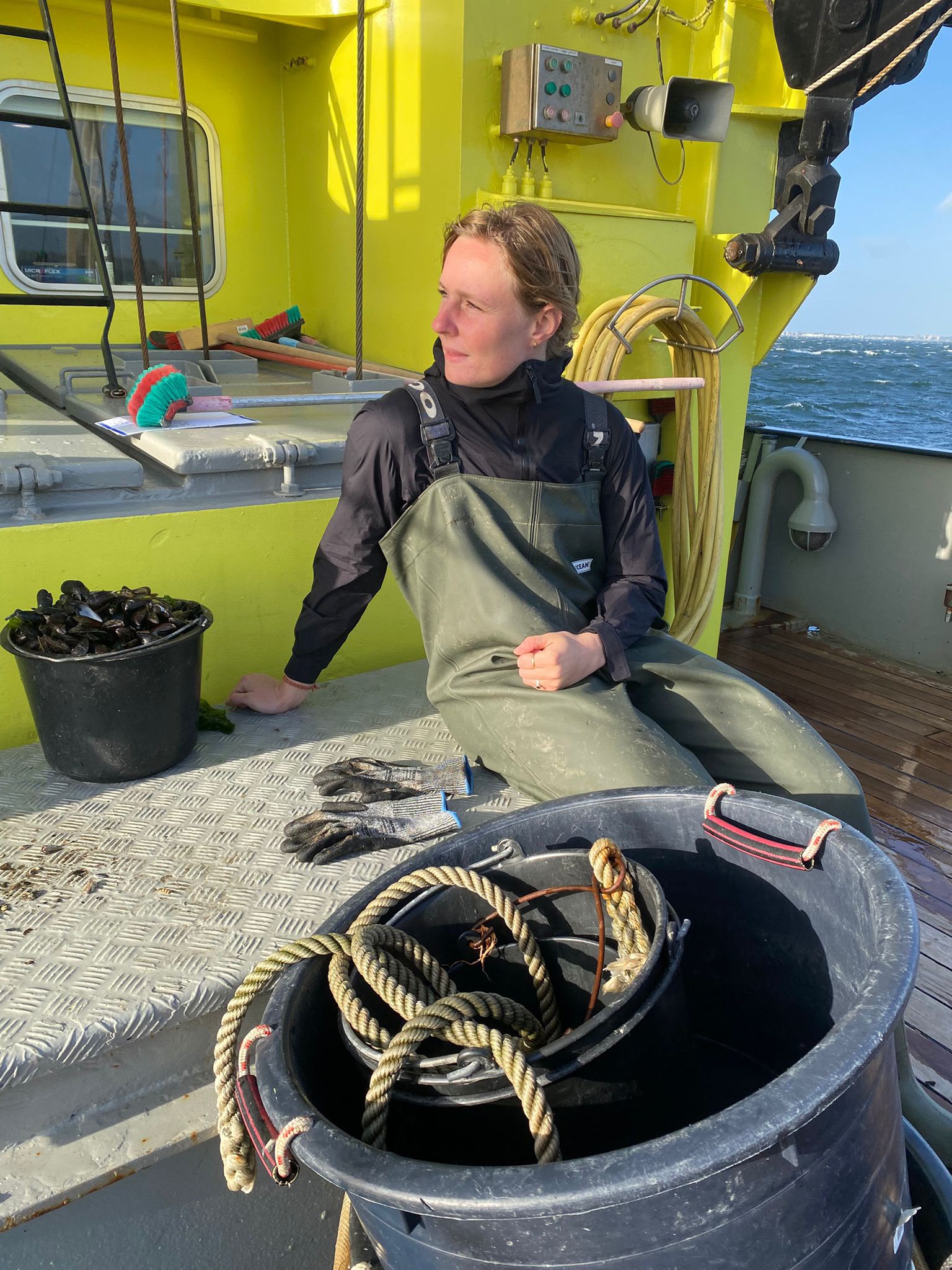
Sophie Valk collecting flat oysters for her research.
Avoid relatedness among hatchery-bred oysters
The hatchery-cultured oysters were genetically very similar to the wild Dutch populations. From a genetic perspective, this is favourable for the use of these oysters in nature restoration. However, Sophie found greater relatedness among the bred oysters. Estimates of inbreeding were not higher in cultured oysters compared to wild populations, but repeatedly breeding closely related individuals can lead to inbreeding within a few generations.
This risk is linked to the reproduction of the European flat oyster. Sometimes only a small proportion of the parent oysters make a disproportionately large contribution to a new generation. As the use of cultured oysters in nature restoration is expected to increase, clear and feasible guidelines are needed. Hatcheries can help safeguard genetic diversity by working with a large group of parent oysters, combining different groups of offspring and carefully recording breeding protocols and metadata.
Caution is also required in selective breeding. The European flat oyster has high levels of genetic diversity, which is important for its ability to adapt. When oysters are selected for a desired trait, such as resistance to a pathogen, other genetic characteristics may also be unintentionally favoured. This can reduce the genetic diversity of the population as a whole.
A sustainable restoration strategy therefore does not end with the selection of the most suitable oysters for restoration. Genetic diversity and relatedness must also be monitored during culturing and after release. This makes it possible to identify how genetic diversity develops over time, and to prevent the inadvertent loss of genetic diversity.
First step towards determining the sex of living oysters
A European flat oyster can change sex several times during its lifetime. To preserve genetic diversity, it is important that both male and female oysters contribute to the next generation. At present, an oyster's sex can only be determined by opening it, which kills the animal. As a result, little is known about sex ratios in wild and cultured populations.
Sophie therefore investigated whether oysters at different sexual stages have different chemical markers on their DNA. Using a computer model, she selected fourteen locations on the DNA where these markers differed across sex phenotypes. The model was able to distinguish hermaphrodite oysters from oysters that were predominantly male or female. It was also able to distinguish between predominantly male and predominantly female oysters with an accuracy of approximately 70 per cent.
The method requires further testing. The ultimate aim is to help hatchery managers determine the sex ratios among broodstock populations through non-lethal approaches. This knowledge would allow them to achieve an equal sex ratio within the broodstock population and better preserve genetic diversity in subsequent generations.
The thesis thus provides knowledge that can be used to tailor oyster restoration to local conditions while safeguarding the genetic diversity of the European flat oyster.


