
RMIT joins the call for universities globally to adopt a regenerative approach and play a key role in addressing the polycrisis
A new paper from RMIT University and the Royal Society of Arts (RSA) is urging universities around the world to fundamentally reevaluate their purpose, arguing that higher education institutions have a critical and largely untapped role to play in addressing the global environmental and social crises now facing humanity.
It was co-authored by a team of researchers from RMIT, including: Professor Wendy Steele (Planetary Civics Inquiry Lead); Professor Naomi Stead (Associate Deputy Vice Chancellor, Engagement, RMIT College of Design and Social Context); Professor Chris Speed (Director, RMIT Regenerative Futures Institute); Professor Andrea Siodmok OBE (Dean, RMIT School of Design); alongside Philipa Duthie (Global Manager, RSA Oceania and Asia) and lead author Josie Warden (Head of Regenerative Design, Subak).
The paper was launched at an event in Melbourne hosted by RMIT's Regenerative Futures Institute and Planetary Civics Inquiry to discuss its findings and what they mean for the future of higher education in Australia and beyond.
The event featured a fireside chat between Duthie and Daniel Christian Wahl, author of Designing Regenerative Cultures, who was awarded RSA's prestigious Bicentenary Medal for his contribution to the field of regenerative design in 2021.
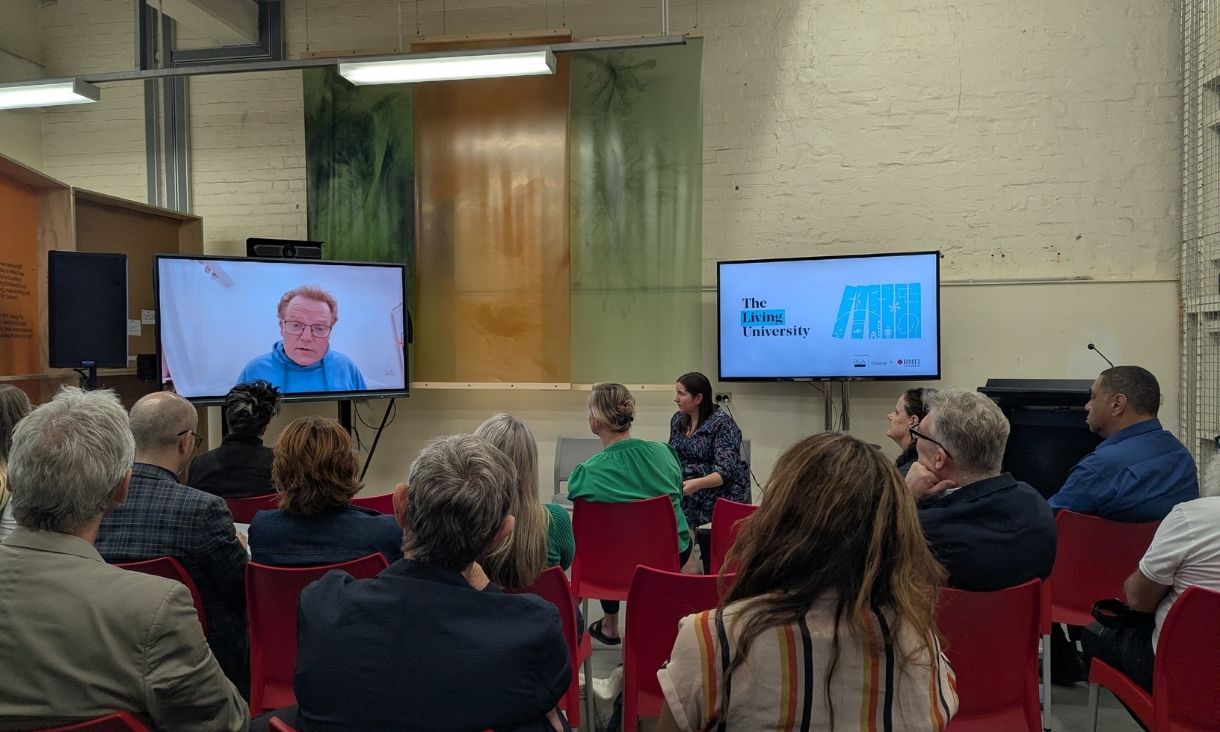 Dr Danial Wahl in conversation with Philipa Duthie. Photo: Nick Adams
 Wahl encouraged universities to reconceive themselves as bioregional learning centres. "They need to reconsider how they're obligated to their specific place, community and region, and how they can be of a service - through innovation, technology and deep understanding - because we can only really fall in love with the things we know deeply and intimately," he said.
He also called for 'two-eyed ways of seeing', where science and academia stand as equal partners to Indigenous ways of seeing and knowing and being.
"We have a tendency to present things as 'new', and in the process, dismiss what we then consider as 'old'. We lose a deeper connection: of anchoring regeneration in life itself - in our cells, in our body - in the ecosystems around us.
Our species has been practicising regenerative cultures for 99% of our journey. What we call 'history' is a relatively recent period that might just be the aberration from the bioregioning pattern of fitting into context, which has made our species survive in a decentralised way for the long evolutionary journey."
A subsequent panel discussion contemplated the role of universities in an era of rapid change and complexity across a multi-lens of environmental, social, political, cultural, and historical and future imaginaries.
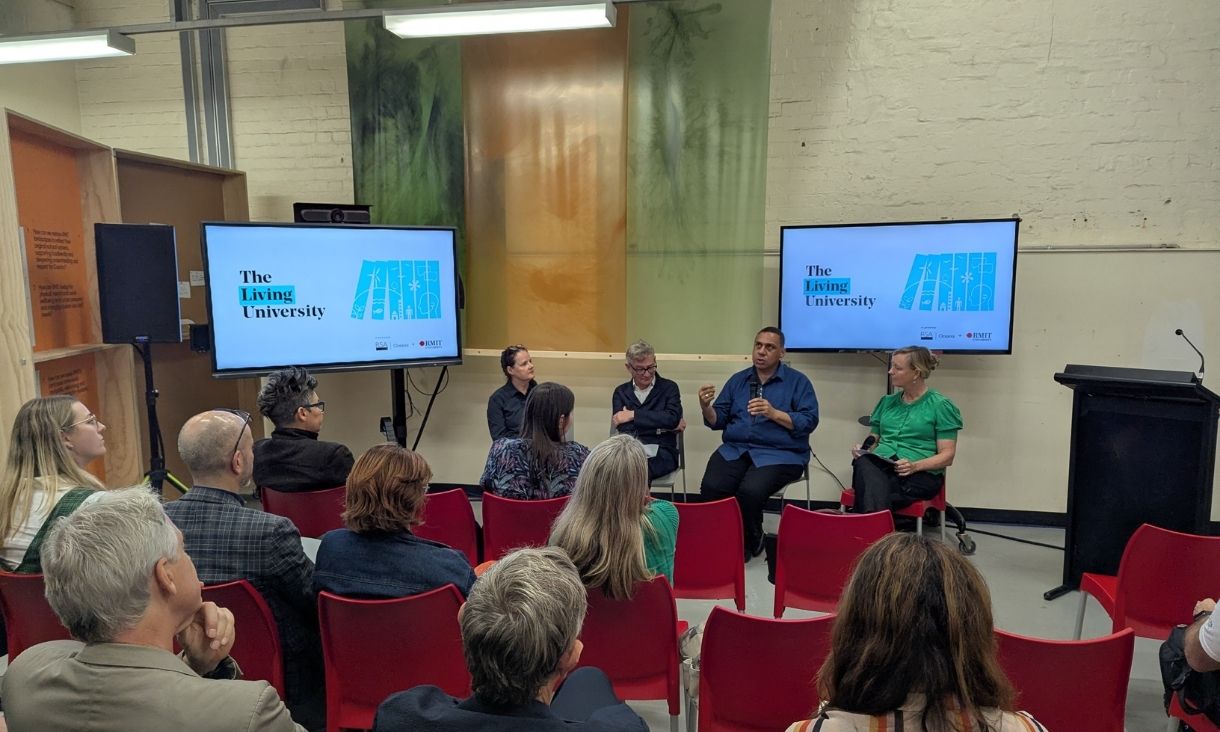 Living University panel at RMIT University Melbourne City Campus. Photo: Celine Saoud.
 Warden referred to universities as 'keystone species' in an ecosystem, with a unique role in enabling and maintaining entire civic and knowledge to function. "If you think about what happens when a university exists in a town or a city, there are clusters of hospitals, of research, of cultural venues, cafes, startups and NGOs. People with wildly different expertise end up in the same place and bump into each other, whether that's a poet sitting next to an engineer or a musician sitting next to a biochemist. Conversations happen that nobody planned for. We shouldn't treat that as a side effect - it's actually really the point," she said.
Reflecting on her personal journey to academia, Siodmok said that universities have offered her the so-called 'social mobility' that eluded her mother and grandmother, who did not attain a formal qualification. She suggested that RMIT's 100,000+ students have their own pathway to a better future, despite facing a generational research and innovation challenge, as identified in Federal Government's recent Ambitious Australia: Strategic Examination of Research and Development final report.
Speed added that universities are uniquely agile, as actors in an ecosystem, relative to the likes of car and clothing manufacturers. "It takes seven years to build a car. Even fast fashion takes several months. I was teaching this morning. In 15 minutes, I could co-create a new narrative of regenerative value with students and turn it on a dime."
"I think sometimes within universities we forget that we have individual and collective agency. We are the university... human beings doing things with other human beings," added Thomas.
Their comments echoed The Living University paper, which makes the case that universities must move beyond traditional notions of sustainability and instead embrace what the authors call a 'regenerative' approach that actively restores the health of Earth's ecological and social systems rather than simply reducing harm.
"We are on the brink of destabilising the interconnected systems that ensure a stable and resilient planet," the paper warns, citing Earth Commission Co-Chair Professor Johan Rockström. "The actions we take now will decide their - and by virtue our - future."
At its heart, the paper envisions a new kind of institution that draws inspiration from living systems in nature to become what the authors describe as a catalyst for place-based regeneration, a hub for relationality, an evolutionary space, and a holder of complexity and holistic thinking.
For policymakers, the paper includes a set of concrete recommendations: embedding place-based learning across all disciplines; funding Indigenous research institutes; incentivising cross-institutional collaboration; and investing in the regenerative learning ecosystem beyond the university campus itself.
Thomas commented that the paper represents a call to action for the entire sector. "The prospect of working regeneratively requires self-reflection at the level of the individual, discipline, whole-of-institution and the tertiary education sector as an industry," he said.
A central theme of the paper is the need for universities to treat Indigenous Knowledge Systems as foundational to how they generate and share knowledge, rather than as an afterthought. The authors argue that Indigenous and place-based cultures have practised regenerative stewardship of the land for millennia, and that universities have a responsibility to learn with and from them, rather than extracting or marginalising that knowledge.
 Professor Andrea Sidmok OBE, boarding the University of Fiji's Drua 'Vola Siga' which sails between Fiji's archipelago of islands, helping to preserve and revive the knowledge and language of Fiji's Indigenous peoples.
 The paper draws on case studies from institutions across Australia and the world, including with University of Fiji, with whom RMIT recently signed a Memorandum of Understanding. RMIT's own RFI is cited as a focal point for new approaches to learning, teaching and collaboration.
Internationally, the paper points to the Edinburgh Futures Institute, the Inter-University Design Studio in Mexico City, and the MA Regenerative Design programme at Central St Martins in London as models of transdisciplinary, place-conscious education in action.
The authors are frank about the gap between aspiration and current practice. "There are currently limited examples of regeneration being embedded structurally or as a guiding purpose within traditional universities." However, momentum is clearly building, and the authors urge the higher education sector to move now with urgency and integrity.
They are equally clear about the risks of superficial adoption. "Preventing 'regen washing' and resisting the temptation to see regeneration as the latest thing to differentiate universities in the competitive higher education market is essential. The Living University will need to act with both ambition and integrity."
The Living University paper is available to download now at https://www.thersa.org/rsa-journal/issue-3-2025/living-university/


