What the research is about
Apply force to a molecule, and part of it moves. That tiny movement can reveal light that was previously suppressed. In this study, researchers used this mechanism to switch light on and off repeatedly.
Why would this be useful? When a material is bent or stretched, forces build up inside it that cannot be seen from the outside. If molecules could sense those forces and signal them through changes in light, they could provide a way to see what is happening inside a material. Researchers have therefore been developing molecules whose brightness or color changes when they experience force.
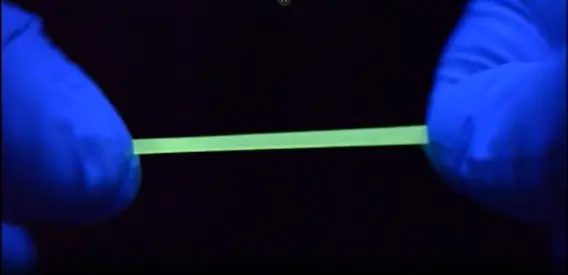
A research team led by Associate Professor Yoshimitsu Sagara at Institute of Science Tokyo (Science Tokyo) took this idea a step further. Rather than simply making light brighter, they set out to use force to control the intensity of circularly polarized luminescence (CPL), a special type of light that can have either a right- or left-handed character.
CPL has potential applications in areas such as 3D displays, anti-counterfeiting technologies, and sensors that distinguish between biomolecules. Previous studies had shown that CPL could be controlled by adding chemicals or changing acidity. Until now, however, researchers had not been able to switch it on and off through molecular motion driven by force.
Why this matters
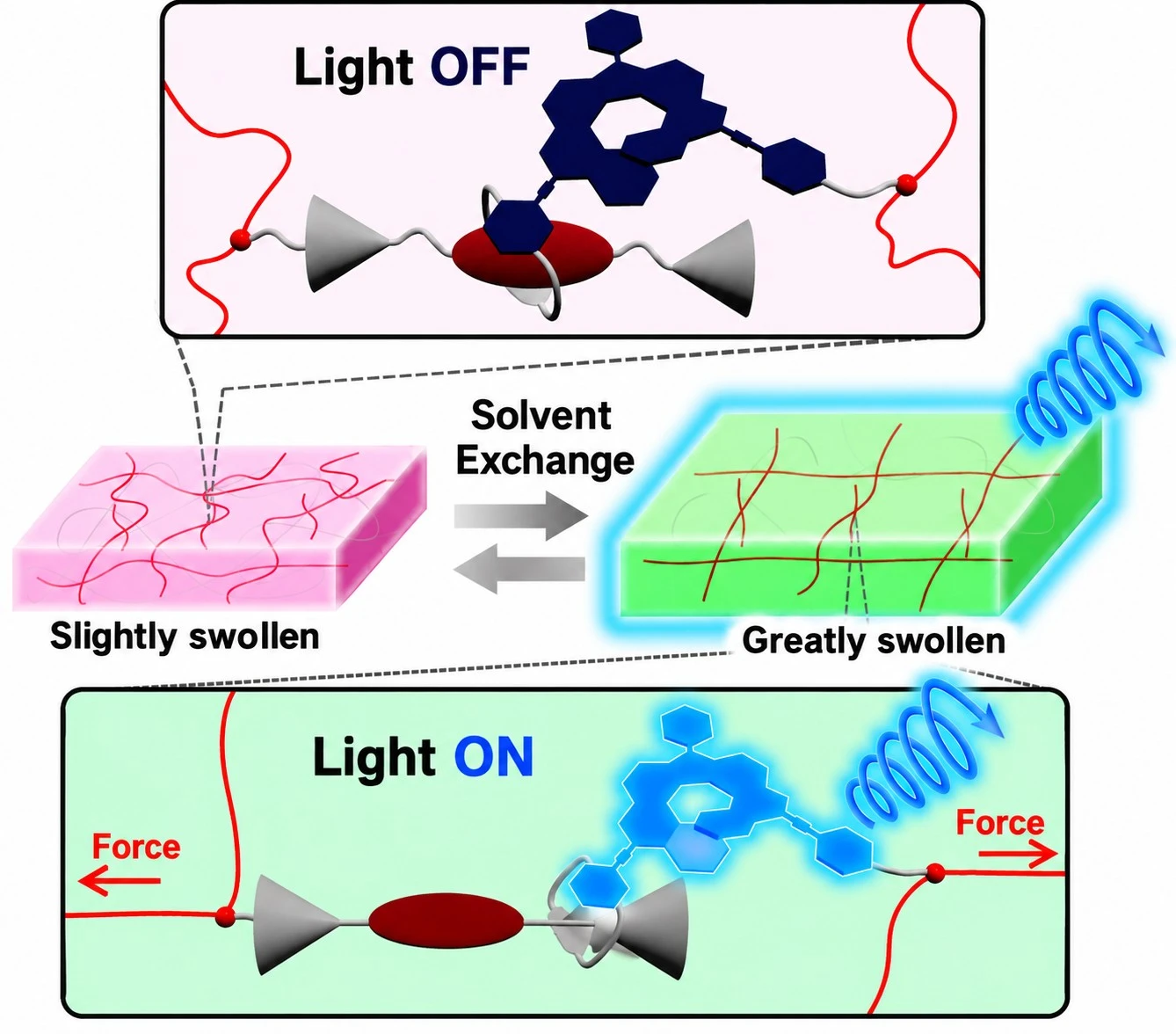
The team designed a molecular system in which force acts like a light switch. At its heart is a molecule called a rotaxane. A rotaxane consists of a ring-shaped molecule threaded onto a long, rod-like molecule. The ring carries a light-emitting component, while the rod contains a component that suppresses that light. When the two are close together, the emission remains weak.
The researchers embedded these rotaxanes in a soft gel that swells as it absorbs liquid. When the gel expands, the force generated inside it is transmitted to the rotaxane, causing the ring to move. This separates the light-emitting and light-suppressing components, allowing CPL to appear. When the gel shrinks again, the molecule returns to its original state. The researchers were able to repeat this light-on/light-off cycle multiple times. In other words, they succeeded in converting force acting on a material into molecular motion, and then turning that motion into a measurable change in light (Figure 1).
The team also had to solve another problem: how to measure the light accurately. Stretching a material in one direction can align its molecules, producing other optical effects that can interfere with the CPL signal researchers actually want to measure. Instead of pulling the gel in one direction, the team allowed it to swell evenly in all directions. This reduced unwanted effects and allowed the researchers to accurately measure the force-induced CPL.
What's next
The study shows that molecular motion caused by force can be detected through changes in CPL. The team now plans to develop molecules that use force to control not only CPL but also other optical properties.
In the future, such molecules could contribute to sensors that use light to reveal forces acting inside materials.
The method developed in this study-swelling a gel evenly rather than stretching it in one direction-could also become a useful way to accurately study other light-emitting materials that respond to force. The researchers are exploring both new force-responsive molecular systems and broader applications of this measurement approach.
Comment from the researcher
What makes force-responsive luminescent materials so interesting is that extremely small molecular movements can be detected as changes in light. In this study, we were able to extend this idea to circularly polarized luminescence, adding another function that can be controlled through molecular motion. We hope to keep exploring what force-sensing molecules can do, while enjoying the unexpected phenomena we encounter along the way.
(Yoshimitsu Sagara, Associate Professor, Department of Materials Science and Engineering, School of Materials and Chemical Technology, Institute of Science Tokyo)

Dive deeper
Explore more research in Science for All
Science for All showcases cutting-edge research at Science Tokyo and highlights the ideas, people, and possibilities shaping the future.

Follow Science Tokyo research on X
Our Research Frontiers account features selected stories from Science for All and regularly shares research from across Science Tokyo.