
Polydopamine-coated magnetic liposomes offer insight into the lectin-glycan interactions in motion. By observing minute changes in the rotational motion of magnetic nanoparticles under alternating magnetic field, the technique reveals binding patterns, including strong multivalent binding events under natural and physiological conditions. The findings of this study emphasize the role of structure-property relationships, while designing magnetic liposome-based biorecognition systems. This approach could accelerate innovations in diagnostics, glycoscience research, and drug discovery.
Harnessing Polydopamine Adhesiveness for Lectin-Glycan Interaction Sensing
The accelerating need for rapid and early detection of diseases has intensified efforts to identify biomolecules that act as signals of infection, long before symptoms appear. The search for sensitive biosensing tools has intensified. Magnetic nanoparticle-based approaches have emerged as promising candidates, yet most tools still rely on surface biomolecules. This can distort their natural behavior, especially for interactions between glycans (sugar molecules) and lectins (protein molecules).
To understand these interactions better, a research team led by Associate Professor Kyohei Okubo from the Department of Oral Devices and Materials, Graduate School of Medical and Dental Sciences, Institute of Science Tokyo (Science Tokyo), Japan, and Professor Yoshitaka Kitamoto from the Department of Materials Science and Engineering, the School of Materials and Chemical Technology, Science Tokyo, and Professor Katsunori Tanaka from the Department of Chemical Science and Engineering, School of Materials and Chemical Technology, Science Tokyo together with Dr. Tsung-Che Chang from the RIKEN Pioneering Research Institute, Japan, developed a novel magnetic biosensing technique using polydopamine-coated magnetoliposomes (PDA-MLs). The study was made available online on October 15, 2025, and published in Volume 17, Issue 43 of the journal ACS Applied Materials & Interfaces on October 29, 2025.
Okubo remarks, "The ability to monitor lectin-glycan binding in liquid form gives us a clearer window into how these interactions take place in biological reality, and it helps us to measure interactions that were previously very difficult to observe."
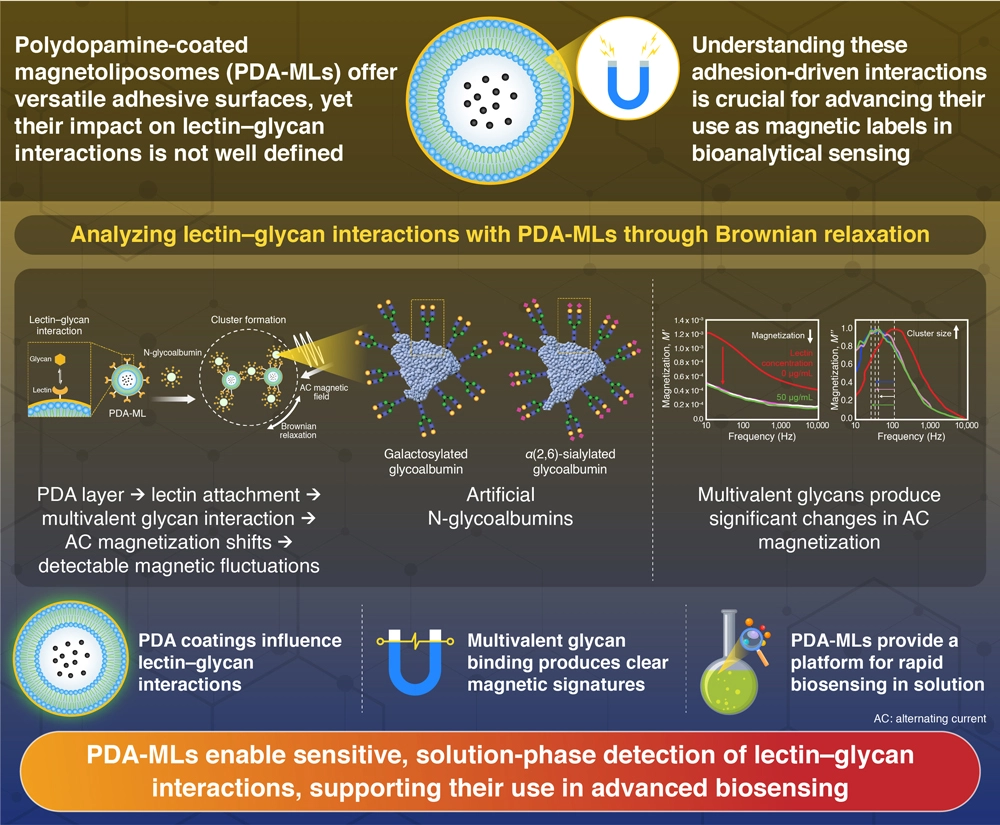
The technique focuses on PDA-MLs which are small, stable lipid spheres containing superparamagnetic iron oxide nanoparticles. The strong adhesion provided by the outer polydopamine layer allows glycans to be presented in a natural, flexible environment, unlike those surface biomolecules that are attached to a surface and have rigid constraints. In order to establish adhesion with the polydopamine coating, the researchers employed two types of glycan molecules-α(2,6)-sialylated (Sia-N-glycoalbumin) and galactosylated (Gal-N-glycoalbumin).
The limelight is on the Brownian relaxation, which is the wobbling and reorientation of magnetic nanoparticles in an alternating magnetic field. During lectin-glycan interactions, when the lectin binds to the glycans on the polydopamine coating, the interaction changes the rotational motion of the particle, especially amplified by the cluster formation of PDA-MLs via the interaction. By measuring these changes, detection of binding events directly in the solution becomes possible, without any need for immobilization or optical labels.
Explaining a highlight of the study, Okubo says, "What makes this technique particularly interesting is the high sensitivity to multivalent interactions. These multivalent bindings oversee many biological processes, especially during infections when the pathogen latches on to host cells with multiple bindings sites. The PDA-ML system produces strong magnetic signals for multivalent binding, which helps us differentiate between the varying signals and understand them better."
By merging magnetic responsiveness with the adhesive properties of polydopamine, the PDA-ML system is a highly sensitive and comparatively easy-to-use technique, which has potential for use in the field of medical diagnostics. It could possibly aid in pathogen or biomarker detection, offering a convenient platform for screening unfavorable binding events, advancing research in infection inhibitors.
The technique sets the stage for advances in diagnostics and drug discovery making it easier to study the mechanisms that regulate many biological processes.
Reference
- Authors:
- Adira N. Ryofi1, Kyohei Okubo1,2*, Akito Nunome3, Tsung-Che Chang4, Katsunori Tanaka3,4, and Yoshitaka Kitamoto1*
- Title:
- Polydopamine-Functionalized Magnetoliposomes as Magnetic Probes for Lectin-Glycan Interaction Analysis through Brownian Relaxation
- Journal:
- ACS Applied Materials & Interfaces
- Affiliations:
- 1Department of Materials Science and Engineering, School of Materials and Chemical Technology, Institute of Science Tokyo, Japan
2Department of Oral Devices and Materials, Graduate School of Medical and Dental Sciences,Institute of Science Tokyo, Japan
3Department of Chemical Science and Engineering, School of Materials and Chemical Technology, Institute of Science Tokyo, Japan
4Biofunctional Synthetic Chemistry Laboratory, RIKEN Pioneering Research Institute, Japan


