
Deli Zhang of Wageningen University & Research is investigating a possible shared mechanism behind atrial fibrillation and heart failure. Her research, supported by a Vidi grant from the NWO Talent Programme, could pave the way for new approaches to preventing and treating these heart conditions.
Cardiovascular disease is the leading cause of death worldwide. Two conditions that are becoming increasingly common are atrial fibrillation, the most common heart rhythm disorder, and a form of heart failure in which the heart's pumping capacity is preserved (HFpEF). Both conditions mainly affect older people and those with metabolic problems, such as diabetes and obesity. Despite their significant impact on health, treatment options remain limited.
Although atrial fibrillation and HFpEF often occur together, not enough is yet known about the biological processes linking the two conditions. Dr. Deli Zhang aims to change this through new research. Zhang is an associate professor in the Human and Animal Physiology research group at Wageningen University & Research. "My research focuses on a mitochondrial communications in the heart muscle cells that may play an important role in both diseases," explains Zhang. The NWO has awarded the researcher a VIDI grant, a talent programme specifically designed for young researchers taking the next step in their careers. The grant is worth 850,000 euros.
"My research focuses on a mechanism in heart muscle cells that may play a role in atrial fibrillation and a form of heart failure known as HFpEF."
- Deli Zhang
Co-operation within heart muscle cells
Mitochondria, the parts of cells that produce energy, are central to Zhang's research. Mitochondria work closely with other parts of the cell. Through small contact points, they exchange signals and substances that are necessary for the heart muscle to function properly.
These contact points, also known as mitochondrial-organelle contacts (MOCs), play a role in, for example, the processing of fats, the regulation of calcium and the protection of cells against harmful substances. Exactly how this collaboration contributes to a healthy heart and what happens when the contact points become disrupted is still largely unknown. "It is suspected that disruptions to these contact points affect fat metabolism and the functioning of heart muscle cells. This could contribute to the development of both atrial fibrillation and heart failure, particularly in the context of ageing and metabolic disorders," explains Zhang.
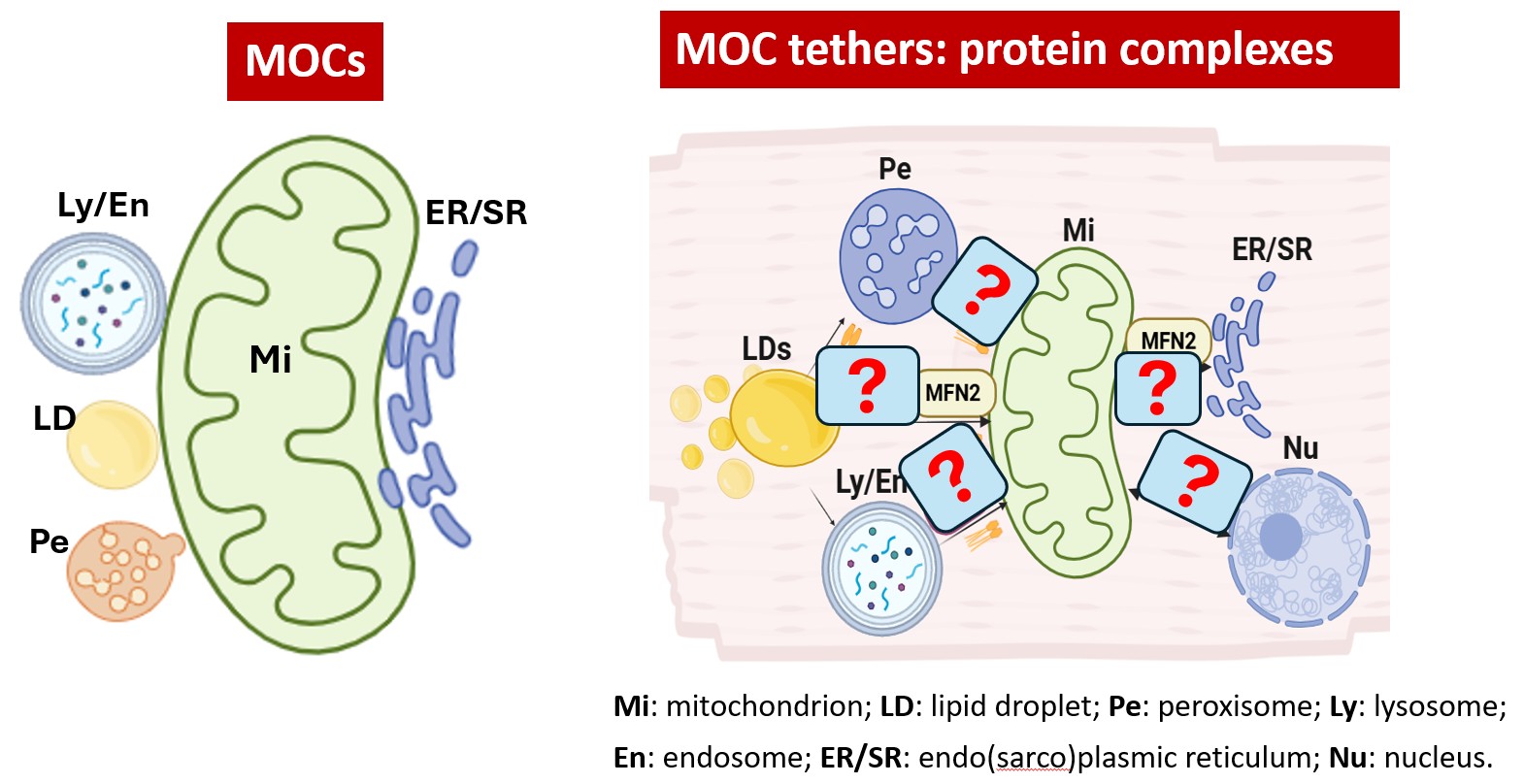
Mitochondria-organelle (mis)communication via mitochondrial-organelle contacts (MOCs)
From cell research to potential treatments
Using various advanced research techniques, Zhang aims to identify which proteins are responsible for the interactions between mitochondria and other cell components. The next step is to investigate what happens when these interactions are disrupted and whether maintaining these interactions could help prevent heart problems.
This research utilises a combination of three experimental models with analyses of human tissue. "In this way, we hope to determine whether disruptions at the contact points actually contribute to the development of heart disease."
Focus on differences between men and women
An important aspect of the research is the focus on differences between men and women. Much existing research into heart disease has been carried out predominantly on men, whilst the underlying disease processes and the progression of heart disease can differ between the sexes. "By taking these differences into account from the start, we hope to gain a better understanding of which mechanisms apply to both sexes and where differences arise."
New avenues for prevention and treatment
Zhang's research aims to provide greater insight into the processes that cause atrial fibrillation and heart failure. If it turns out that the interactions between mitochondria and other cell components do indeed play a significant role, these could provide a new avenue for the development of treatments. "In the longer term, this research could therefore contribute to more targeted strategies for preventing and treating heart disease," concludes Zhang.


