
By Joey Garcia, University Communications and Marketing
For decades, technology in schools meant desktop computers and basic digital instruction. Today, more immersive tools are beginning to reach children, changing how they interact with information and their surroundings. As these tools become more advanced, researchers at USF are examining whether they align with how children think and learn.

USF Assistant Professor Julia Woodward
"Even though more children are using technology in different contexts, these tools are still designed with adults in mind," said Julia Woodward, an assistant professor in the Bellini College of Artificial Intelligence, Cybersecurity and Computing. "Developers aren't thinking about how children will engage with these products, which results in a frustrating experience for children."
Woodward observed this disconnect firsthand through her research on augmented reality and children. Her latest published study, conducted with colleagues in the Bellini College highlights clear differences in how children ages 9 to 12 engage with AR compared with adults.
THE LIMITS OF ADULT-FOCUSED AR DESIGN
Technology, such as AR headsets, is typically designed for users ages 13 and up. Yet younger children are already engaging with these tools, primarily in educational settings such as schools and museums.
"Unlike virtual reality, augmented reality allows for interactive experiences while keeping users grounded in the real world, reducing symptoms like cyber fatigue and motion sickness," Woodward said. "It also has the potential to enhance STEM learning, especially for concepts that can be difficult to grasp through traditional textbooks."
However, how children attempt to use AR headsets reveals a different set of expectations than those built into adult-focused design.
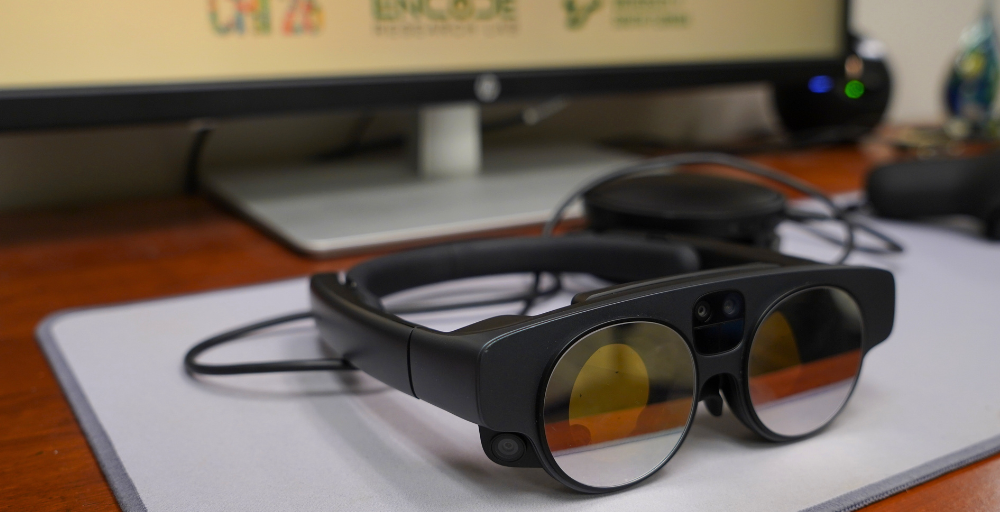
Current AR technology is largely focused on adult audiences and lacks an understanding of how children think
This behavior highlights a mismatch between adult-designed systems, which rely on rigid gestures or command-based inputs, and the more exploratory, intuitive ways children engage with new technology.
TARGETING CHILD ENGAGEMENT IN AUGMENTED REALITY
Woodward and her team conducted a foundational study with children ages 9 to 12 to better understand how they engage with AR headsets. Each child spent an hour in the lab, using an AR headset in 12-minute intervals while completing a series of tasks involving a virtual 3D cube.
"We wanted to see how they would perform 17 different actions, such as moving, shrinking or making the cube disappear," Woodward said. "Children came up with many creative responses, including imagining the use of a hydraulic press to shrink the cube or using external objects like a stick to move it."
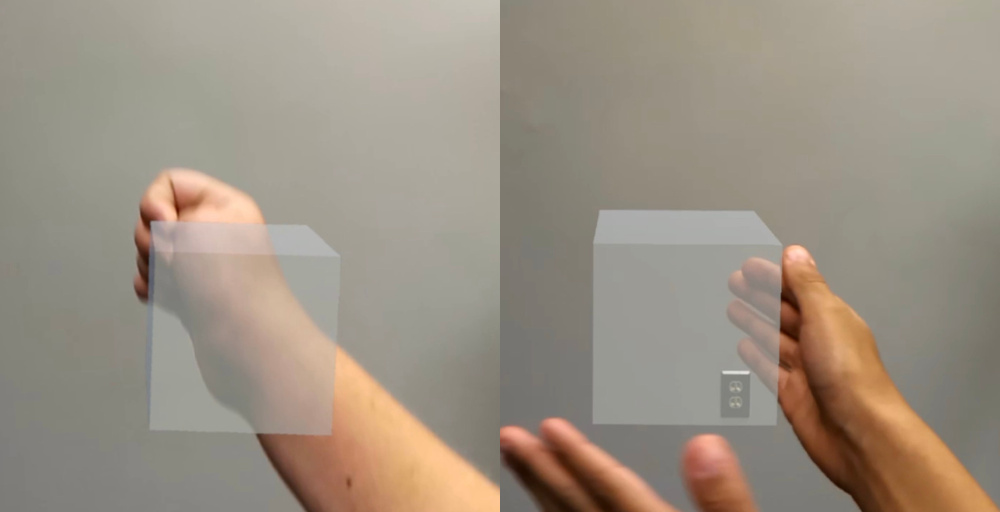
Children performed 17 actions with a 3D cube, showcasing their creativity and unique thought processes [Photo courtesy of Julia Woodward and the Association for Computing Machinery ]
After explaining and physically demonstrating an initial interaction, children were then asked to provide a second way to achieve the same result. This approach allowed researchers to observe both instinctive choices and flexibility in how children approached the same task. Children also gave simple usability ratings for each interaction, scoring how well it fit the task and how easy it was to perform.
WHY CHILDREN EXPERIENCE AUGMENTED REALITY DIFFERENTLY
By comparing first and second responses, the team examined whether children maintained the same interaction style or adjusted their approach. Researchers later compared those findings with results from previous studies examining adult interaction with the same technology.
"Compared with adults, we saw children use a much more physical approach," Woodward said. "They relied heavily on gestures and thought creatively about using external objects to perform actions. Adults, on the other hand, often relied on familiar hand gestures first and switched to speech as a second option."
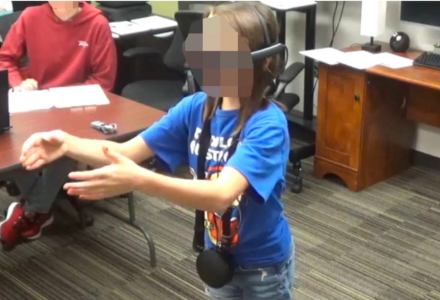
Children displayed a more physical approach when engaging with AR headsets [Photo courtesy of Julia Woodward and the Association for Computing Machinery ]
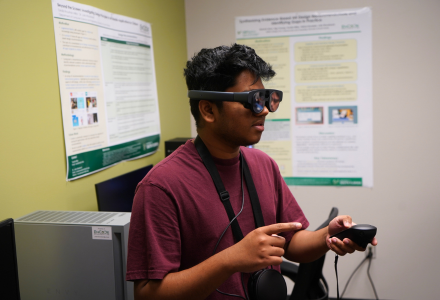
Compared with children, adults use AR headsets in a more controlled way, relying on learned habits
Woodward describes this tendency among adults as legacy bias. Rather than lacking creativity, adults often apply interaction patterns they are already familiar with from other technologies.
"Children don't really have that same legacy bias, which makes them more open to exploring technology in new ways," Woodward said. "It's why children often discover features or interaction styles adults didn't realize were possible with everyday technologies such as computers or smartphones."
A MORE THOUGHTFUL APPLICATION
As immersive technologies continue to evolve, the research underscores a key point: children interact with AR differently than adults, and systems should be designed with this distinction in mind. Creating AR tools for educational use requires more than adapting technologies originally built for adults.
If we are going to design for children, we need to consider all the elements. Children think about AR in terms of real-world objects and try to interact with them like physical items, with weight and force. We need to design with those expectations in mind.
Julia Woodward
USF Assistant Professor
While the study served as a baseline, Woodward and her team are already building on the findings. They are applying insights from the cube‑based experiment to a new educational project focused on teaching fractions through an interactive AR experience with virtual pizzas.
By moving beyond simple virtual objects and into practical educational applications, the research team hopes to bring child-centered AR design one step closer to real-world classroom use.


