
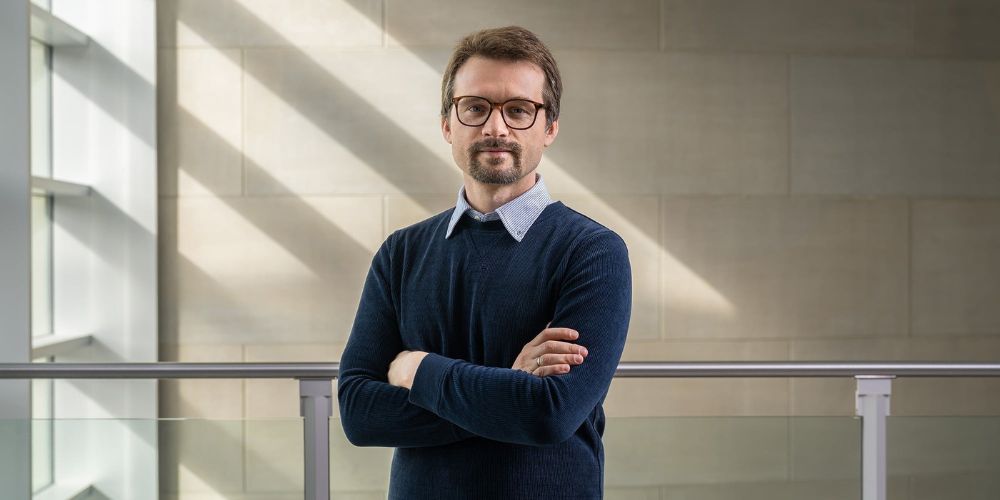
New faculty member Anton Artemyev is bringing his award-winning research in space physics to The University of Texas at Arlington, strengthening the University's growing presence in space science and data-driven research.
He joined the Department of Physics in January as an associate professor after a decade at UCLA, where he conducted both observational and theoretical studies of Earth's magnetospheric dynamics. He has received multiple honors for his work on space plasma, the ionized gas that makes up 99% of the visible universe.
At UT Arlington, Dr. Artemyev also serves as associate director for research in the new Center for Space and Data Science. The opportunity to help shape the center's direction was a key factor in his move.
"I believe there is a clear demand from the space industry, national agencies and leading educational institutions for a new generation of researchers and Ph.D. students with multidimensional advanced training in mathematics, data science and space physics, including space weather and engineering disciplines," Artemyev said. "Organizing such a center at UTA, especially given its substantial undergraduate student population, appears both timely and highly compelling."
Artemyev was recently named a co-investigator of Phase B of NASA's Cross-Scale Investigation of Earth's Magnetotail and Aurora (CINEMA) project. CINEMA aims to better comprehend how plasma energy flows into the Earth's magnetosphere—an unpredictable process that helps explain why some space weather events are more disruptive than others.
The long-term goal is to improve space weather forecasting to mitigate impacts on satellite and ground-based communications, the power grid and other infrastructure. The mission will also deepen understanding of the energetic connection between the sun and Earth, offering insight into how similar space environments could affect future human exploration.
"We are delighted to welcome Dr. Artemyev to UTA and the Department of Physics," said Alex Weiss, professor and chair of the department. "We were fortunate to be able to recruit him. He brings an outstanding research record, a rare ability to explain his science clearly and exceptional promise as a teacher. His participation in the CINEMA mission will create terrific opportunities for him and his students to work at the cutting edge of space science and will further strengthen the reputation of UTA and the Center for Space and Data Science."
Artemyev and his co-investigators are sharing $28 million in Phase B funding. The overall mission budget is approximately $180 million, much of which will support the design and construction of nine satellites and instrumentation being developed at Johns Hopkins University's Applied Physics Laboratory and other institutions.
He was involved in Phase A of CINEMA while at UCLA, where he analyzed data from two small Electron Losses and Fields Investigation (ELFIN) satellites built there.
"My role during this phase focused on providing observational and theoretical expertise related to ELFIN measurements in the context of formulating CINEMA's scientific objectives," Artemyev said. "In many respects, CINEMA actively builds on our understanding of low-altitude monitoring of the magnetosphere derived from ELFIN observations."
Artemyev earned his Ph.D. in physics from the Space Research Institute of the Russian Academy of Sciences in Moscow in 2010. He then worked as a research scientist at the Space Research Institute of the Austrian Academy of Sciences in Graz, Austria, where he analyzed spacecraft data from the European Space Agency's Cluster mission, which examined how the solar wind drives space weather variations.
He later joined the Laboratory of Physics and Chemistry of the Environment and Space at the University of Orléans in France, studying radiation belt dynamics—an essential element of space weather research.
In 2015, Artemyev joined UCLA, where he analyzed data from major NASA missions including THEMIS and ARTEMIS. In 2019, he was awarded the James B. Macelwane Medal by the American Geophysical Union for his contributions to understanding magnetospheric dynamics.


