
Hundreds of scientists attended the inaugural VP&S Frontiers in Research Symposium-a two-day event held earlier this month that showcased the most innovative biomedical research conducted at Columbia University.
"The event really captured the enthusiasm of nearly every lab at VP&S," said Stavros Lomvardas, interim vice dean for basic science research at VP&S. "Our research community is eager to learn more about the work of their colleagues and build spaces where new ideas and collaborations can be cultivated. And I know the symposium has sparked at least a few already."
More than 200 abstracts were submitted to symposium organizers by researchers ranging from medical students to department chairs. Selected presenters represented 30 VP&S departments, centers, and institutes, as well as the Graduate School of Arts and Sciences, the Fu Foundation School of Engineering and Applied Science, Columbia College, and the Union Theological Seminary.
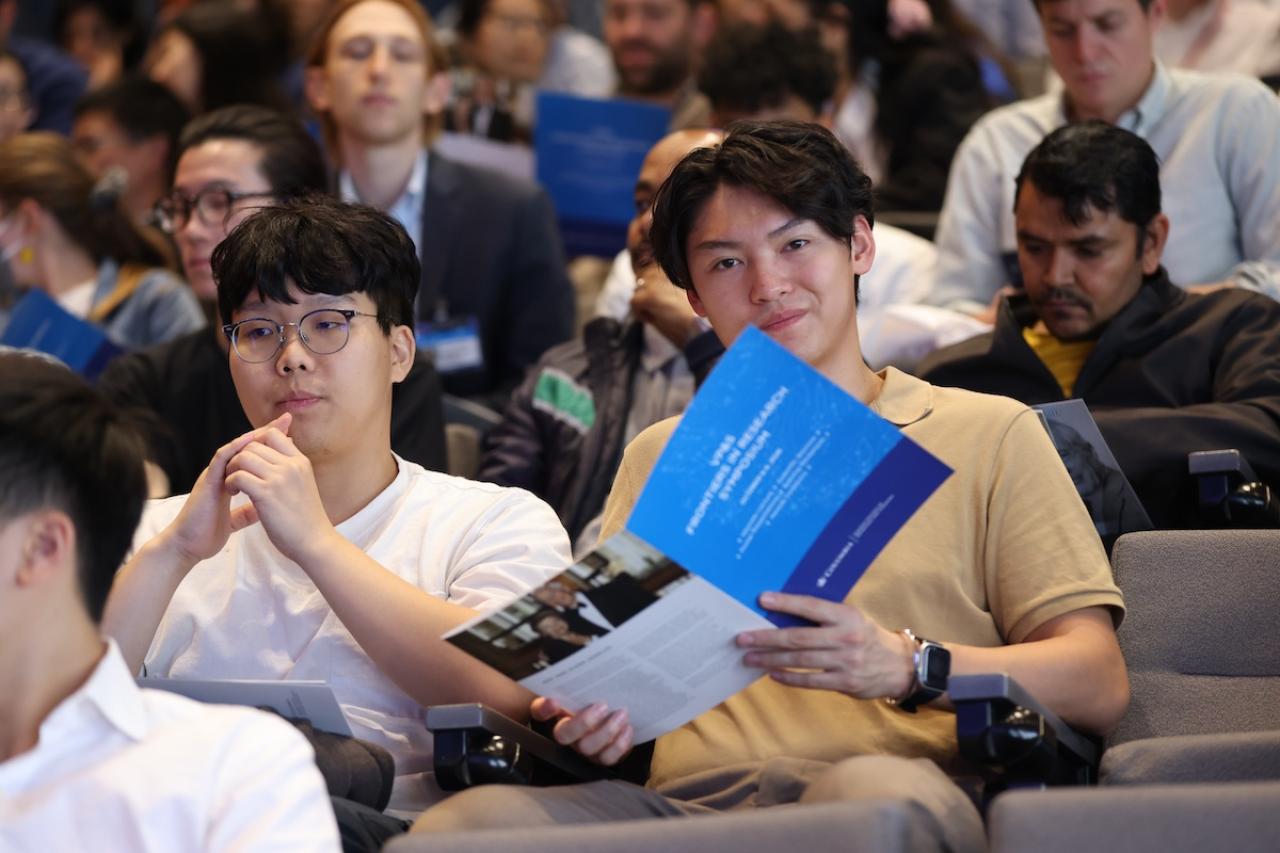
Photo by Bruce Gilbert for Columbia University Vagelos College of Physicians and Surgeons
Unlike most symposia, VP&S Frontiers abstracts were reviewed by a committee of postdoctoral research and clinical fellows, a change appreciated by both faculty and postdocs.
"The process gave our early-career scientists an opportunity to explore research beyond their own fields and strengthen critical evaluation skills needed for effective peer review," said Filippo Mancia, chair of the Scientific Research Advisory Committee, which envisioned and organized the symposium with help from Sandra Ryeom, associate dean for postdoctoral affairs, and Bob Tillman, associate vice dean and director of mentoring at the Vagelos Institute for Biomedical Research Education.
"The postdocs and fellows brought fresh and valuable perspectives to the review process, ensuring we had a wide variety of presenters, from established faculty to graduate students," Mancia added.
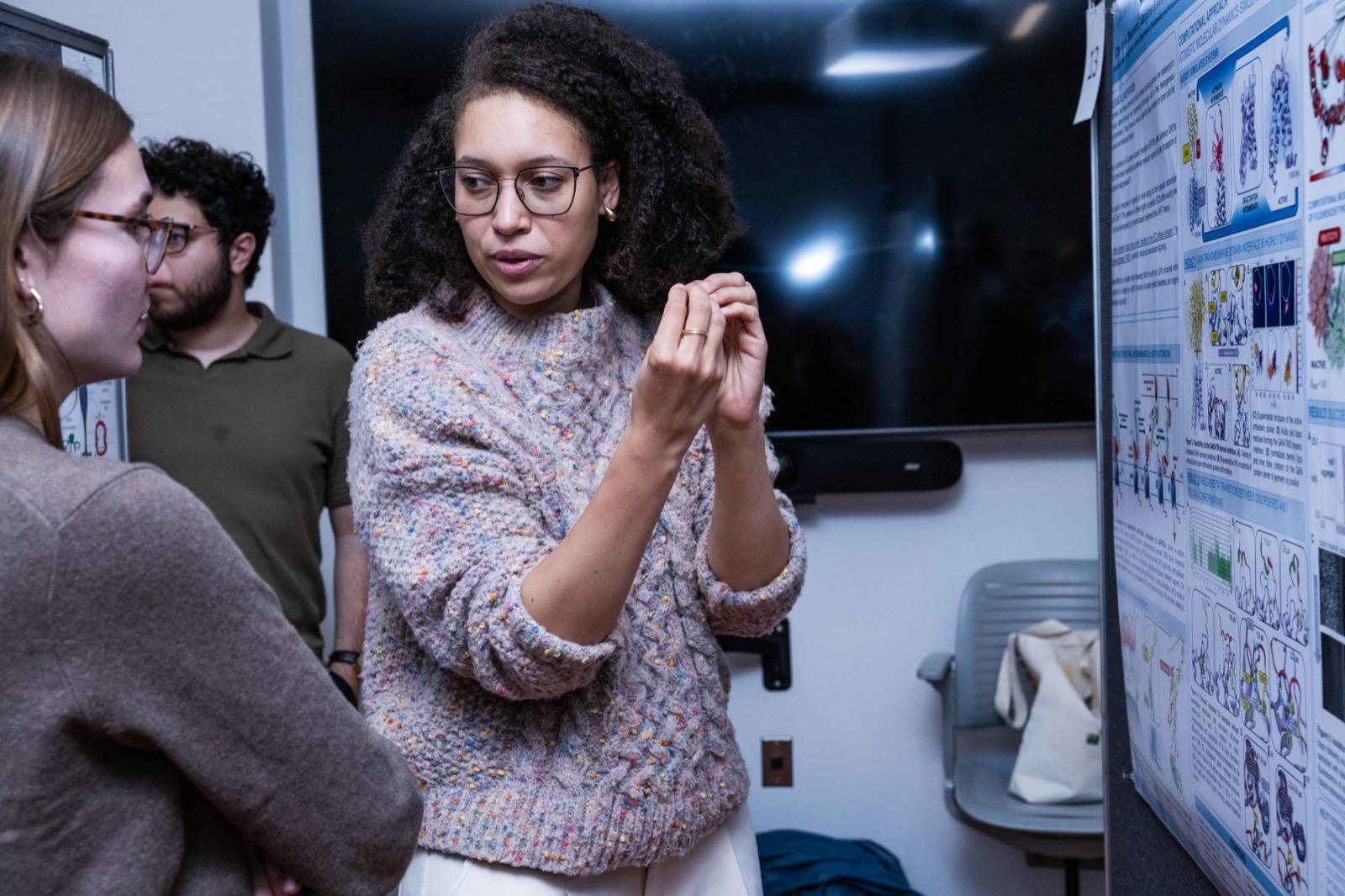
Christina Stephens, who received second place among postdocs in the symposium's poster competition, explains her research. Photo by April Renae for Columbia University Vagelos College of Physicians and Surgeons.
Students and trainees were given special attention from Roy Vagelos, whose birthday was celebrated on the first day of the symposium. The philanthropy and vision of Roy and Diana Vagelos has played a central role in shaping VP&S as a national leader of biomedical research, education and patient care, in part through their support of scholarships. "The most valuable thing you can spend money on is to support young people," he told the crowd. "When you support young people, you create possibilities for people to thrive, explore areas that capture their imaginations, and make the discoveries needed to improve medicine."
The symposium began with a packed auditorium to hear gene editing pioneer David Liu, this year's Zacharias Dische, MD, Lecturer, speak about his lab's development of new DNA editing techniques that could have the ability to repair a patient's genetic mutation regardless of the mutation, and in some cases, regardless of the disease. (The Dische Lectureship was established by the Department of Ophthalmology in honor of Zacharias Dische, a professor of biochemistry at VP&S known for discovering feedback inhibition in metabolic pathways).
At the end of each day of talks, well-attended poster sessions gave attendees more opportunities to learn from insights across fields and catalyze new research ideas. One postdoc presenter commented that he had received many insightful questions that will help strengthen his work, and discussions at one faculty member's poster has already sparked ideas for future projects.
"This is the type of cross pollination that drives innovation and that events like the Frontiers symposium are designed to create," said Lomvardas.
Poster Winners
Postdoctoral Research Scientists
1st Place: Nicholas Tolman, Ophthalmology, Simon John Lab, "A metabolically vulnerable trabecular meshwork cell population links LMX1B dysfunction to glaucoma"
2nd Place: Christina Stephens, Biochemistry and Molecular Biophysics, Naomi Latorraca Lab, "A Biophysical Toolkit for Developing aGPCR-targeted Cancer Therapies"
3rd Place: Ted Piorczynski, Medicine, Jennifer Amengual Lab, "Dual HDAC and EZH2 inhibition coordinately remodels malignant B cells and the immune microenvironment in germinal center-derived B-cell lymphoma"
Students
1st Place: Akshay Raman, graduate student, School of Engineering, Kaveri Thakoor Lab, "AI-based Longitudinal Prediction of VMT Progression and Automated 3D Segmentation of the Vitreomacular Interface in OCT"
2nd Place: Samuel Ogunsany, medical student, Elaine Wan Lab, "Laser Speckle Contrast Imaging, a novel clinical diagnostic and risk stratification imaging modality to prevent cardiac implantable electronic device infection"
3rd Place: Shailen Sampath, medical student, Andrew Chan Lab, "Improving Patient-Reported Understanding of Radiographic Reports in Spine Surgery Through Implementation of Natural Language Processing: A Randomized Controlled Study"


