
Key takeaways
- Microbes remove usable nitrogen by converting it into nitrogen gas, but measuring this process is difficult because abundant nitrogen gas dissolved from air masks the microbial signal.
- New research uses rare pairs of heavy nitrogen atoms as a natural fingerprint to distinguish gas produced by microbes from this atmospheric background.
- These measurements can help assess the impacts of fertilizer and wastewater on water quality and refine estimates of the global nitrogen budget.
Nitrogen is one of life's building blocks, but it's only helpful in the right amounts. Too much nitrogen in water, for example, can lead to poor water quality and the gradual death of aquatic organisms. Microbes remove nitrogen from water by converting it to a gas that escapes into the atmosphere. But scientists have difficulty determining how much nitrogen is removed this way.
Biogeochemists at UCLA, UC Santa Barbara and collaborating institutions have shown that a rare form of nitrogen gas can act as a natural fingerprint for microbial nitrogen conversion. The study, published in Science, reveals microbial nitrogen loss that conventional methods obscure, offering a new tool for improving water quality assessments and estimates of the global nitrogen budget.
"The problem is that our water naturally has a huge amount of nitrogen gas that is dissolved from the air, so the gas that microbes produce can be very difficult to see," explained first author Jiarui Liu, who conducted the research as a postdoctoral fellow at UCLA and UC Santa Barbara. "The answer is written in the way nitrogen atoms are paired inside the nitrogen molecule."
The nitrogen cycle
Nitrogen is essential for proteins and DNA. Yet most organisms can't use nitrogen gas directly from the atmosphere. As nitrogen cycles through air, water and life, some microbes convert the gas into usable compounds while others return those compounds to gas. The balance between these processes helps determine how much nitrogen is available to support life. However, quantifying these processes has proven challenging.
Nitrogen gas, or N2, consists of two nitrogen atoms joined together. These come in two weights, called isotopes: the common nitrogen-14 and the heavier nitrogen-15, which has one extra neutron. Most N2 molecules contain two nitrogen-14 atoms; some contain one of each isotope; and very rarely, both atoms are nitrogen-15.
In atmospheric nitrogen gas, the two heavy nitrogen-15 atoms pair up more often than expected by chance. Meanwhile, the nitrogen gas produced by microbes has atoms paired nearly at random. When nitrogen from microbes mixes with nitrogen from the air, it reduces the excess of heavy pairs. As a result, the relative abundance of the rare molecule can reveal how much nitrogen gas was produced by microbial activity.
Using a bigger machine
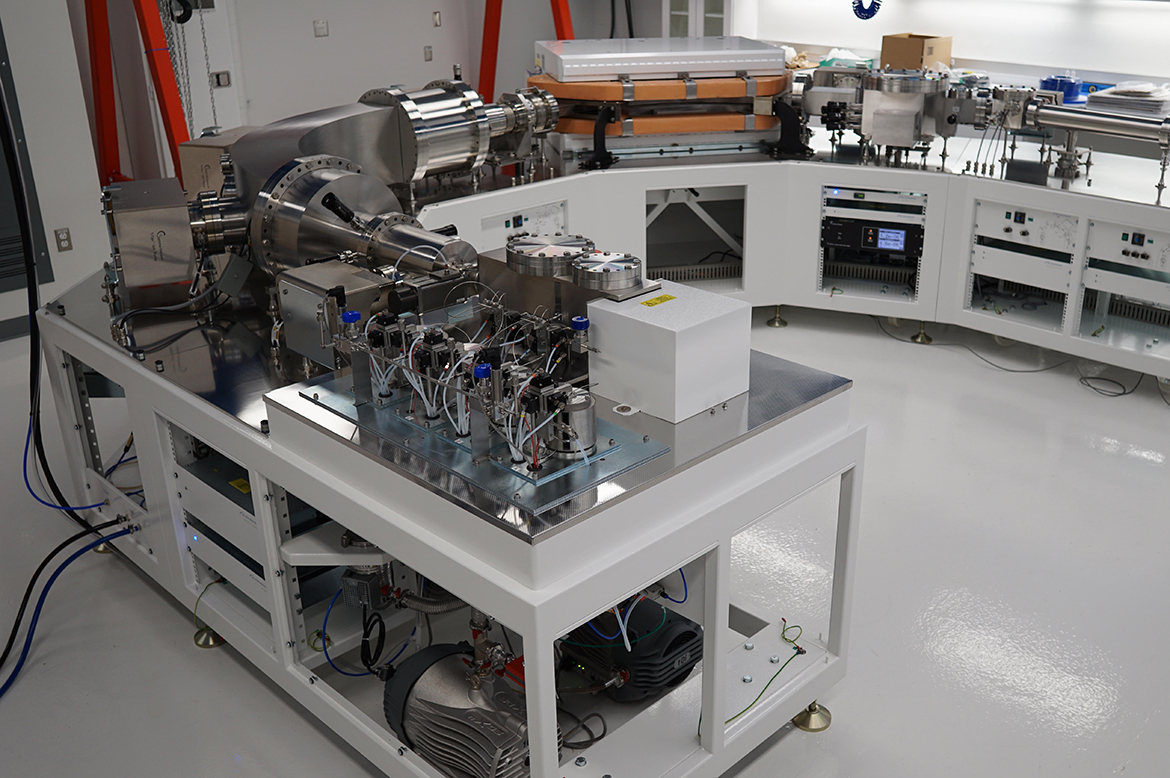
The team measured nitrogen gas extracted from water and sediment samples using UCLA's Panorama mass spectrometer, which uses electric and magnetic fields to separate molecules by their mass and charge. Usually, the rare nitrogen pairs are difficult to distinguish because other molecules have almost the same mass. But Panorama's unusually large size enables it to separate molecules with these tiny differences in mass.
"At UCLA, we discovered the anomalous pairing of heavy nitrogen atoms in Earth's atmosphere and are now making use of this signature of nitrogen in air as a powerful and unique geochemical tool," said geochemist Edward Young, one of the paper's co-authors and Liu's postdoctoral advisor at UCLA.
The study brought together researchers working in groundwater, lake and marine environments. Their combined field and laboratory expertise made it possible to apply the approach to Texas groundwater, lakes in Antarctica and Minnesota, coastal basins off Southern California, the Bay of Bengal and deep-sea sediments offshore from Alaska.
Results with global reach
In modern times, fertilizer runoff, wastewater discharge and other human activities have played an increasingly large role in the nitrogen cycle. Excess nitrogen from these sources can degrade water quality and fuel harmful algal blooms. As blooms die off, their decay consumes oxygen and can create low-oxygen "dead zones" that threaten fish and other aquatic life.
Studying the nitrogen cycle helps scientists identify how people can intervene to reduce or remediate environmental harm. By measuring how much nitrogen microbes remove naturally, the approach can help assess fertilizer and wastewater inputs and inform efforts to protect water quality.
"We want to understand whether microbes in groundwater can mitigate nitrate pollution and how much nitrogen is removed along the way before it can fuel algal growth in lakes, rivers and coastal waters," Liu said. "This gives us a clearer picture of whether nitrogen stays in an ecosystem or is removed from the nutrient pool as N2 gas."
The approach could also address a gap in routine groundwater monitoring.
"Many routine groundwater-quality monitoring programs do not measure the nitrogen gas produced within an aquifer, which can create substantial biases in our accounting of where nitrogen comes from and where it goes," said co-author Alan Seltzer, assistant professor of hydrogeology at University College Dublin. "This study, and this exciting new technique, opens the door to a much more complete picture of the sources and fate of nitrogen in groundwater systems."
The broader goal is to understand the pace of Earth's nitrogen cycle. Scientists calculate nitrogen budgets to compare the rates at which usable nitrogen is supplied and removed. This balance influences the growth of plants and microbes that sustain food webs around the world.
"We study how nitrogen cycles on the planet, and we know that these processes of nitrogen removal occur," said co-author David Valentine, the Norris Presidential Chair and Liu's postdoctoral advisor at UCSB. "But it's very difficult to figure out how quickly that's happening in a given environment, which makes it hard to work out the global nitrogen budget. Our new approach gives us a direct measure of that loss."
Combined with information about water transport and how nitrogen gas accumulates, the measurements allow researchers to estimate nitrogen-loss rates at the ecosystem level. Extending those measurements across environments can link local estimates of nitrogen loss to regional and global budgets. Together, they offer an independent way to test whether nitrogen inputs and losses balance across the planet, and how that balance changes over time.


