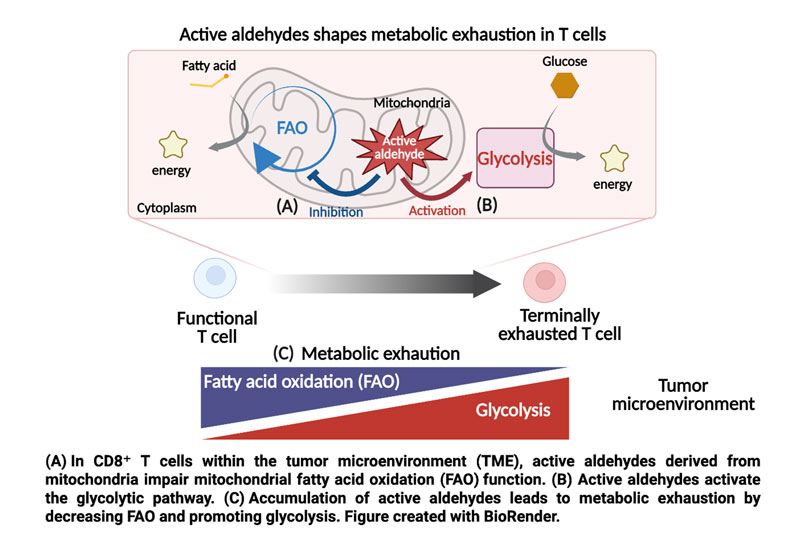
Kyoto, Japan -- Cancer immunotherapy is a type of cancer treatment that harnesses the immune system to fight cancer cells. The treatment involves CD8⁺ T cells, also known as killer T cells, which play a crucial role in attacking tumors. Unfortunately, these cells gradually become exhausted within the tumor microenvironment and lose their full functionality.
The exhaustion of killer T cells is linked to an imbalance in energy metabolism involving glycolysis, the breakdown of glucose into energy, and fatty acid oxidation, or FAO, the breakdown of fatty acids. Previous studies have established that glycolysis drives killer T cells toward terminal exhaustion while FAO can hinder this progression. Yet scientists still don't entirely understand how these two processes are balanced, how this contributes to terminal exhaustion, and how FAO contributes to anti-tumor immunity.
This motivated a team of researchers from Kyoto University to investigate this conundrum. A key physiological role of FAO is the consumption of fatty acids, so the team hypothesized that impaired FAO leads to intracellular fatty acid accumulation, thereby promoting toxic lipid peroxidation. The team focused on active aldehydes, the end products of lipid peroxidation, whose roles in immune cells have not been fully understood.
With multicolor flow cytometry analysis, the team studied tumor-infiltrating killer T cells from mice and human samples by examining their metabolic activities, mitochondrial function, and the accumulation of harmful active aldehydes.
The scientists observed that mice with a genetic deficiency for FAO enzymes generated excessive fatty acid uptake, which led to increased lipid peroxidation and thus increased accumulation of active aldehydes. This accelerated killer T cell exhaustion and made the mice more vulnerable to tumors.
Further analysis revealed that active aldehydes were partly produced from mitochondria as a result of lipid peroxidation, inhibiting FAO and activating glycolysis. This then causes killer T cells to enter a vicious cycle of metabolic exhaustion, exacerbating T cell differentiation and dysfunction.
"We were surprised to find that lipid peroxidation impairs the function of intratumoral CD8⁺ T cells, not only through ferroptotic cell death, as previously thought, but also by rewiring energy metabolism," says co-first author Koji Kitaoka.
"This effect is mediated by active aldehydes which disrupt the balance between glycolysis and FAO, leading to terminal exhaustion," adds co-first author Yasuharu Haku.
These findings are promising for enhancing cancer treatment, as they pave the way for new therapeutic strategies that target active aldehydes, disrupting the vicious metabolic cycle of exhaustion.