
Florida State University psychologists, education researchers and computational scientists have teamed up to transform raw data from educational research into a digital resource that can advance the teaching and learning of K-12 mathematics.
The interdisciplinary team will bring together six existing dataset covering about 90,000 elementary students and 3,000 teachers and build an interactive dashboard with an AI chatbot that allows users to ask questions about the data in plain language.
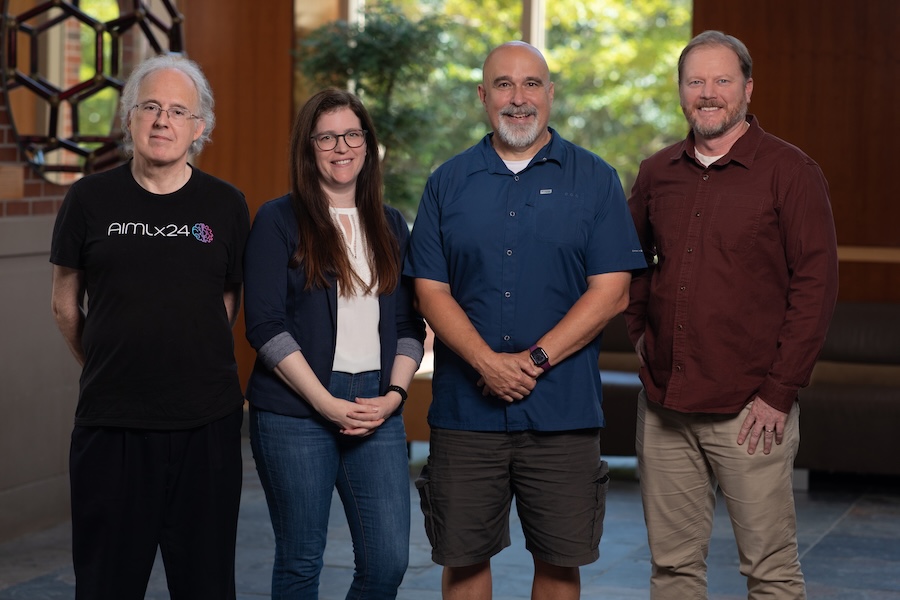
Professors of Psychology Colleen Ganley and Chris Schatschneider, Professor of Scientific Computing Gordon Erlebacher and Associate Professor of Mathematics Education Robert Schoen have been awarded $1.5 million from the National Science Foundation (NSF) to support the creation of the Integrated Data for Education AI, and Learning in Mathematics Project (IDEAL-Math) Network.
The collaboration between researchers and educational practitioners aims to improve the quality of existing math education data by developing a digital dashboard to increase accessibility to education research.
"This project represents an important national investment in FSU's strengths in psychological science, education, artificial intelligence and data science," said Brad Schmidt, Robert O. Lawton Professor of Psychology and Department of Psychology chair. "By bringing researchers together with teachers and technology experts, this project will organize the high-quality data needed to better understand how children learn mathematics and develop increasingly effective educational tools and practices."
The IDEAL-Math project is one of five projects funded across the country through NSF's Collaboratory to Advance Mathematics Education and Learning for K-12 initiative. Together, these five projects will form a shared national hub intended to have a lasting influence on the collection, digital organization and sharing of U.S. education data.
The interdisciplinary nature of this work is reflected by the versatile affiliations of its lead researchers. Alongside their roles in the FSU Department of Psychology, Ganley is a faculty affiliate of the Florida Center for Research in Science, Technology, Engineering and Mathematics, or FCR-STEM, and Schatschneider is the associate director of the Florida Center for Reading Research. Schoen is also an associate director of FCR-STEM, and Erlebacher directs FSU's Interdisciplinary Data Science Master's Degree Program.
"Every year, researchers collect large amounts of data through surveys, test scores, classroom videos and other methods trying to understand how children learn math," said Ganley, director of FSU's developmental psychology program. "Too often, those data get squirreled away after a few publications and never make it back to the educational community or public. This project aims to change that by taking data that have already been collected and making them more useful for researchers, educators and policymakers who want to ask their own questions."
"By bringing researchers together with teachers and technology experts, this project will organize the high-quality data needed to better understand how children learn mathematics and develop increasingly effective educational tools and practices."
– Brad Schmidt, Robert O. Lawton Professor of Psychology and Department of Psychology chair
Data sharing is often mandated as a condition of funding for federal agencies and an increasing number of foundations that support research. However, back-end tasks - producing high-quality documentation, organizing information so computers and humans can easily reuse it and de-identifying sensitive information like names and faces from classroom videos - require a significant amount of expertise and time that a research team may not have once the research itself has concluded.
To protect the privacy of research participants, the IDEAL-Math Network's team will employ de-identification processes that prevent data, such as test scores and survey answers, from being traced back to one person. For example, the data will not include specifics on parents' occupations but instead include broad job categories from public databases. Statistical and AI-based methods will assess reidentification risk for participants across multiple datasets to ensure student, parent and teacher confidentiality.
"As a computational scientist, my role is in translation, or taking data that are meaningful to psychology and education researchers and turning them into a structured, validated and well-documented dashboard that someone without coding experience, as well as AI systems, can easily understand," Erlebacher said. "As we build the AI chatbot component, I am focused on lowering barriers for teachers and principals by eliminating weak points where the chatbot risks giving a confident-sounding wrong answer."
Researchers will curate and assemble six datasets collected by FSU researchers into the interactive dashboard and develop the custom chatbot so users can ask questions and receive answers in plain language. The team will also host workshops for education researchers on ethical data sharing, data management and AI in education research.
"Research shows that beyond a person's preference for one subject over another, the way someone learns math as a child has ripple effects into adulthood, influencing aspects like reading capability, the likelihood of pursuing a STEM career, and eventual socioeconomic status," Erlebacher said. "Through this project, we hope that a district administrator, for example, can ask for strategies to increase students' confidence in their math skills and receive a data-backed answer in seconds instead of never being able to ask the question at all."
To learn more about research conducted in the FSU Department of Psychology, visit psychology.fsu.edu


