
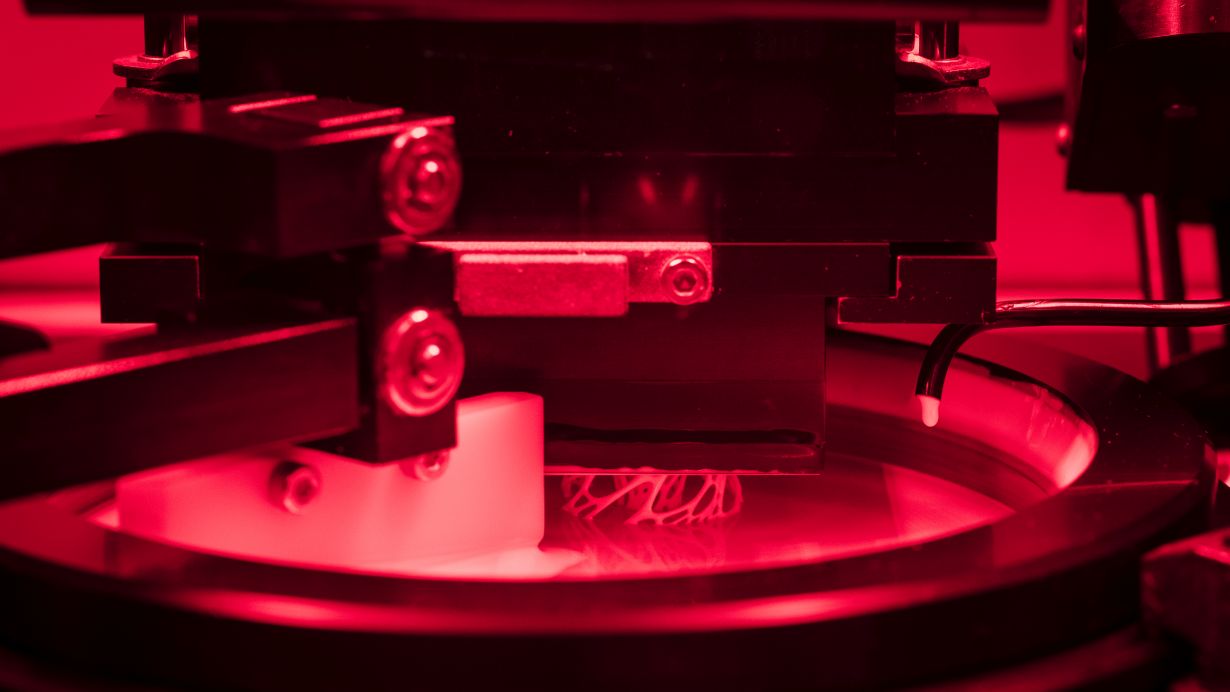
In its CeraMMAM project, a team of researchers at the Karlsruhe Institute of Technology (KIT) has developed a system with which high-performance components can be produced from multiple materials in a single process using a universal binder system. This technology offers new prospects for industrial applications, particularly in medicine, mechanical engineering, and aerospace. During the Hannover Messe, April 20-24, 2026, the researchers will be presenting potential applications of multi-material additive manufacturing along with the first industrial prototypes and demonstrators at the KIT booth (Hall 11, Booth B06).
With additive manufacturing, complex components can be produced layer by layer. Until now, it was usually only possible to use pure materials, such as metals or ceramics. In their CeraMMAM (Ceramic Multi Material Additive Manufacturing) project, researchers at KIT's wbk Institute of Production Science have made a major breakthrough by developing an innovative universal binder system that allows different ceramic materials, or ceramics and metals, to be combined.
New Designs and Functionality with Multi-material 3D Printing
The new technology is based on vat photopolymerization, a 3D printing technique in which components are produced layer by layer from a photosensitive material containing ceramic or metal particles. The material is then exposed to light of a specific wavelength, with the aim to polymerize and cure it locally. The specially developed binder system ensures that different materials bond durably during a single printing process, streamlining production considerably. The binder system, which consists of liquid polymers, functional additives, and a photoinitiator, is removed after the printing process through debinding, after which the part is densified by sintering.
"Using our universal binder system, we can produce multi-material components with novel and partially contradictory material properties," said wbk's Chantal-Liv Lehmann. "That makes completely new and previously impossible designs and functionalities possible. For example, we can produce components such as ceramic gears with flexible interiors and especially hard surfaces." The process also allows the precise reproduction of delicate and complex structures - a technological milestone, particularly in ceramics manufacturing.
Combining Ceramics and Metals
The researchers are working on further technological refinements to enable combinations of ceramics and metals in the future. The ability to combine electrically insulating ceramics with conductive metallic structures is especially promising. Possible applications include power electronics, 5G, 6G, and high-frequency technologies, miniaturized sensors for internet-connected devices, and autonomous vehicles.
More information:


