
An international team of scientists featuring faculty at Binghamton University has recreated a 1,000-year timeline documenting the ecological changes and human impact to the area surrounding Crawford Lake, the famed location of the proposed Anthropocene.
By analyzing sedimentary ancient DNA (sedaDNA) samples found preserved in the lake bottom sediment, scientists were able to reconstruct a diverse, high-resolution dataset of the entire ecosystem surrounding the lake - including plants, animals, bacteria, and fungi - and map changes over the centuries.
Crawford Lake is a meromictic lake, meaning the water column does not mix with the lakebed. Its unique properties cause sediment in the upper level to settle on the lake floor, where it is preserved in alternating layers of calcite and organic laminae (sediment layers that are rich in organic material).
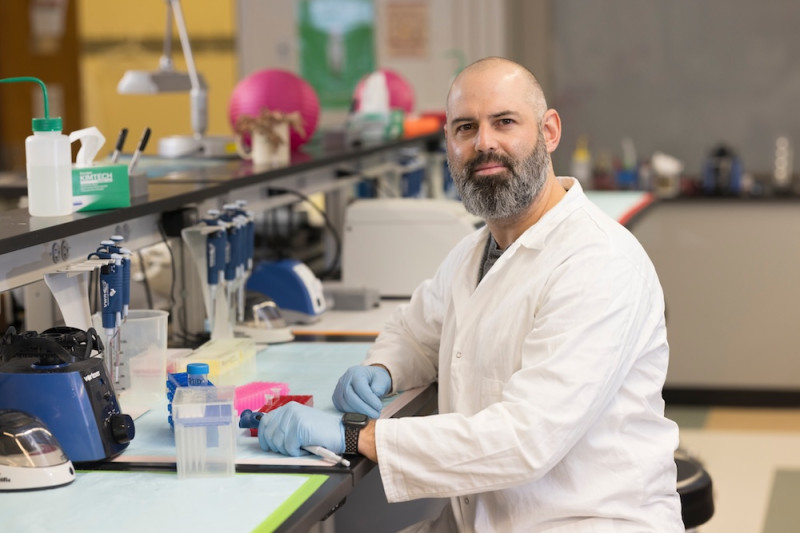
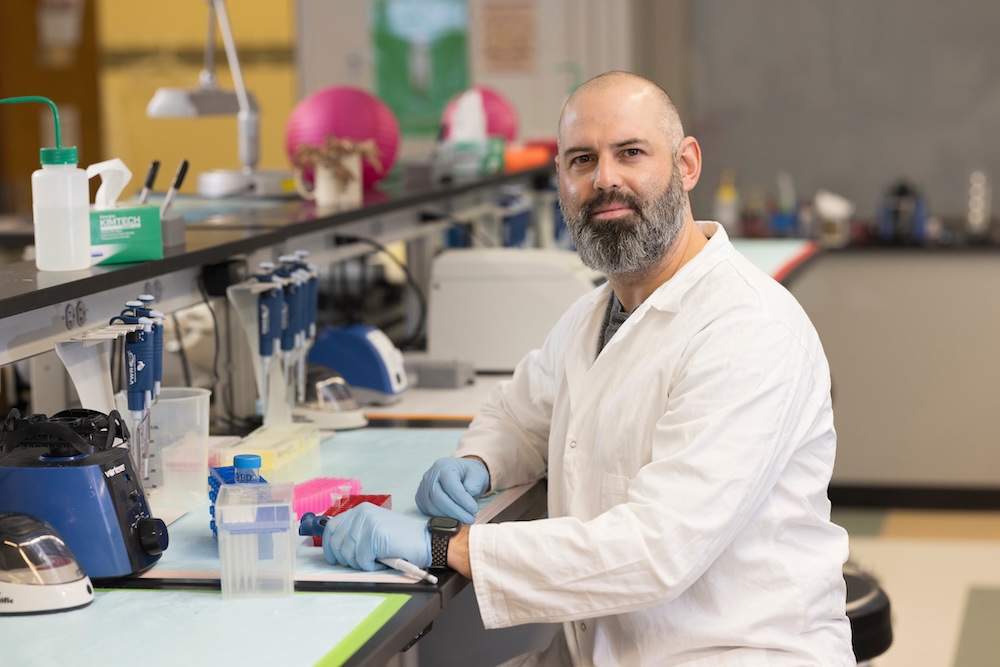
"Like the rings of a tree, each layer of sediment can be dated to a specific year, offering an exceptionally preserved record of environmental changes over time," said Matthew Emery, co-first author of the study and assistant professor of anthropology at Binghamton University.
"Our analysis of these sedimentary biomolecules shows us how the whole ecosystem changed over time - from the period before local agriculture, through periods of Indigenous farming by Longhouse Peoples, followed by site abandonment and local ecological succession, and then into the Euro-Canadian period with renewed impacts from logging, lumbering, milling, farming, and eventually global markers in the upper layers from industrialization," said Tyler Murchie, co-first author of the study, lead scientist of Biodiversity Genomics: Ancient DNA at the Hakai Institute and adjunct assistant professor of Anthropology at McMaster University.
The lake gained global prominence within the scientific community as researchers debated the merits of the Anthropocene, which was a proposed geological epoch marked by humanity's lasting impacts on the environment. Because Crawford Lake's sediment contains a well-preserved record of human impact - including fossil fuel remnants, plastics, artificial fertilizers, acid rain, and even plutonium - it was a favorite among geologists supporting the new epoch. Though ultimately rejected, debate on the validity of the Anthropocene continues.
"What we're really looking at is a filing cabinet, a time capsule," said Emery. "Each layer holds the plants and animals that were living around the lake when those layers formed, and if nothing has shuffled the order, you can read straight down through the centuries and millennia."
Since Crawford Lake has been the subject of decades of scientific scrutiny, it offered scientists using sedaDNA an unparalleled opportunity to validate their work and to reveal new insights.
"Some of what we found confirmed what decades of research at Crawford Lake had already shown, but the sedaDNA also revealed things no one had seen before," said Murchie. "For example, cattle DNA appears in sediments dating to the early 1800s, giving us new evidence of cattle in the surrounding landscape that wasn't visible in the traditional palaeoecological record. In addition to being able to simultaneously track the shifting mosaic of algae, bacteria, plants, animals, and insects - all through the fragments of environmental DNA they left behind over the last 1,000 years."
Murchie, along with co-senior author Hendrik Poinar, professor of Anthropology at McMaster University, have worked extensively to sequence ancient DNA found in sedimentary rock and other sources.
To separate useful DNA from background noise, scientists use genetic baits made of RNA that bind to the DNA of a specific species, if it is present in the sample. The RNA also binds to magnetic beads, allowing researchers to reel in their target DNA using a magnet.
"These techniques were designed to chase down extinct megafauna - Pleistocene mammals - including our extinct hominin relatives, the Neanderthals and Denisovans," said Emery. "Now we're using them on lake mud to track human-environment interactions as recent as centuries and extending back deep in geological time. It's the range and resolution that I find remarkable."
Baits can be combined into sets that target hundreds to thousands of species genomes at a time. This method, called capture enrichment, is far more efficient compared to random or shotgun sequencing.
Capture enrichment allows us to be very selective in the plants and animals we target," said Poinar. "We can decide what it is we want to search for beforehand - what we think might or could be in there."
At McMaster, Poinar was among the first to bring capture enrichment to ancient DNA, which has led to many insightful discoveries about the ancient world.
"One of the biggest surprises was that older DNA isn't necessarily more damaged," said Murchie. "Some of the roughly 500-year-old lake sedaDNA from plants and animals at Crawford Lake is more damaged than DNA tens to hundreds of thousands of years older from permafrost sites in northwestern Canada, showing that preservation conditions matter far more than age alone."


"The study data also confirms the presence of Indigenous peoples who farmed maize (corn) and sunflowers near Crawford Lake between the 1200s and the 1500s.
Three Sisters agriculture is an Indigenous farming technique introduced to the Great Lakes region during the Late Woodland Period (approximately 1000 to 1650 CE). It features maize, beans, and squash - crops that help each other grow when planted side by side. The technique is called Four Sisters when sunflower is included.
For the first time, scientists have detected two of the Four Sisters crops - maize and sunflower - via sedaDNA analysis of lake core samples. The findings are also helping scientists understand the human-led changes to the environment, including the impacts of early farming.
"We see a sharp increase in Canada goose DNA during periods of Indigenous agriculture, consistent with geese foraging in the cultivated fields and then roosting on Crawford Lake," said Murchie. "Their droppings would have carried both nutrients and traces of the crops they were eating into the lake, likely helping drive the repeated algal blooms from nutrient influxes that we can also see evidence of in the sedimentary DNA record."
Known scientifically as eutrophication events, algae blooms are caused by excess nutrients in the water. These nutrients can come from natural sources, like geese droppings, though today they are often driven by artificial fertilizers. Algae blooms may have led to the site's abandonment, which happened on more than one occasion, according to the sedaDNA record.
After abandonment in the 1500s, Crawford Lake's ecology eventually shifted back to pine trees, rabbits, deer, beavers, and loons - with a notable absence of maize.
While fossil and pollen studies have found the presence of beans and squash at the village surrounding Crawford Lake, these targets were not found in the lake sediment. Scientists believe this could be due to the geese preferring maize and sunflower in their diets, or a gap in the bait set used in their DNA analysis.
The study used the PaleoChip Arctic v1.0, a bait set designed for Pleistocene and early Holocene sites - far older than the more contemporary period of human activity at Crawford Lake. The team is working to improve their bait sets for better capture enrichment.
"The lack of beans and squash in our results highlights the importance of developing an Eastern Woodland panel for future targeted ancient DNA research," said Murchie.
In January, Poinar and Murchie received an NSERC Alliance grant to develop improved sedaDNA methods for permafrost and marine sediments, support the reconstruction of long-term terrestrial and marine ecosystem dynamics, and build the Canadian Ancient DNA Network.
"Our study was only possible through collaboration - genetics, archeology, traditional Indigenous knowledge, lake chemistry, and geochemistry - these sit at the intersection of making the unknown a little bit more tangible and the past recovered, almost like magic," said Poinar.
The international team included scientists from McMaster University, the Hakai Institute, Brock University, the University of Alberta, and the University of British Columbia in Canada; Binghamton University, and Arizona State University in the United States; and Stockholm University in Sweden.
The study was published today in the journal Molecular Ecology.


