
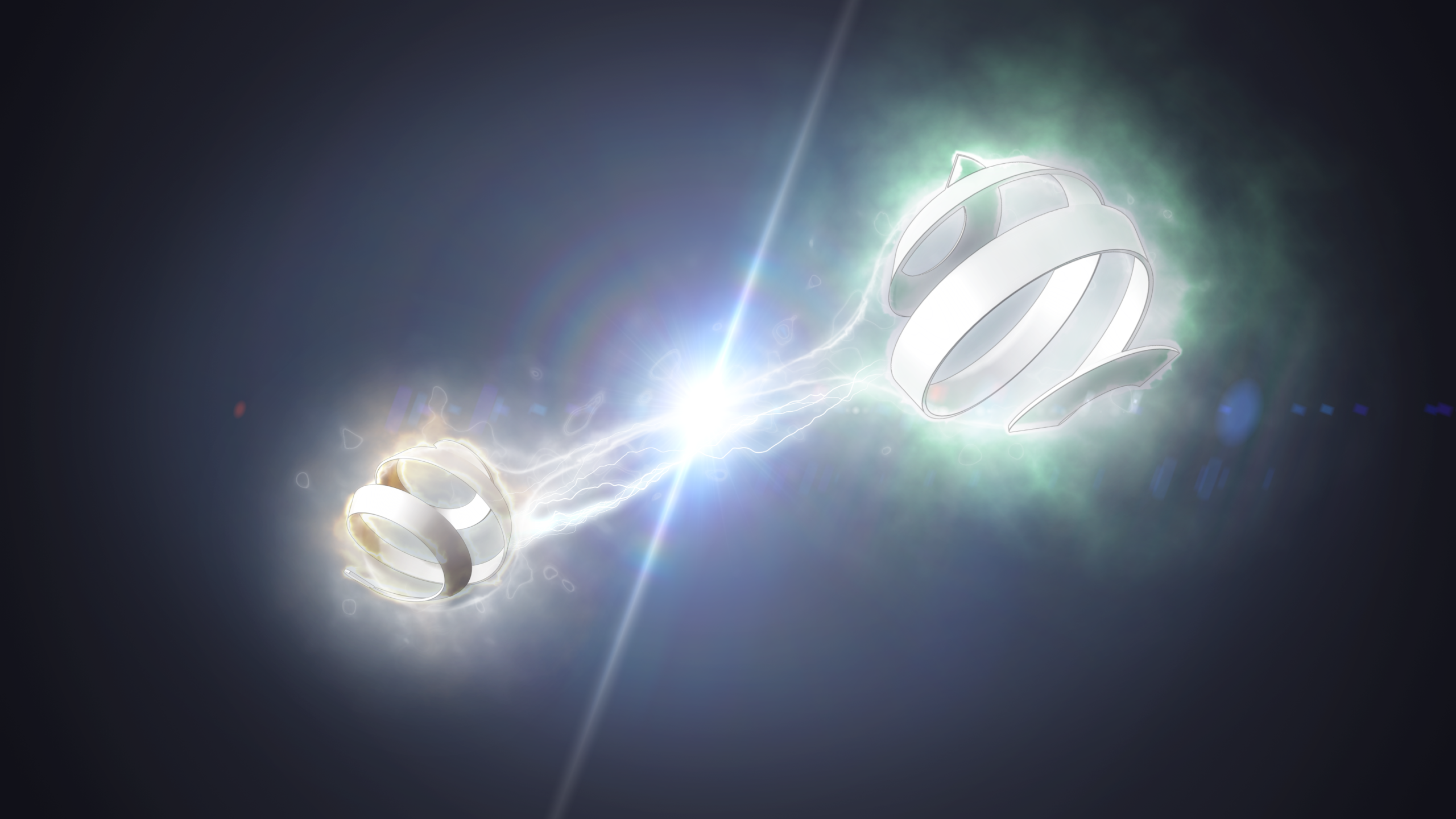
Quantum entanglement is certainly one of the stranger concepts to have emerged from the melting pot of 20th-century physics. Many great physicists, including Einstein, struggled to accept that the phenomenon could be real but, for decades now, the number of examples demonstrating it has been increasing. And, recently, the ATLAS and CMS Collaborations have added to these results by finding strong evidence of Z bosons produced in collisions at the Large Hadron Collider (LHC) being entangled.
The reason that quantum entanglement puzzled many physicists is that, in quantum mechanics, a particle can exist in multiple possible states at the same time. If two particles are quantum entangled, the state of one is linked to the state of the other, no matter how far apart they are.
Entanglement led Einstein and his colleagues to challenge quantum mechanics by arguing that hidden properties must exist to determine the states of two quantum systems before they are measured. But experiments have consistently demonstrated that quantum mechanics really is that strange and that particles can indeed be quantum entangled.
Most experiments demonstrating quantum entanglement have involved low-energy particles. The quantum entanglement of the extremely high-energy particles produced in collisions at the LHC is completely different. At such energies, quantum entanglement may provide an additional probe of the Higgs boson and its interactions with elementary particles.
The ATLAS and CMS Collaborations have previously searched for signs of quantum entanglement in short-lived particles produced in high-energy collisions at the LHC. A couple of years ago, they observed the quantum entanglement of top quarks - the heaviest fundamental particles.
In recent studies, ATLAS and CMS analysed decays of the Higgs boson and found the first evidence of quantum entanglement between two Z bosons. The Z boson carries the weak nuclear force, and exploring whether it can be entangled may help to further our understanding of this fundamental force and its behaviour at extreme energies.
Typically, when searching for signs of entangled particles, researchers look for a correlation in two particles between the values of a quantum property known as spin. While top quarks can occupy two possible spin states, +1 or −1, Z bosons can occupy three: -1, 0 or +1. If two Z bosons are produced from the decay of a Higgs boson, the sum of their spin states must equal that of the Higgs boson, which is zero. This means that, if one Z boson produced from a Higgs boson decay has a spin state of +1, the other Z boson coming from that same decay must have a spin state of -1.
Z bosons are unstable and decay almost immediately, so the researchers searched for signs of them through their decay into pairs of either electrons or muons, which can be measured by the ATLAS and CMS detectors. From these two pairs of particles the spin properties of the Z bosons can be reconstructed and, through statistical analysis, researchers can determine a measurement of entanglement.
Using data from across the second and third runs of the LHC, both the ATLAS and CMS Collaborations found strong evidence for quantum entanglement between Z bosons produced by a Higgs boson decay.
These results highlight the importance of the Higgs boson as a means of studying quantum entanglement at high energies. They are also a promising sign of the opportunities to come with the HiLumi LHC, where the dramatic increase in the number of collisions has the potential to further expand the study of quantum entanglement and other quantum phenomena at extremely high energies.


