
Scientists have long known that Black women with estrogen-receptor positive breast cancer and those who live in disadvantaged neighborhoods often have more aggressive forms of the disease and poorer survival rates. However, the underlying factors that link these outcomes with women's living environments have remained unclear.
Scientists at the University of Illinois Urbana-Champaign and the University of Illinois Chicago led a recent study that explored the molecular signatures associated with neighborhood disadvantage by analyzing plasma and tumor samples taken from Chicago-area women with ER-positive breast cancer. The team found that patients who lived in disadvantaged neighborhoods had elevated levels of proteins, metabolites and genes associated with inflammation and tumorigenesis - the process whereby normal cells transform into cancer cells and form tumors - compared with the women from more affluent areas.
The team - which included scientists at Northwestern University's Feinberg School of Medicine - analyzed plasma from 91 pretreatment patients with ER-positive breast cancer, comparing it with that of 141 healthy patients in the control group who had no symptoms or history of breast cancer. The researchers investigated steroid hormone levels, global metabolite changes and metabolites related to chronic stress and inflammatory proteins.
"The study sample included women who lived in very affluent neighborhoods as well as those from extremely disadvantaged areas," said first author Hannah Heath, who is a predoctoral fellow in food science and human nutrition at Illinois. "We found that women who were living in disadvantaged neighborhoods - both those with cancer and the healthy controls - had extremely high levels of inflammatory proteins. Within the tumor samples, we also found dysregulated expression of genes related to DNA repair. Both of those things are associated with worsened prognoses."
The participants were patients of three Chicago-area hospitals, and their addresses at the time they enrolled in the study were used along with data from the Area Deprivation Index to classify the patients into three groups, from those living in the least to the most disadvantaged neighborhoods. The greatest proportion of Black women in the study lived in the most deprived areas of the city, according to the study.
Analyzing 71 tumor samples taken from the cancer patients, the team classified the tumors into three groups by grade, with higher grades indicative of more aggressive disease. Even among tumors within the same grade, those removed from women living in disadvantaged neighborhoods exhibited increased inflammation compared with those of patients from affluent areas, the team wrote.
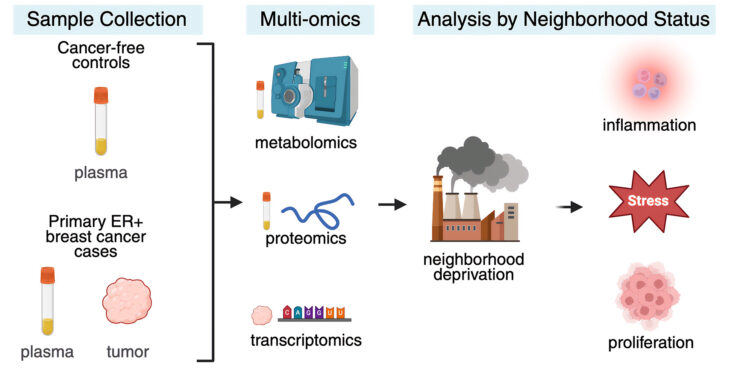
Graphic by Hannah Heath
"This is important because tumor grade is often what is used to determine how aggressive patients' cancers are and what type of treatment they should receive," Heath said. "But based on these results, that protocol might not be benefitting people who live in disadvantaged neighborhoods because they still have much higher levels of inflammation."
Cancer patients from the most affluent neighborhoods had increased levels of cortisol metabolites while those living in the most deprived areas had decreased levels, along with significantly elevated levels of testosterone and cholesterol, the team found. "We know that, generally, cortisol hormones are necessary to reduce inflammation. But when those hormones become dysregulated, they have the opposite effect and can increase inflammation. And that appears to be what's happening with those living in disadvantaged areas," Heath said.
"Our analyses show that neighborhood disadvantage correlates with upregulation of inflammatory and proliferation-related gene expression within tumors themselves, establishing a biological pathway linking social determinants of health to tumor aggression," said co-author Zeynep Madak-Erdogan, a nutrition professor and the associate director for education at the Cancer Center at Illinois. "These findings move beyond documenting disparities in breast cancer outcomes to identifying specific, potentially modifiable molecular mechanisms - including chronic inflammation and metabolic dysregulation - that may drive these inequities and represent actionable targets for intervention."
Published in the Journal of Proteome Research, the paper was co-written by Ashlie Santaliz Casiano, a postdoctoral fellow at the National Cancer Institute.
Co-authors at both the University of Illinois College of Medicine and the University of Illinois Cancer Center in Chicago were Jonna Frasor, professor and associate head for research of physiology and biophysics; Dr. Kent F. Hoskins, UI Health's oncology service line medical director and the co-leader of the Heredity Cancer Program; and Oana C. Danciu, the associate director of clinical research at the Cancer Center and a breast oncologist at UI Health.
Senior research scientist Margaret Wright Geise and resident Ayesha Zaidi at the University of Illinois Cancer Center also co-wrote the study, along with epidemiology and biostatistics professor Garth H. Rauscher at the UIC School of Public Health.
Co-authors at Northwestern University Feinberg School of Medicine were Dr. Sarah M. Friedewald, an adjunct professor of radiology in the Division of Breast Imaging; Dr. William J. Gradishar, the Betsy Bramsen Professor of Breast Oncology; Seema A. Khan, the Bluhm Family Professor of Cancer Research; J. Julie Kim, the Susy Y. Hung Research Professor of Obstetrics and Gynecology in the Division of Reproductive Science in Medicine; clinical research coordinator Natalie Pulliam and then-research project manager Elona Liko Hazizi.
Then-graduate student Farizi Fazli and undergraduate student Hannah McGee, both at Illinois, also co-wrote the paper.
The work was supported by the National Cancer Institute; the National Institute of Food and Agriculture; the Office of the Vice Chancellor for Research and the College of Agriculture, Consumer and Environmental Sciences, both at the University of Illinois Urbana-Champaign; a Sylvia D. Stroup Scholars Award; and a Prairie Dragon Paddlers Award.


