
A blood test that measures how quickly tumour cells divide could in future help doctors assess prognosis and select treatment strategies for patients with melanoma that has spread to other parts of the body. This is shown in a study involving researchers from Karolinska Institutet, published in the journal Clinical Cancer Research.
Around half of all patients with metastatic melanoma carry a mutation in the BRAF gene. For these patients, both immunotherapy and targeted drugs aimed at the tumour's genetic alteration are available. An important question is in which order these treatments should be given to achieve the best outcome.
In the current study, the researchers analysed blood samples from 81 patients with metastatic melanoma and a BRAF mutation. The patients participated in the international SECOMBIT study, which compared three different treatment sequences involving immunotherapy and targeted therapy. The study is the first clinical trial to evaluate the blood biomarker TKa in patients with metastatic melanoma.
High levels of biomarker linked to poorer prognosis
The researchers investigated a blood biomarker called TKa, which provides information about how quickly tumour cells grow and divide.
Patients with high TKa levels before treatment started had shorter survival and their disease progressed sooner despite treatment, compared with patients who had low TKa levels. After five years, around 71 per cent of patients with low TKa levels were still alive, compared with approximately 37 per cent of those with high levels.
Treatment sequence may matter
The researchers also found that patients with high TKa levels appeared to benefit from a short initial period of targeted therapy before immunotherapy. For patients with low TKa levels, starting treatment with immunotherapy produced better outcomes.

"The results suggest that TKa may help identify which patients could benefit from different treatment strategies. At the same time, further studies are needed before the method can be introduced into clinical practice," says Hildur Helgadottir , docent at the Department of Oncology-Pathology , Karolinska Institutet, and first author of the study.
The study also showed that TKa levels often increased when the disease worsened. This suggests that the biomarker could potentially be used to monitor how well treatment is working over time.
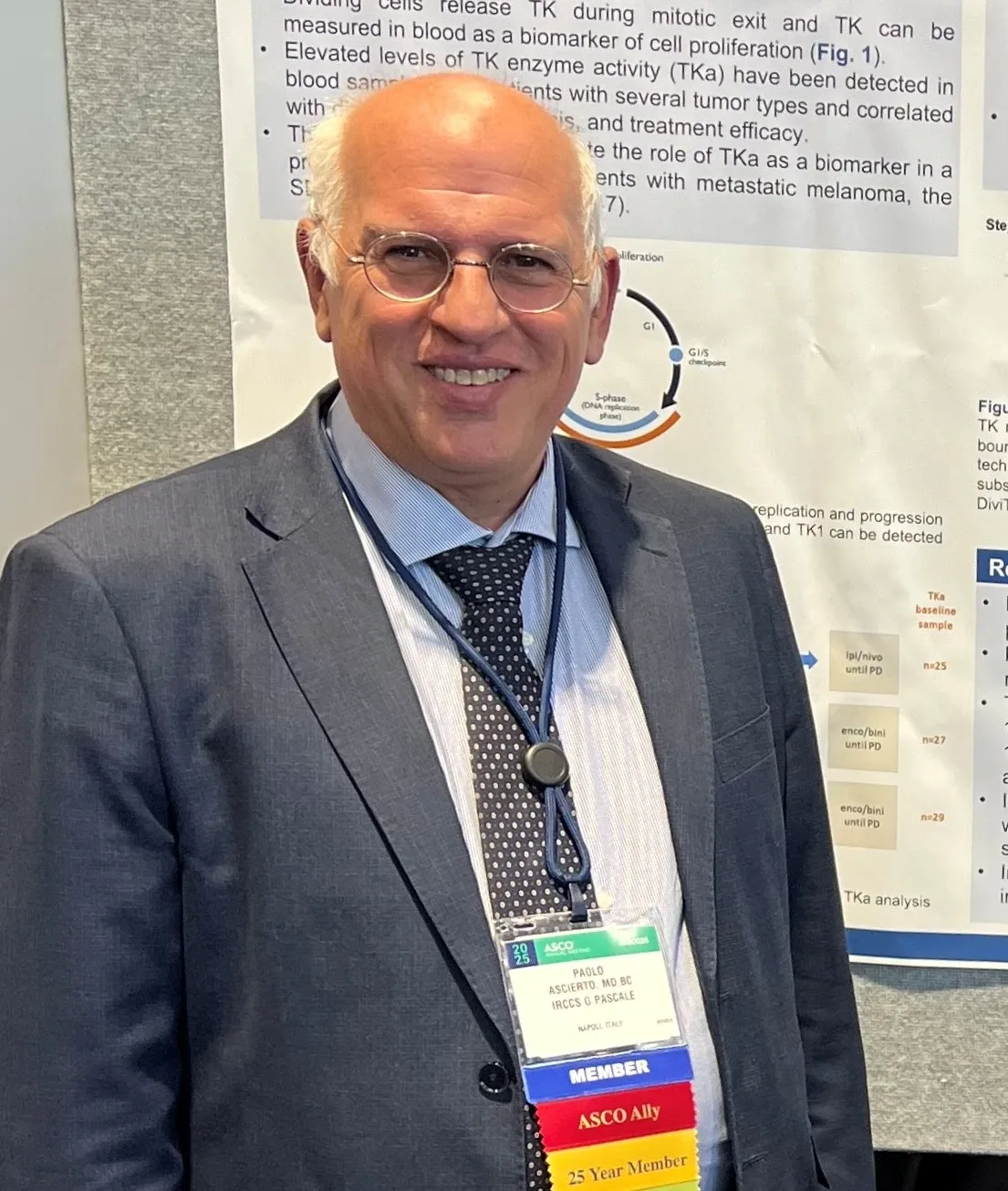
The biomarker analysis was led by Hildur Helgadottir at Karolinska Institutet together with Mattias Bergqvist at the Uppsala-based biotechnology company Biovica. Paolo Ascierto at IRCCS Fondazione G. Pascale in Naples was the principal investigator of the international SECOMBIT study. The research was conducted in collaboration with researchers from several European universities and hospitals.
The study was funded by, among others, the Swedish Cancer Society, Bristol Myers Squibb and Array Biopharma/Pfizer. Potential conflicts of interest are reported in the scientific article.
Publication
Circulating thymidine kinase activity predicts survival and optimal treatment sequencing in BRAF-mutated metastatic melanoma in the SECOMBIT trial , Helgadottir H, Capone M, Ridolfi L, Zambelli A, Piccin L, Gogas H, Tucci M, Quaglino P, Del Vecchio M, Minisini AM, Spagnolo F, Rutkowski P, Ferraresi V, Arance A, Guida M, Maiello E, Lebbé C, Bulgarelli J, Chiarion Sileni V, Paone M, Melero I, Trojaniello C, Bergqvist M, Dummer R, Giannarelli D, Palmieri G, Ascierto PA; Clinical Cancer Research, online 4 August, doi.org/10.1158/1078-0432.CCR-26-1402


