
Cancer cell-derived small extracellular vesicles (sEVs) can travel from distant tumors through the bloodstream and kidneys and be excreted into urine, as reported by researchers at Science Tokyo. Using sophisticated molecular tagging systems in mouse models of brain, lung, and pancreatic cancer, the researchers directly traced sEVs from tumors to urine. They also revealed that the kidney's glomerular cells actively transport sEVs across the filtration barrier, supporting their use in emerging urine-based cancer diagnostics.
Shedding Light on the Journey of Extracellular Vesicles Through the Body
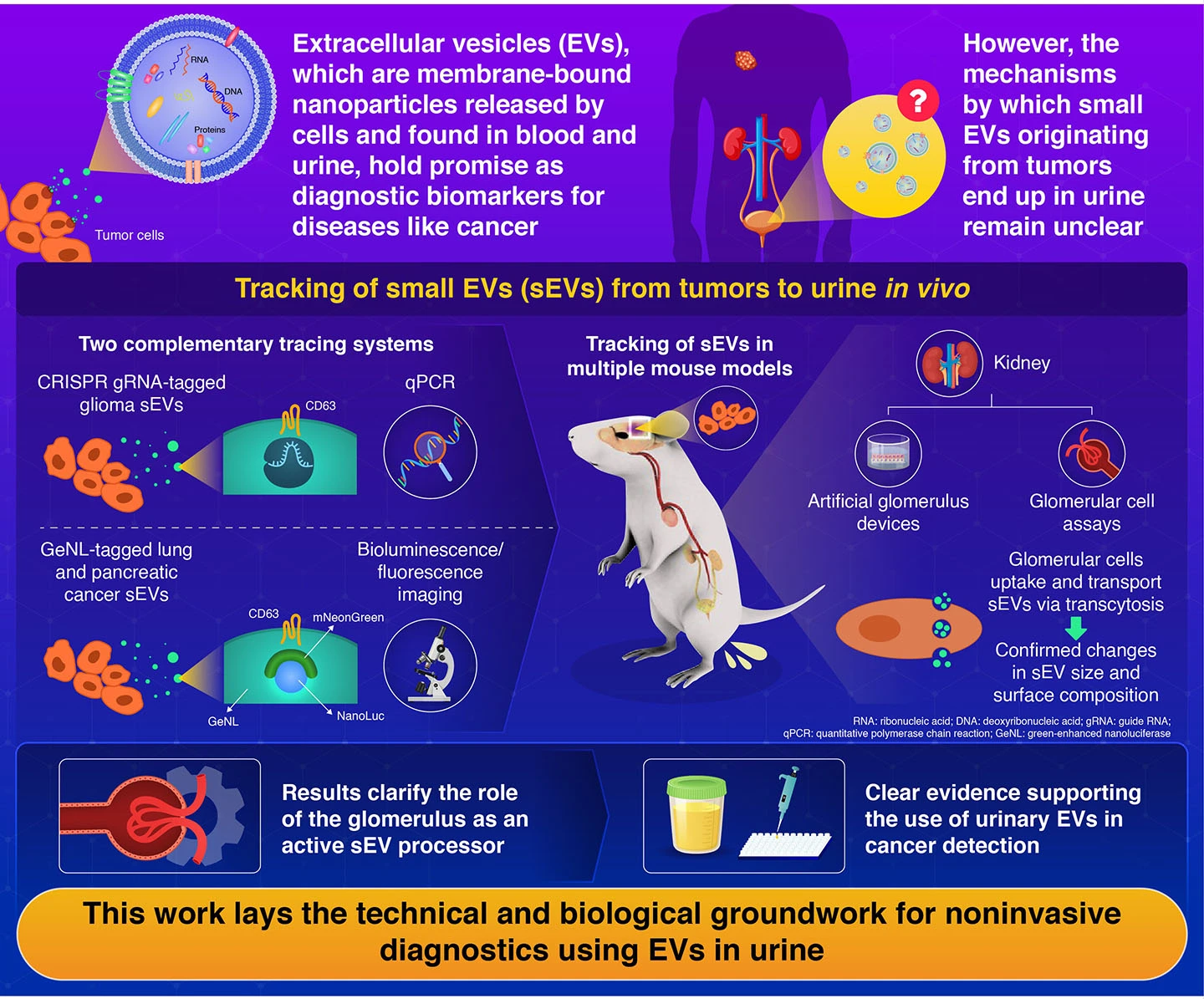
Liquid biopsy has become an important tool in cancer care, allowing doctors to detect and monitor tumors using body fluids, such as blood and urine, instead of tissue samples. Over the past few decades, scientists have focused on tiny particles called small extracellular vesicles (sEVs), which are released by almost all cells and readily found in body fluids. These nanosized, membrane-bound packages often carry ribonucleic acid (RNA) and proteins that reflect the state of their cells of origin. In theory, analyzing sEVs in urine could reveal the presence of cancer, even for tumors located far from the urinary tract; some studies have even reported signs of sEVs originating from brain tumors in urine samples.
However, how tumor-derived sEVs actually reach the urine remains unclear. The glomerular filtration barrier in the kidneys is considered to be a highly selective filter that blocks particles larger than eight nanometers. By contrast, sEVs typically measure 30 to 200 nanometers across, which is far larger than the supposed cutoff. This size mismatch has raised doubts about whether intact tumor-derived sEVs can truly pass from the bloodstream into urine under normal conditions.
Against this backdrop, a research team led by Professor Takao Yasui from the School of Life Science and Technology, Institute of Science Tokyo, Japan, and Associate Professor Ryosuke Kojima from the University of Tokyo, Japan, in collaboration with Nagoya University, Tohoku University, Gunma University, Hokkaido University, and the National Center for Geriatrics and Gerontology, Japan, set out to solve the puzzle. In a study published in Volume 12, Issue 8 of the journal Science Advances on February 20, 2026, they employed two independent tracking systems to follow tumor-derived sEVs in mouse models of brain, lung, and pancreatic cancer. Their goal was to determine whether the vesicles truly travel from tumors, through the bloodstream and kidneys, and finally into urine.
In the first approach, the team engineered brain tumor (glioma) cells to produce sEVs carrying a specially designed RNA tracer. This RNA tracer allowed the researchers to sensitively detect and quantify tumor-derived vesicles. In the second approach, lung and pancreatic cancer cells were modified to produce sEVs tagged with a dual luminescent and fluorescent reporter protein, allowing the vesicles to be quantified in body fluids through well-established microscopy techniques.
Using these complementary systems, the researchers tracked tumor-derived sEVs as they circulated through the body, confirming the theorized journey from the tumor site into urine. Interestingly, tumor-derived sEV signals were consistently higher in urine than in blood plasma in the mouse models. This pattern held true across multiple cancer types and tumor locations, including the brain.
The study also showed that the kidney does not simply act as a passive sieve. Through cell-based experiments and a "glomerulus-on-a-chip" device that mimics kidney filtration under realistic flow conditions, the researchers demonstrated that glomerular cells actively take up circulating sEVs and transport them across the filtration barrier through a process called transcytosis. During this passage, some vesicles even changed in size and surface composition. "Taken together, our results redefine the glomerulus as an active regulator of sEV processing and provide a mechanistic foundation for urinary liquid biopsy," says Yasui.
Overall, this work provides the first direct proof that sEVs originating from cancer cells can be excreted into urine, which could reshape the future of cancer diagnostics. "Our work substantiates urinary EV-based cancer detection, including for tumors distant from the urinary tract, and lays the technical and biological groundwork for early, noninvasive diagnostics using urinary sEVs," concludes Yasui.
Reference
- Authors:
- Shota Kawaguchi1, Taiga Ajiri1, Rina Mitsuya2, Reiko Tsuchiya3, Koki Kunitake3,4, Yoshikazu Tanaka5, Takeshi Yokoyama5, Kiichi Sato6, Yusuke Sato7, Zetao Zhu1, Kunanon Chattrairat1, Yasuko Kobayashi8, Kimiko Inoue9, Keisuke Imaeda9, Kosei Ueno9, Sou Ryuzaki9, Akira Kato10, Yasuyuki Kimura11, Atsushi Natsume10, Ryosuke Kojima3,12, and Takao Yasui1,2,13,14
- Title:
- Glomerular routing of tumor-derived extracellular vesicles substantiates urinary biopsy
- Journal:
- Science Advances
- Affiliations:
- 1Department of Life Science and Technology, Institute of Science Tokyo, Japan
2Department of Biomolecular Engineering, Graduate School of Engineering, Nagoya University, Japan
3Graduate School of Medicine, The University of Tokyo, Japan
4Graduate School of Pharmaceutical Sciences, The University of Tokyo, Japan
5Graduate School of Life Sciences, Tohoku University, Japan
6Graduate School of Science and Technology, Gunma University, Japan
7Department of Chemistry, Graduate School of Science, Tohoku University, Japan
8Department of Pediatrics, Graduate School of Medicine, Gunma University, Japan
9Department of Chemistry, Faculty of Science, Hokkaido University, Japan
10The Institutes of Innovation for Future Society, Nagoya University, Japan
11Department of Clinical and Experimental Neuroimaging, Center for Development of Advanced Medicine for Dementia, Research Institute, National Center for Geriatrics and Gerontology, Japan
12FOREST, Japan Science and Technology Agency, Japan
13Institute of Quantum Life Science, National Institutes for Quantum Science and Technology (QST), Japan
14Research Institute for Quantum and Chemical Innovation, Institutes of Innovation for Future Society, Nagoya University, Japan


