
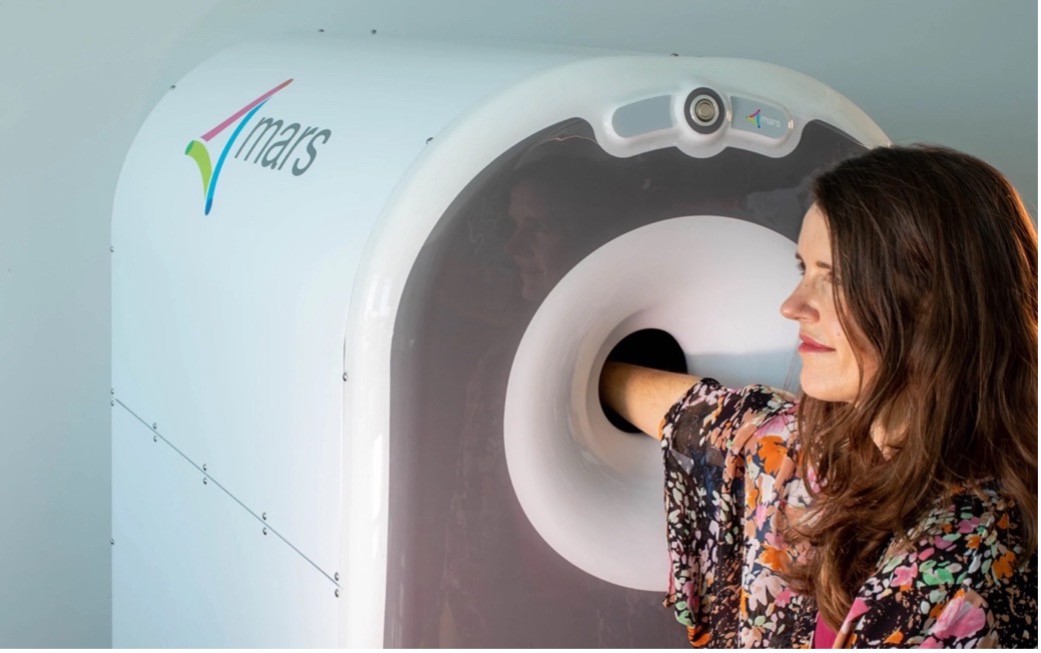
Originally derived from a technology developed to explore the fundamental nature of the Universe, Medipix3 technology now powers a medical scanner that is on track to benefit an increased number of patients. MARS Bioimaging Ltd has received 510(k) clearance from the US Food and Drug Administration (FDA) for its portable photon-counting CT scanner for upper-limb imaging, allowing the system to enter the US health sector and enable broader clinical adoption.
Medipix technology is based on hybrid pixel detectors, which were originally designed at CERN for particle detection in high-energy physics experiments. This technology was adapted to create the Medipix family of pixel detector readout chips, enabling a new approach to medical imaging.
Unlike conventional CT (computed tomography) systems - which combine X-ray measurements taken from different angles to produce a 3D image - photon-counting technology measures individual X-ray photons and their energy. This produces detailed, three-dimensional images that help clinicians to distinguish between different types of tissue and materials, better informing their decision making. John Carrino, M.D., Vice Chairman for Radiology and Imaging at the Hospital for Special Surgery in New York, who is involved in clinical trials with MARS Bioimaging, noted: "Photon-counting CT is going to be the future of CT for medical imaging."
Designed for use outside traditional hospital radiology departments, the MARS Bioimaging Extremity Scanner System can bring this advanced imaging capability into community and point-of-care environments, including outpatient clinics and sports medicine settings. Its recent FDA clearance will not only allow more patients to benefit across the United States, but also help support uptake internationally.
Anthony Butler, Chief Technology Officer at MARS Bioimaging Ltd, recalled: "Phil Butler [his father] had worked at CERN and convinced me that some of the new detectors would be useful in medicine by improving access to high-quality imaging. Twenty years later, with the support of the Medipix Collaboration, we are starting to have a significant impact."
CERN played an important role in helping move photon-counting techniques from the laboratory to the clinic by hosting a series of workshops. These brought together scientists, engineers, clinicians and industrial partners to develop and exchange expertise and explore new applications. Rafael Ballabriga, Spokesperson for the Medipix3 Collaboration, said: "It is very rewarding to see a technology developed initially for high-energy physics go on to benefit society through medical application."
A public summary of the 8th Workshop on Medical Applications of Spectroscopic X-ray Detectors will be presented by Anthony Butler at CERN on Friday, 24 April, offering an overview of progress made in the development of photon-counting CT technology.


