
The gas ethylene causes fruit and vegetables to ripen faster and is responsible for millions of tons of food being lost annually during transport and storage. Now researchers from the University of Copenhagen, among others, have succeeded in getting clay to collect the gas and hope that the material can help reduce food waste in the long term.
Avocados from Chile, bananas from Costa Rica, tomatoes from southern Spain, mangoes from Brazil. A large part of the fruits and vegetables we eat have travelled across the globe before they reach store shelves here at home. But many millions of tons are lost every year before they reach that far.
One of the main reasons is ethylene - a natural gas that many fruits and vegetables produce and that controls their ripening. When fruits and vegetables are confined in closed packaging or containers during transport and storage, the concentration of ethylene in the air increases, accelerating the ripening process. As a result, a large part of the cargo ends up rotting before it reaches its final destination.
Clay may be the solution
Now, new research led by the University of Copenhagen shows that ordinary clay could probably be part of the solution.
- Ethylene is a natural plant gas that many fruits and vegetables secrete and which controls their ripening.
- When ethylene gas accumulates during transport and storage, it can significantly shorten the shelf life of fruits and vegetables.
- In the study, the researchers used the clay mineral Montmorillonite, which is widespread, nontoxic and naturally occurring.
- To investigate how the gas moves in the clay material, the researchers used advanced measurement methods with neutrons and X-rays as well as thermal analyses, where the material is heated and its reaction is measured.
- The study shows that chemically modified clay can both increase the uptake and retention of ethylene.
"Clay is an interesting material because it is natural, cheap, non-toxic and found everywhere - and we can absorb it safely into the body. Our thought was: Can we use chemistry and physics to modify clay so that it captures the gas and thus slows down the ripening process? We have succeeded in doing so," says Associate Professor Heloisa Bordallo from the Niels Bohr Institute, who led the new study .
First, the researchers tried to capture the gas with the clay in its natural form. Here, a small amount was captured. By increasing the voids in the clay's structure with a mild chemical treatment, the researchers made room for the clay to capture more gas - but without the gas escaping again - while keeping the material nontoxic.
Researchers have never succeeded in getting clay to absorb such large amounts of ethylene, which is why they believe the concept has potential for use in food packaging.
"Now we know the fundamental physics and chemistry of the process that affects the clay's ability to absorb and retain ethylene. We didn't do that before. So now we can control and optimize the process, which is necessary for it to be used in industry," says Karina Kovalchuk, a a member of Bordallo's group at Lawrence Berkeley National Laboratory and first author of the study.
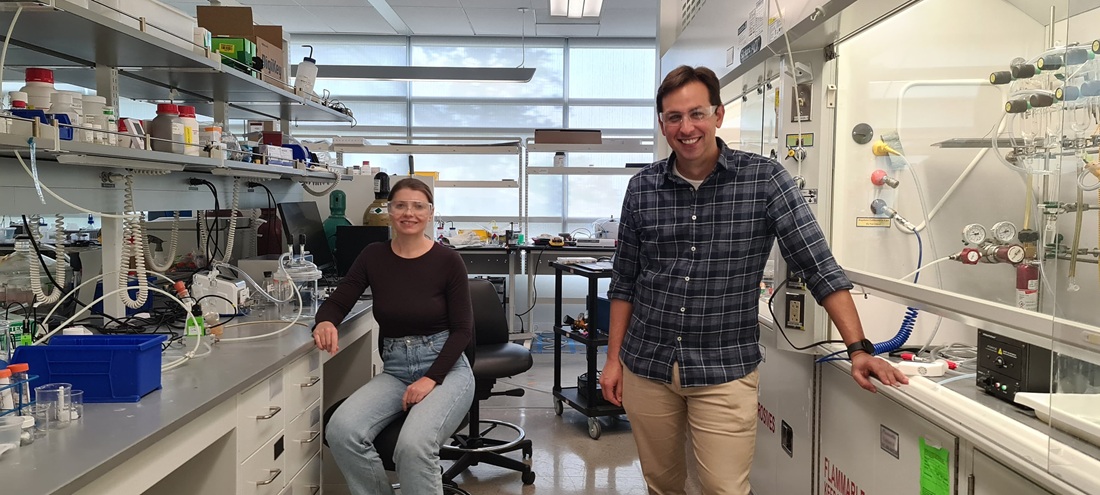
The research was led by Bordallo's group at the University of Copenhagen in collaboration with her group members, Karina Kovalchuk and Leander Michels at Lawrence Berkeley National Laboratory (LBNL).
Degasser in food packaging
According to the researchers, the research results provide a kind of design manual for how to develop sustainable materials for food packaging that tackle the problem of ethylene.
"We imagine small bags or pads of powdered clay that can be placed with fruit and vegetables during transport and absorb ethylene - in the same way as the moisture-absorbing silica bags that often come in the packaging when you buy, for example, shoes and electronics," says Karina Kovalchuk.
- The scientific article about the study has been published in the journal Applied Surface Science Advances.
- The following researchers have contributed: Karina Kovalchuk and Leander Michels from Lawrence Berkeley National Laboratory, USA; Will Gates from Deakin University, Australia; Murillo Martins from Oak Ridge National Laboratory, USA, GW Greene from La Trobe University, Australia and Heloisa N. Bordallo from the University of Copenhagen.
- The research is supported by the Laboratory Directed Research and Development (LDRD) Program of Lawrence Berkeley National Laboratory and the Carlsberg Foundation.
The research group is currently working on optimizing the chemical process to strike the right balance between effectiveness and environmental friendliness. They are also investigating whether they can make the clay capture even more ethylene and retain it for even longer. Next, the clay material will be tested in food packaging, and hopefully then the concept can be brought to market.
Two good purposes
The new material not only has the potential to reduce food waste. Another consequence of the ethylene problem and the long transport is that fruits often do not develop their full flavour. Much fruit is harvested early precisely to avoid them rotting along the way. But many processes in the fruit are thus not fully developed and cannot be 'caught up' fully later, even if the fruit ripens with ethylene during transport. And this affects the taste and aroma.
"If we manage to solve the problem with ethylene, it serves two good purposes. First, we can reduce the global problem of food waste. At the same time, it can make it possible to harvest fruit later in the ripening process, so that consumers get fruit that tastes as it should," concludes Heloisa Bordallo.
Although the study focuses on ethylene and food, the researchers point out that the research results may also have implications for other technologies where materials need to collect certain gases.


