
Archaeological work carried out at the Coves del Fem (Ulldemolins, Priorat)—located within the Serra de Montsant Natural Park—between 30 May and 28 June 2026, has yielded new evidence of exceptional interest for understanding the prehistory of the northeastern Iberian Peninsula. The campaign was conducted by a team of researchers from the Department of Prehistory at the Universitat Autònoma de Barcelona (UAB) and the Milà i Fontanals Institution for Research in the Humanities of the Spanish National Research Council (CSIC-IMF), with the support of the Ulldemolins Town Council and the Serra de Montsant Natural Park, as part of the four-year archaeology projects of the Catalan Ministry for Culture.
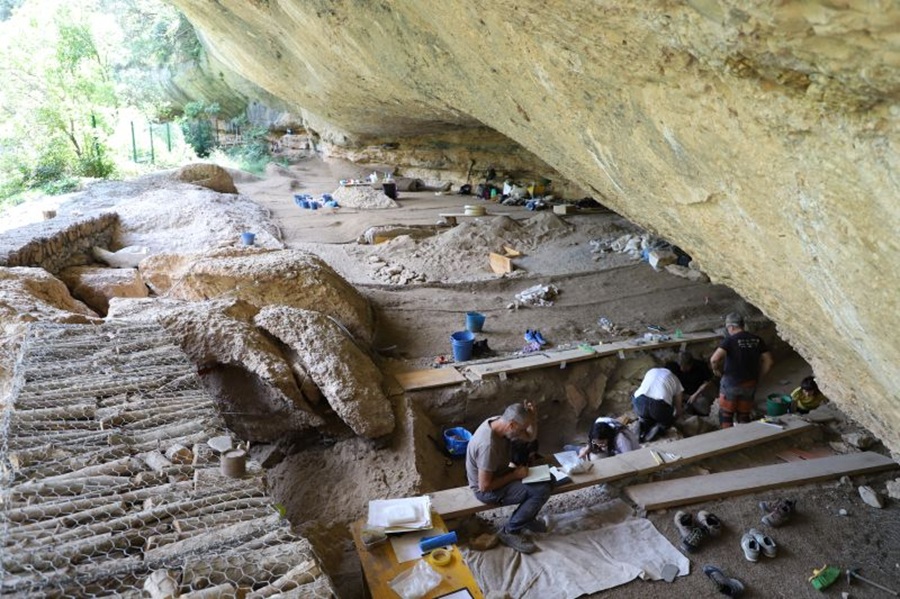
Twenty-five people participated over the course of the four-week dig, including lecturers, researchers, and students of the UAB bachelor's degree in Archaeology, who were able to carry out their practical fieldwork training.
A significant Early Neolithic Cardial occupation
The work carried out has revealed extensive occupation dating to the Early Neolithic Cardial period, characterised by the presence of two hearths and eight pits dug into the subsoil, interpreted as silos originally intended for storage. Once they ceased to serve this function, these structures were repurposed as disposal sites for domestic waste. Their fill deposits have yielded an abundant and diverse assemblage of archaeological materials, notably including decorated pottery fragments, flint tools and lithic debris, faunal remains from consumed animals, carbonised seeds and fruits, and other evidence linked to the daily activities of the early farming communities that inhabited the Montsant Valley.
This exceptional record allows for a deeper understanding of the economic practices, consumption habits, and lifestyles of these populations during the early stages of the Neolithic. The construction, use, and abandonment of these pits affected older, aceramic archaeological levels that, in all likelihood, correspond to Mesolithic occupations already identified in other sectors of the site.
Exceptionally well-preserved Mesolithic levels
One of the key contributions of the 2026 campaign has been the documentation of two exceptionally well-preserved Mesolithic layers, contrasting with the results of previous interventions. These layers feature three associated hearths and show excellent preservation of archaeological remains. Notable among the recovered materials are flint artifacts, faunal remains, and a significant assemblage of archaeobotanical remains; these will provide valuable information regarding the environmental setting and the activities of the final hunter-gatherer groups to inhabit the area.
A unique window into the process of Neolithisation
The excavation of these Mesolithic levels yields information of great interest, and not only for the study of the site itself. It also offers an exceptional opportunity to understand the socioeconomic changes that took place during the transition from the last hunter-gatherer groups to the first farming and herding communities in an inland mountain setting, such as the Montsant massif. This period of change, known as Neolithisation, remains poorly understood in the northeastern Iberian Peninsula due to the scarcity of sites preserving stratigraphic sequences as extensive and well-preserved as those at Coves del Fem.
Studying the recovered materials will provide deeper insight into subsistence strategies, mobility, natural resource exploitation, and the social transformations that accompanied the adoption of agriculture and livestock farming.
A key archaeological site in the Montsant massif
The Coves del Fem form a large rock shelter with a surface area of approximately 300 m², situated just above the course of the Montsant River within the municipality of Ulldemolins. The site has been the subject of ongoing archaeological excavations since 2013 and has become a key reference point for the study of recent prehistory in Catalonia, as it preserves an exceptional archaeological record documenting a pivotal—and hitherto little-known—period of social and economic transformation. Analysis of the materials recovered during recent archaeological work reinforces the site's status as a benchmark for studying the transition between the last hunter-gatherer societies and the first food-producing communities in the northeastern Iberian Peninsula.
The arcaheological digs carried out in recent years have made it possible to document almost uninterrupted human occupation spanning the Late Mesolithic (around 6000 BC) to the Early Neolithic (around 4500 BC), i.e., from the final occupations by hunter-gatherer groups to the arrival and establishment of the first farming communities in the area. Scattered traces of even earlier occupations have also been identified, possibly dating to the final stages of the Upper Paleolithic, as well as evidence from later prehistoric periods, such as the end of the Neolithic or the beginning of the Metal Age.
This continuity in human occupation—rare among Catalan sites of this period—makes Coves del Fem an exceptional observatory for analysing the cultural, technological, and economic transformations associated with the Neolithisation of the northeastern Iberian Peninsula.
This four-week dig campaign formed part of the four-year archaeology and paleontology research project "Coves del Fem: Land Use and Exploitation in the Upper Montsant Basin (8000–2000 BC)" (2026–2029), awarded to the UAB. The project aims to deepen the understanding of the human communities that inhabited this area during recent prehistory, as well as to comprehend how they used their surroundings, exploited resources, and impacted the landscape. The archaeological work has been made possible thanks to the Borrull family, owners of the Coves del Fem.


