A student who left Ukraine after war broke out has used her medical sciences training at the University of Exeter to create a new method of observing the behaviour of cells under the microscope, which scientists are now using in research.
Marta Tsybanova studied two years of a Medicine degree in her home country, when Russia invaded in early 2022. She leftn to study Medical Sciences (now renamed Biomedical Sciences) at Exeter, entering the second year based on her previous education.
Marta, 23, said: "I was really feeling the psychological pressure of the attacks and air raid sirens. It's constant, day and night. You can't rest or concentrate on studies. I felt unsafe, and I felt I could serve my country better by pursuing a career in science
"I've had great support at Exeter, and I felt I was fulfilling my potential. In Medical School we focus on how to treat disease, but here I was finding out more about the mechanism and how to prevent conditions. I really like this area of science."
During her Exeter degree, Marta's final year project was working with Professor Chris Scotton on research into the lung condition idiopathic pulmonary fibrosis. This condition is more prevalent in men, and the team has been researching the impact of testosterone and oestrogen on cells in the lab.
To see how lung cells grow and move, the team used a microscope system which took photos of the cells every 15 minutes for 2 days - but existing software struggled to assess groups of cells moving in unison. Marta used her knowledge from taking a computer coding module, which she built upon by exploring more resources, to develop a system to track clusters of cells. She said: It took a long time and lots of trouble-shooting, but it worked. Each experiment generates a huge amount of data - 60 GB. I once waited six hours just for the data to transfer."
Professor Chris Scotton said: "Marta's system works superbly, giving us some great insights into how these cells are behaving together. We're now planning to use her approach to analyse more data beyond the original project. Marta is extremely bright and highly motivated – we were all impressed by how she used her skills and initiative to problem solve, and ultimately create something we can continue to use in our work, to better understand and treat pulmonary fibrosis. It just goes to show the mutual benefit of lab experience during our undergraduate programmes."
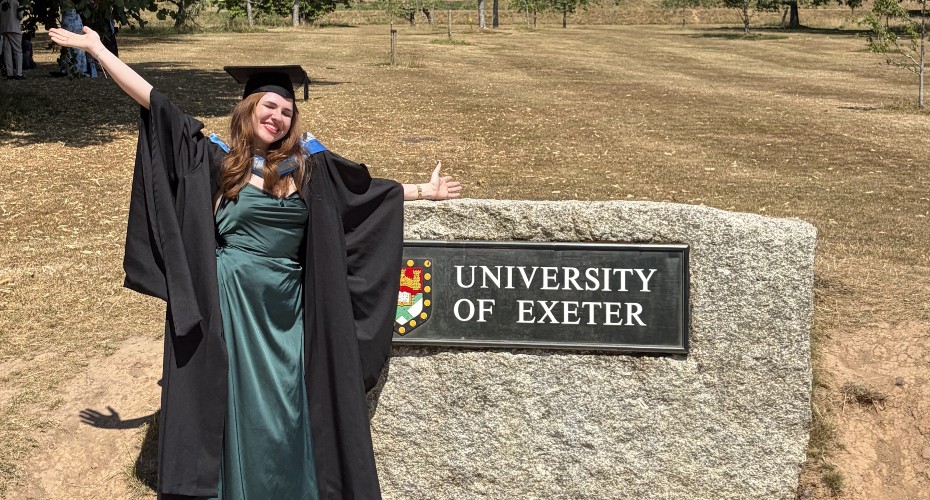
Marta, who also works as a healthcare assistant in a residential home, feels she now has insight into disease from multiple angles. She hopes to take this forward into her future studies, and is applying to undertake a PhD at Exeter. "My degree went by so quickly. I wanted to make some impact. It's s great to develop skills, and I'm proud that what I did may lead to discoveries that ultimately benefit patients in future."