
Carlyn Scott, College of Marine Science
Under clear blue skies on a bright morning, researchers from the University of South Florida gather at wooden docks on Virginia Key, preparing for a science expedition. A pickup truck sporting the Florida Fish and Wildlife logo backs up to the pier, and with practiced efficiency, the team unloads equipment onto the deck of the Walton Smith, a vessel operated by the University of Miami, one of the partners on the research cruise. The crew trades updates after two months apart as they embark on another trip around South Florida.
In the tight quarters of the ship's lab space, crew members from five research institutions maneuver around bodies and instruments, securing their beakers, filtration set ups, pipettes, microscopes, and computers before the ship sets out on the waves. They take turns with the ethanol and deionized water station, careful not to interfere with each other's research. They exchange plans and sleep schedules and set in for their 12-hour shifts.
Among the science party is Sebastian Di Geronimo. A graduate of the University of South Florida College of Marine Science with 37 cruises under his belt, Di Geronimo now serves as a scientific technician in the lab of Frank Muller-Karger, a USF Distinguished University Professor, where he works with samples collected on these cruises to determine the health of the waters around Florida. During a midnight shift in the wet lab, Di Geronimo brings a graduated cylinder with seawater to eye level, preparing a sample for filtration.
"We can use samples like this to look at which organisms are in the water, study how productive they are, and measure traits like size, color, and their genetic composition," he said.
Di Geronimo's research is part of the Marine Biodiversity Observation Network (MBON), a nation-wide collaboration that aims to measure and improve the health of ocean ecosystems. Every seven weeks for the past 10 years, the Southeast MBON regional partners have used these cruises to gather samples and many different types of data. The specialized techniques that are used by the science teams allow researchers to track biological changes off the coast of Florida that are invisible any other way.
Muller-Karger's lab, the Institute for Marine Remote Sensing, has been central to the national MBON effort, helping to coordinate between 10 different projects and collaborating state, federal, private, and academic research groups. The lab recently celebrated 10 years collecting data on behalf of MBON.
For the past 10 years, researchers from the University of South Florida College of Marine Science have joined bimonthly research cruises to assess the health of coastal waters in South Florida for the Marine Biodiversity Observation Network.
"The United States relies on this region for our economy, recreation, and food," said Muller-Karger, principal investigator for the Southeast MBON project. "Yet, if we don't continue to measure details about marine life that's out there, we can't tell if it's changing. We depend on the living and non-living things in the ocean, and it is essential for our own good to monitor them."
The Southeast MBON project builds on the South Florida Ecosystem Restoration (SFER) efforts spearheaded by the National Oceanic and Atmospheric Administration's Atlantic Oceanographic and Meteorological Laboratory (NOAA AOML). Expeditions for the SFER program began in 1998 to investigate coral bleaching in the Florida Keys. The science has expanded in scope, length, and partnerships. USF had been working with NOAA AOML on the SFER program since the late 1990's, along with the University of Miami, the Florida Fish and Wildlife Research Institute, Mote Marine Lab, and the Virginia Institute of Marine Science.
A team effort
Science seems always underway on the Walton Smith. Crew members on deck don hard hats and life vests as they deploy the conductivity, temperature, and depth (CTD) rosette sampler, a device equipped with sensors to measure physical, chemical, and biological data, along with Niskin bottles to collect water samples at discrete depths. Once the rosette is back on board, the group descends on the back deck to retrieve seawater samples from the bottles.
In the wet lab, researchers swirl beakers with seawater, empty the contents and swirl them again. Pressurized pumps pull samples through fine meshed filter pads, filling the room with a near-constant whir. Each of these tests generates valuable data that help identify stressors affecting corals, plankton, fish, and other marine life of the Florida Keys and the West Florida Shelf.
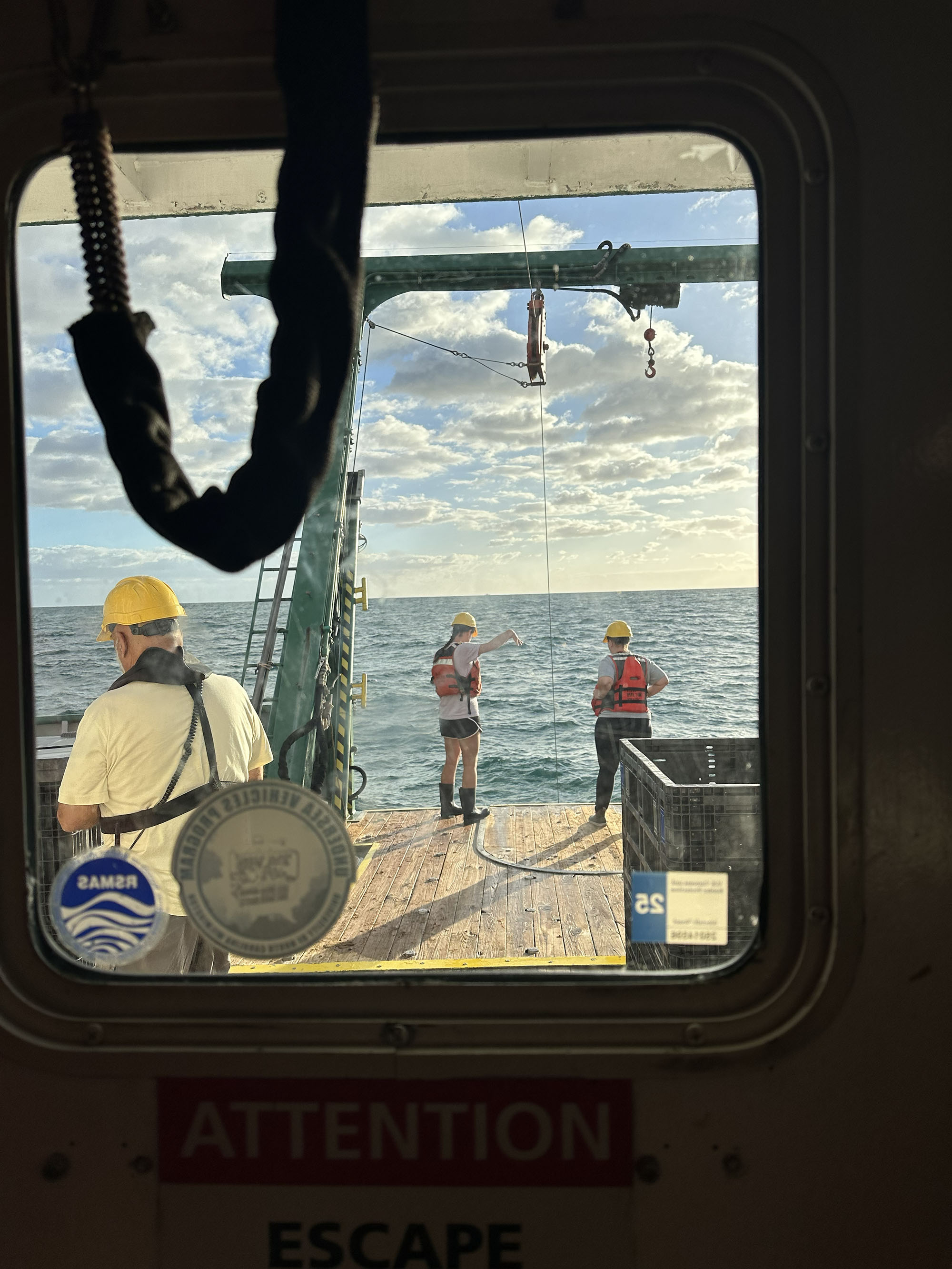
CTD rosettes are deployed throughout the cruise and are equipped with sensors that evaluate water conditions such as oxygen levels, temperature, and salinity.
Over the years, cruises by SFER and MBON have documented first-hand many stressors of South Florida that have offered valuable data on the health of the region. A series of red tide blooms starting in 2017 devasted marine life, was responsible for increased reports of asthma, and caused an estimated $2.7 billion in lost revenue for local economies. The record-breaking marine heat waves of 2023 and 2024 - and, more recently, the extreme cold wave of winter 2026 - have stressed coral reefs, turtles, manatees, and other organisms in the region. Extreme events, which are becoming more common, cause significant long-term impacts on marine life and resources.
Back in the wet lab, a map of Florida's west coast is taped above the USF filtration station. The map shows dots, crosses, and squares denoting where samples are collected along the route. With a black marker, Di Geronimo checks off stations as they're completed. As new research partners and techniques are included in the program, the map has become busier, with clusters nearly overlapping along the coastline.


