
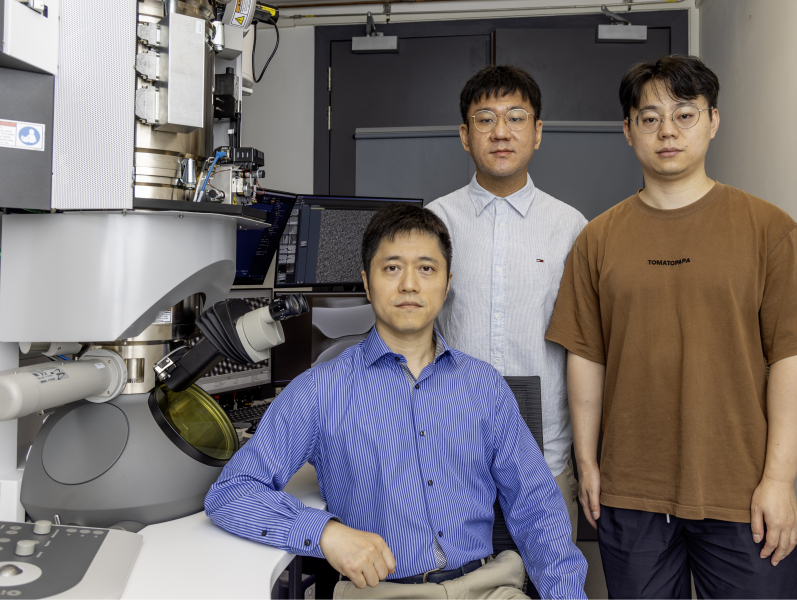
The research by members of the HKU Nanomechanics Laboratory, Professor Yang Lu (left), PhD student Mr Jiayi Li (center), and Dr Heyi Wang (right), has successfully bridged mechanical strain and lattice strains at the experimental physics level, providing significant guidance for strain engineering.
A research team led by Professor Yang Lu from the Department of Mechanical Engineering at the Faculty of Engineering, The University of Hong Kong (HKU), has achieved a breakthrough by uncovering the microscopic physical nature of ultralarge elasticity in covalent semiconductors such as silicon and diamond. This discovery provides crucial quantitative guidance for "Deep Elastic Strain Engineering" (DESE), paving the way for the development of next-generation electronic, optoelectronic, and quantum devices.
Despite the immense potential of DESE, the underlying deformation mechanisms of these covalent crystals have long remained elusive. The research team became the first to directly observe the pure lattice evolution of single-crystalline silicon and diamond under tension at the atomic scale. By precisely quantifying the resulting lattice strains, they successfully bridged macroscopic mechanical strain with microscopic lattice strain, establishing a solid physical foundation for the intelligent design of advanced semiconductor devices. The research team also includes PhD student Mr Jiayi Li and postdoctoral fellow Dr Heyi Wang.
Bulk covalent crystals have been widely considered as "hard and brittle" materials, often undergoing brittle fracture during mechanical loading. In recent years, Professor Lu's first experimentally demonstrated that covalent semiconductor materials such as silicon and diamond can achieve ultra large elastic strains approaching their theoretical limits at the micro/nanoscale (Science Advances 2, e1501382 (2016); Science 360, 300 (2018)). Subsequently, the team further proved that this extreme elastic deformation can bring disruptive physical properties, enabling dynamic, continuous, and reversible modulation of physical properties such as bandgap and optics (Science 371, 76 (2021); Physical Review X 16, 011014 (2026)). However, the underlying deformation mechanisms have remained elusive: whether this ultra large reversible deformation arises from pure atomic lattice displacements, or from atomic rearrangements (such as defects, phase changes, or super elasticity)? Direct, lattice-resolved measurements of deep elastic strain remain scarce.
To uncover its physical nature, the research team developed advanced in situ high-resolution transmission electron microscopy (in situ HRTEM) and in situ four-dimensional scanning transmission electron microscopy (in situ 4D-STEM) techniques for this study. At room temperature, they conducted uniaxial tensile testing on microfabricated single-crystalline silicon and single-crystalline diamond microbridges along the [100] and [110] directions. They not only tracked the distribution of deep-strained atomic coordinates in real-time and extracted lattice-resolved strain maps, but also successfully mapped high-precision elastic lattice strains across the entire sample with nanoscale spatial resolution and a wide field-of-view for both semiconductor crystals.
The study found that the ultra large tensile strains in silicon and diamond originate completely from reversible atomic lattice displacements. Experiments confirmed that, without any extended defects or phase changes, the crystal lattices of diamond and silicon can achieve sample-wide uniform elastic elongation of up to 8.9% and 11.3%, respectively. Additionally, by designing a strain-fixed silicon device and utilising monochromated electron energy loss spectroscopy spectrum imaging, the team verified a reduced bandgap in the uniformly elastic-strained silicon.
This work not only elucidates the physical nature of ultra large elasticity in covalent crystals, but also establishes a quantitative relationship between "macroscopic mechanical strain" and "microscopic lattice strain" and provides the accurate real atomic coordinates under deep strain.
Professor Yang Lu explained, "This finding represents a fundamental milestone in the field of strain engineering. In the future, to design more outstanding strained silicon or diamond microelectronic and photonic devices (such as achieving semiconductor-to-metal transitions and indirect-to-direct bandgap transitions—the "holy grail" in condensed matter physics and materials science), researchers can fully rely on these quantitative experimental results. This major discovery will strongly propel technological innovation based on deep elastic strain engineering, exerting a profound impact on future cutting-edge fields such as quantum information, advanced semiconductors, and photonic technologies."
The research findings were recently published in the premier physics journal Physical Review Letters under the title "Quantifying Lattice Strains in Elastically Deformed Covalent Crystals".
Paper link: https://journals.aps.org/prl/abstract/10.1103/3pvs-gdp8
About Professor Yang Lu
Professor Yang Lu is Chair Professor of Nanomechanics in the Department of Mechanical Engineering, and Kingboard Professor in Materials Engineering at The University of Hong Kong (HKU). In his current role, Professor Lu serves as Associate Dean (Mainland Affairs) in the Faculty of Engineering. Professor Lu is a leading expert in experimental nanomechanics and its interdisciplinary applications in materials engineering, advanced manufacturing, and semiconductor technologies. He has published more than 300 journal articles in peer-reviewed academic journals, including Science, Nature Materials, Nature Nanotechnology, etc., 2 book chapters and 7 US patents granted.


