
A research group from the UAB Faculty of Veterinary Medicine demonstrates that the proliferation of exotic vegetation is one of the main mechanisms explaining biological invasions.
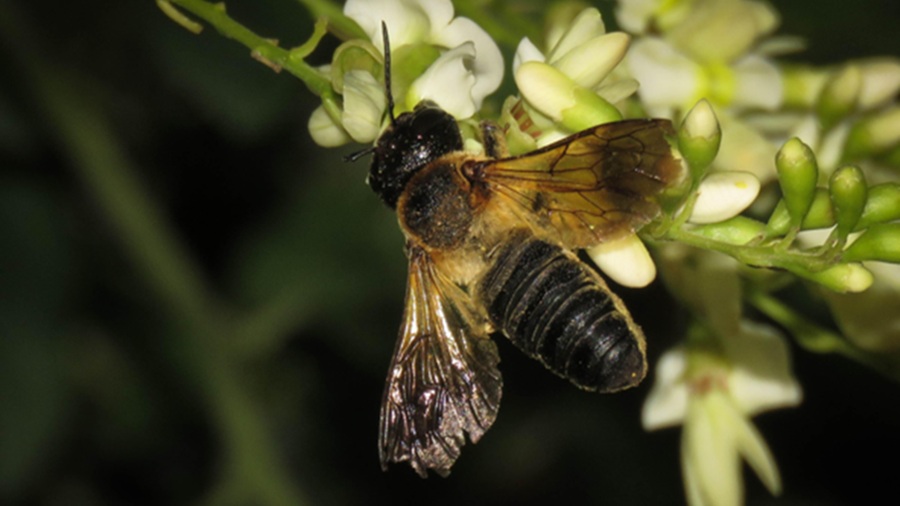
The giant resin bee (Megachile sculpturalis), native to Asia, is the first invasive bee documented in Europe. It is a solitary bee and does not form colonies; instead, all the females reproduce and establish their own nests. It is active in summer and is particularly large, reaching up to 2 cm in length. Outside its native region, it inhabits mainly urban areas, where for years it has been causing nuisance, primarily through its nesting activity in cavities in public infrastructures, private gardens, or trees (sometimes monumental ones) that the bee itself can bore into.
The Wildlife Pollinators research group, part of the Wildlife Ecology & Health of the UAB Faculty of Veterinary Medicine, has been studying the giant resin bee since its arrival on the Iberian Peninsula in 2018. Since then, they have sought to understand why the bee concentrates in cities rather than in more natural ecosystems, where resources would seemingly be more abundant and diverse. The answer may lie in a recurring pattern observed across Europe: both sightings of the bee in urban areas and analyses of the pollen it consumes point to an almost exclusive reliance on the flowers of ornamental trees—specifically the sophora tree, also known as the Japanese pagoda tree (Styphnolobium japonicum).
A tree very much present in our cities
Sophora is an exotic ornamental tree widely used in urban greening. Cities such as Barcelona and Viladecans have streets that are filled with these trees (around 11,000 and 1,000, respectively). It is a tree that blooms in summer, precisely when the giant resin bee is active. In its native region of Asia, this tree is one of the many trees that form part of the giant resin bee's diet. But the key point is that in Europe, because of its ornamental use, the sophora tree is the only abundant tree in this bee's diet.
To determine whether the tree facilitates the invasion of the giant resin bee, scientists compiled data from across Catalonia on the locations where the ornamental tree has been recorded and where the invasive bee has been sighted. They then built models to determine whether the giant resin bee's invasion depends on climatic conditions similar to those of its native range or, rather, on the presence of the sophora tree. The results indicate that both climate and the presence of the tree drive the invasion of the giant resin bee, but that climate tends to be a significant factor only when this tree is present. In other words, areas featuring sophora trees and climatic conditions similar to the bee's native range are more likely to be colonised by the giant resin bee. Indeed, the findings suggest that the invasion front—located in western Catalonia—is advancing thanks to the presence of this tree. These results demonstrate the importance of considering plant-animal interactions when studying potential biological invasions, particularly in urban landscapes.
A need to rethink urban green spaces
Cities have historically used exotic plants in streets, parks, and gardens for a variety of purposes, such as creating climate refuges, fostering biodiversity, and enhancing the aesthetics of public spaces. However, as this study demonstrates, the proliferation of exotic vegetation is a key driver of global biological invasions—a phenomenon that ranks among the leading causes of biodiversity loss worldwide. Biological invasions are not static processes; they can evolve over time, particularly in the context of climate change. An exotic plant that is currently non-invasive could become so in the future if ecological interactions favour its survival and reproduction. For instance, trees of the Ficus genus—which includes fig trees—rely on specific species of small wasps for pollination. Consequently, there are Ficus species that were cultivated as ornamental trees for years without causing any issues, but began spreading invasively beyond gardens following the accidental introduction of their pollinators.
The European Nature Restoration Regulation calls for the restoration of urban ecosystems by 2030. The main objectives include increasing the area of green spaces and the vegetation cover of cities. In light of these findings, cities must be aware of the risk posed by using exotic ornamental vegetation. Based on the research group's conclusions, invasive vegetation or species that promote invasions, such as the sophora tree, should be removed and the selection of native species should be prioritised to enhance ecosystem services and meet the ecological restoration objectives for cities set by the European Union. This challenge involves public investment in the restoration of urban ecosystems, but also in research into forestry and urban ecology and, above all, close collaboration between scientists and municipal technicians, including experts in the environment, gardening and landscaping.
Original article: Echeandía, D., Margalef-Marrasé, J., Riera, M., Belmonte, J., Lanner, J., Mader, S., & Hernández-Castellano, C. (2026). A plant–pollinator invasional meltdown: the Japanese pagoda tree Styphnolobium japonicum facilitates the invasion of the giant resin bee Megachile sculpturalis. Oikos, e12449. DOI: 10.1002/oik.12449


