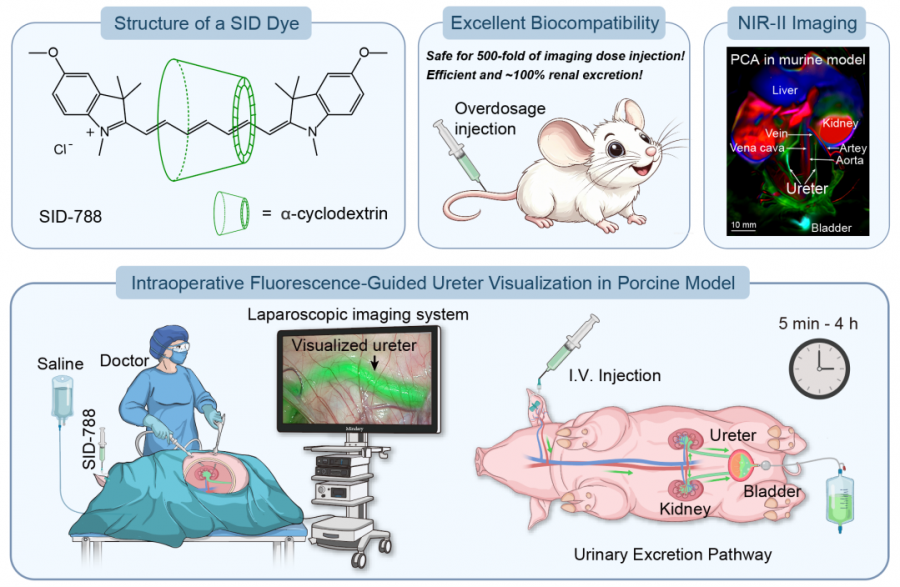
Top left: Structure of the super-inert near-infrared fluorescent rotaxane dye SID-788. Top middle: SID-788 is safe for overdosage injection (500-fold of imaging dose) and exhibits efficient and ~100% renal excretion. Top right: NIR-II imaging in murine model. Principal component analysis (PCA) of NIR-II video (5–40 s post-injection) reveal reveals haemodynamics in various vessels and organs. BottumBottom: Schematic diagram of surgical imaging workflow in porcine model. Image modified from Lu et al., Nat. Photon. (2026).
A cross-disciplinary research team led by Professor Hongjie DAI, Director of The Materials Institute of Life Sciences and Energy (MILES) of The University of Hong Kong (HKU) in Shenzhen, has developed a promising near-infrared (NIR) fluorescent dye for potential clinical application in ureter imaging during surgical navigation.
The novel dye, named SID-788, exhibits excellent biocompatibility and superior ureter imaging performance, enabling clear ureter visualisation for at least four to five hours in porcine model using clinical NIR laparoscopes and robotic surgical systems, a duration sufficient for most abdominopelvic surgical procedures.
Professor Dai is a Sapientia Eminence Professor and Chair Professor in the Department of Chemistry, Department of Mechanical Engineering and School of Biomedical Sciences. The study was conducted in collaboration with The University of Hong Kong-Shenzhen Hospital and Peking University First Hospital.
Challenges of traditional NIR fluorescent dyes for ureter imaging during surgical navigation
Clear visualisation of ureters is critical for avoiding injury during abdominopelvic surgery and for treating ureteral stenosis or obstruction. This requires fluorescent dyes that are highly water-soluble, safe for patients, show minimal unwanted binding to blood proteins or tissues, and are cleared almost entirely through the kidneys, achieving nearly complete renal excretion.
Many strategies have been explored to improve NIR fluorescent dyes for surgical imaging. For example, a benchmark NIR dye IRDye800CW containing multiple charged groups, has been extensively investigated in clinical trials. However, IRDye800CW has several limitations, including poor photostability, non-specific binding to proteins or tissues, and clearance through both biliary and renal pathways, which may reduce its specificity for highlighting the urinary system. Zwitterionic ZW800 improves renal clearance but its chemical stability and photostability are low. Therefore, there remains an urgent need to develop new NIR dyes that combine exceptional aqueous solubility, biocompatibility and stability with high imaging performance for clinical applications.
Super-Inert Near-Infrared Fluorescent Rotaxane Dye
Led by Professor Dai, this work innovated a near-neutral cyanine dye by threading it through an α-cyclodextrin ring, essentially dressing up the dye with a highly biocompatible α-cyclodextrin "cloth" to impart excellent aqueous solubility (~29 mg ml⁻¹) and super-inertness, i.e., exhibiting negligible binding and retention by serum proteins, organs and tissues. The dye undergoes complete renal excretion in its original form within hours after administration and exhibits superior stability in physiological conditions.
The resulting super-inert dye (SID), named SID-788, enables high-performance ureter imaging in mice and pigs using NIR-II (1000-3000 nm) wide-field and clinically approved NIR-I (800-1000 nm) laparoscopes and robotic surgical systems. Further, owing to the cyclodextrin ring protection of the dye backbone against chemical attacks, SID-788 exhibited superior chemical and photostability compared with existing NIR Dye. This work established that threading dye molecules through cyclodextrin provides a versatile strategy for engineering fluorescent probes with excellent biocompatibility, brightness and stability. In preclinical studies, SID-788 was well tolerated in mice at doses up to 500 times the standard imaging dose (0.5 mg kg⁻¹), paving the way for its potential clinical translation.
Professor Hongjie Dai commented, "Wrapping a molecule with a human compatible cyclodextrin ring is exciting in the NIR dye field. The development of SID-788 serves as a compelling example of integrating fundamental innovation with translational research. Through the novel molecular design, SID-788 possesses the properties long pursued by the NIR fluorescent dye field for decades, solving some of the long-standing problems in this field. More importantly, we have successfully accomplished gram-scale synthesis in our laboratory and are currently partnering with a CRO to advance toward kilogram-scale production for clinical translation."
This study is supported by the Materials Institute of Life Sciences and Energy (MILES) in Shenzhen, Hong Kong's Academic and Industry Sectors One-plus Scheme (RAISe+) and the JC STEM Lab of Nanoscience. The team's findings have been published in Nature Photonics.
The research team comprises the following HKU academics:
Professor Hongjie Dai, Sapientia Eminence Professor and Chair Professor, Department of Chemistry, Faculty of Science; Department of Mechanical Engineering, Faculty of Engineering; School of Biomedical Sciences, LKS Faculty of Medicine; and Materials Institute of Life Sciences and Energy (MILES), HKU.
Professor Kenneth Man-Chee Cheung, Jessie Ho Professor in Spine Surgery and Chair Professor, Department of Orthopaedics and Traumatology; and The University of Hong Kong-Shenzhen Hospital, HKU.
Professor Feifei Wang, Assistant Professor, Department of Electrical and Electronic Engineering, Faculty of Engineering; and Materials Institute of Life Sciences and Energy (MILES), HKU.
For more details, please refer to the journal paper "A super-inert near-infrared fluorescent rotaxane dye for surgical navigation" published in Nature Photonics. https://doi.org/10.1038/s41566-026-01945-9