
The clock starts ticking as soon as a potential donor organ or tissue is recovered. From that point, there are mere hours to find a match, get both the organ and recipient to the transplant site, and complete the surgery before the donor tissue is no longer viable.
That short window of time makes or breaks a potential transplant.
For patients waiting for a new lifesaving heart, liver, or kidney, or for service members wounded in combat who suffered lost limbs or traumatic facial injuries, the few hours may not be enough.
However, scientists at Johns Hopkins University and partner institutions around the country are conducting groundbreaking research that could extend the time donor organs or tissue can be preserved before a transplant. Additional research is exploring ways to reduce or eventually eliminate the regimens of anti-rejection medication to minimize harmful side effects of the drugs.

Separately, the two developments are both important, "but if you put them together, you can really open up new opportunities for the future," says Damon Cooney, associate professor of plastic and reconstructive surgery and clinical director of the Johns Hopkins Face Transplant Program.
The work is part of the Reconstructive Transplant Research Program, or RTRP, supported by critical grant funding from the United States Department of Defense. It could not only improve function and quality of life for wounded service members but also have significant impacts in civilian care.
"The breakthrough we're aiming for is that time would no longer matter in transplantation," says Gerald Brandacher, professor and scientific director of the Reconstructive Transplantation Program in the Department of Plastic and Reconstructive Surgery at Johns Hopkins University School of Medicine.
The typical method of keeping an organ on ice—often seen in medical movies and TV shows, with the organ carried in a cooler—is rather antiquated, Brandacher says. Using several new methods and machines could extend the preservation window from hours to days.
"Every aspect of a transplant is affected by the extreme time constraints," he says. "Going from hours to days would allow us to exchange organs nationally or globally, expand the donor pool, conduct better screening and find better matches, and pre-treat recipients before surgery. All would lead to significantly better outcomes."
Transformative surgeries
The RTRP includes Johns Hopkins and a consortium of universities and hospitals such as the University of Louisville, the University of Pittsburgh, UCLA, and the Cleveland Clinic. DOD has provided $29 million in collaborative RTRP funding since 2013, with close to $17 million directly awarded to Johns Hopkins in 24 separate awards.
The first hand transplant in the United States was completed at Louisville in 1999, according to Christina Kaufman, associate professor in the Department of Cardiovascular and Thoracic Surgery at the University of Louisville and scientific director of the UofL Health VCA Program. Kaufman, who participates in RTRP research, was involved in the 1999 transplant, studying immune response.
VCA stands for vascularized composite allografts, the type of complex reconstructive surgeries performed at Hopkins and elsewhere such as hand, face, or urogenital transplants. Unlike a liver or kidney transplant, these procedures require microsurgical techniques to connect nerves, muscles, blood vessels, skin, and sometimes bone, Brandacher says.
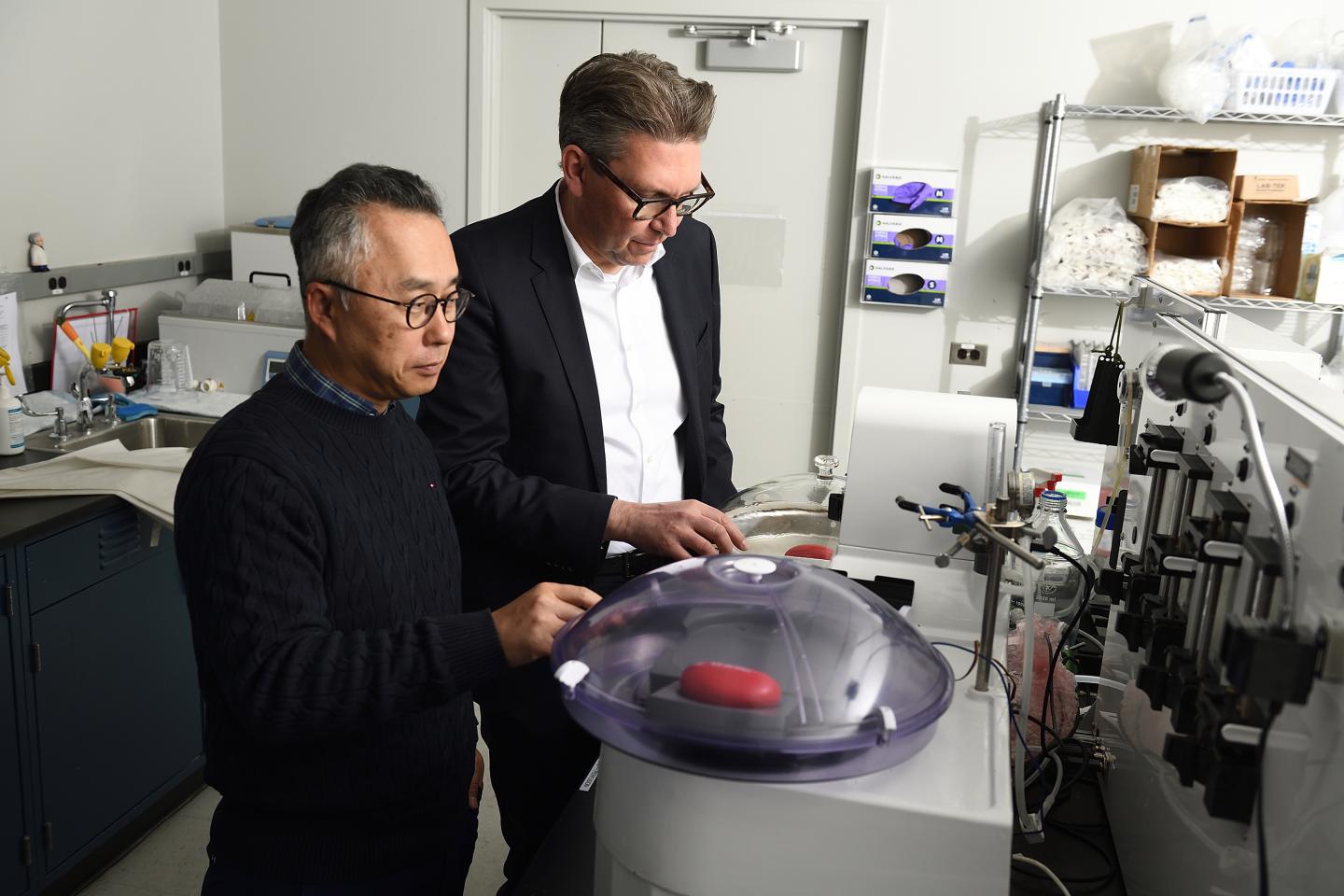
Image caption: Oh and Brandacher in their East Baltimore lab
Image credit: Will Kirk / Johns Hopkins University
"This is not just about appearance, it's about function," he says. "With a face transplant, often, you can't really breathe, you can't smell, you can't taste, because you're missing large parts of your face, and all those components can be restored with transplants. It's about regaining a normal life."
Cooney, a microsurgery specialist who performs VCA transplants in human patients as well as on animals in research trials, said it makes sense for the DOD to support VCA research. "These battlefield injuries are some of the most devastating injuries you can see, where reconstruction isn't possible and transplant is the only option," he says.
Extending the window
There are several methods being tested that extend the time organs and tissue can be preserved.
One is to store the organs at temperatures below freezing. However, the problem there is the formation of ice crystals that can damage tissue. Researchers are developing methods to store tissue at below freezing temperatures without the formation of ice, slowing down the metabolism of the tissue almost to a halt.
Another option is machine perfusion, which uses a machine with a specialized solution to keep the organ at temperature, oxygenation, and nutrient levels to maintain a physiological state outside of the body. Brandacher says the optimal method is a combination of the two.
Testing this process requires a phased approach. First is demonstrating proof of concept—that you can supercool and preserve the organs and use the machine to restore function outside the body. The next step is to test transplanting organs in animal models. Once that's successful and clears all the regulatory hurdles, they can test the technology for human transplants.
Because much of the RTRP research like this is translational—that is, it fills the gap between bench science and clinical implementation—there aren't usually a lot of funding options. That makes the DOD grants even more important, Cooney says.
According to Brandacher, the cooling technology has received FDA breakthrough device designation, and researchers are in the final steps of FDA clearance. They hope to begin clinical trials in humans with relatively "simple" kidney transplants some time in 2026, before moving to more complex VCA procedures.
"There have been times we've received calls with potential donors from California or Texas, and we've had to say no because there wouldn't be enough time," Cooney says. "Even a day or two would be dramatic improvement."
Benefits vs. risks
Another major research development relates to the immunosuppressive medications required for transplants. That's the focus of Byoung Chol Oh, assistant professor of plastic and reconstructive surgery at the Johns Hopkins School of Medicine.
Oh says transplant recipients typically take up to three different medications daily for the rest of their lives to prevent the immune system from rejecting the transplant. With the damage these medications can do to the immune system as well as other side effects, there is a risk-benefit calculation for non-life-saving transplants.
Hopkins researchers, though, have been able to infuse bone marrow from the donor into the recipient at the time of transplant, essentially creating a second immune system in the recipient's body.
"We were able to minimize to one daily medication," Oh says.
Cooney likened the process to reprogramming the body's immune system so that it no longer considers the transplanted part as foreign. "Right now, the benefit of the transplant has to outweigh the risk of the medication," he says. By decreasing the risk—by reducing or eventually eliminating the amount of immunosuppressants—that changes the risk-benefit calculation and would open the door for more transplant opportunities.
This is also where the preservation work and immunosuppression research can intersect. With more time before the surgery must occur, Cooney says, there is more time to pre-treat the recipient with bone marrow or specialized medications or even do treatments to the donor tissue itself. These are things that can't be done now because the surgery must be done immediately.
Oh's research continues to look at the underlying protocols of the medications and the role of the donor bone marrow in hopes of further minimizing immunosuppression. The work includes both translational research on animal models as well as using protocols with patients. With a PhD in immunology and an earlier background in veterinary medicine, it's a perfect match for Oh.
Kaufman, whose work also centers on immunology and the rejection aspect of transplants, said that with a VCA transplant, unlike an internal organ, you can sometimes see evidence of rejection early. That allows you to raise or lower the regimen of immunosuppressive drugs. It also has helped with her research to identify biomarkers that can predict or detect rejection, so there is still time to control it before damage is done.
Other members of the consortium are using DOD grants for several trials related to immunosuppressives—some testing specific regimens and another testing a standardized regimen.
"These injuries, especially to the face, can be so traumatic that it becomes a miserable existence," Kaufman says. "To restore that to a level of relative normal can be transformative. We don't understand what a gift it is being normal and how hard it is, especially in our society, to not be normal."


