The gloves are off. Seniors are reeling from the proposal to cut the private health rebate to pay for aged care (read about this here ).
But it's not just seniors who are angry at the Federal Government. The medical fraternity, via the Australian Medical Association, has also stepped up attacks in the face of government criticism of specialists.
They claim the real cost driver of rising specialist fees is the rising gap between what the government pays them via Medicare and the costs of running a specialist practice.
The latest iteration of their Gaps poster, which you may see next time you are in for a check-up, highlights the widening gap between Medicare, Average Weekly Earnings, and CPI since 1986 (See below).
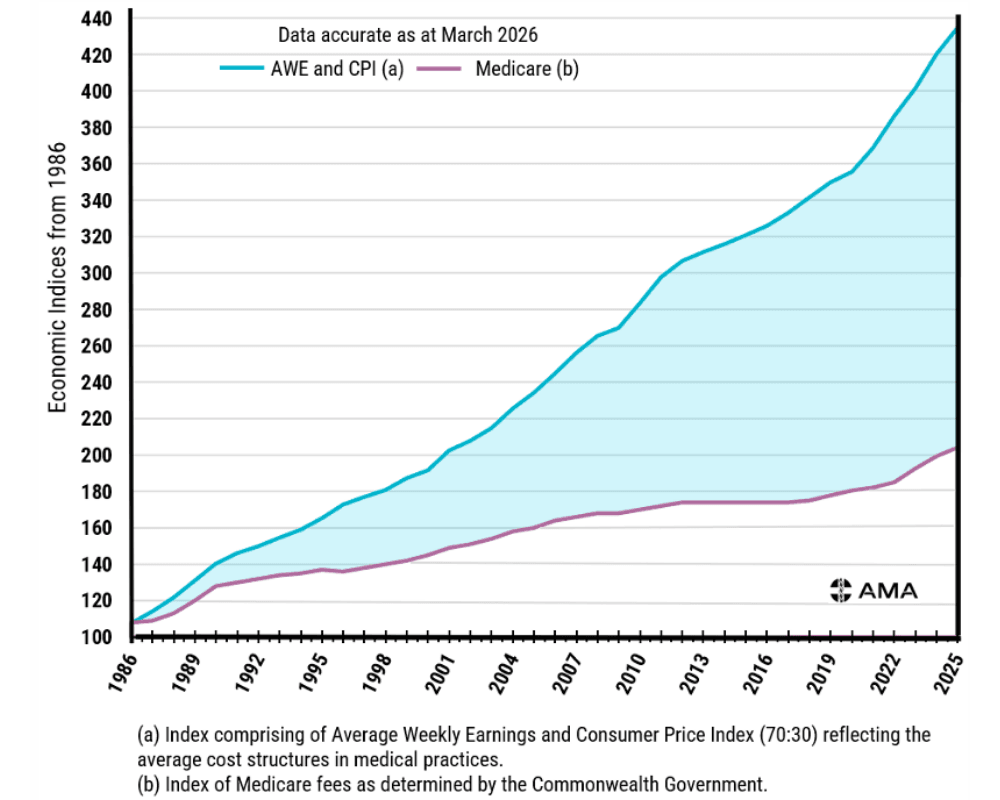
According to the AMA president, Dr Danielle McMullen, "We have had decades of under-indexation, and half a decade of a Medicare freeze, leaving the rebate woefully out of reach of covering the cost of care".
The AMA is calling on the federal government to make several policy changes to make health care more affordable for patients.
In non-GP specialist care the AMA is calling for:
Injections into Medicare rebates to doctors
Reform to the no-gap policy under private health insurance
An increase in the known gap rate
Better indexation and transparency of varying insurer rebates
A greater return of patients' premiums back to their healthcare.
Cut to private health insurance rebate
The Federal Budget next week will confirm a cut to the Private Health Insurance rebate for seniors.
Higher rebates for seniors were introduced to increase the number of people using private health. Rebates for seniors will be reduced to the amount offered to people under 65. This will increase the cost of an annual policy by hundreds of dollars a year.
Higher premiums for seniors could result in significant numbers of older people dropping or downgrading their policy, with pensioners and part-pensioners most likely affected.
NSA has created a new estimator to show how much more you might pay because of the cut to the health insurance rebate.
Supply and demand of specialists
While the amount government pays specialists is clearly part of the problem, are there other factors at play?
The ageing of the population has placed significant demand on health services in Australia. Ageing is associated with greater need and use of health care services.
But are we supplying enough specialists to meet this rising demand?
According to the Grattan Institute , the simple answer is no.
This is partly related to the length of time that it takes to train specialists, which can take at least 12 years!
But that isn't the only issue. As Grattan claims, government-funded training places are determined by specialist colleges, which approve training places.
Curiously, though, the AMA was silent on this issue when discussing the cause of rising specialist fees.
According to the vice president of AMA NSW, Dr Fred Betros, "Private specialist fees reflect the real cost of delivering care, including employing nurses, allied health and reception staff, medical and IT equipment, and the cost of running a modern practice which delivers excellence, as well as increasing indemnity costs".
But surely supply and demand has some bearing on the price patients pay for medical services.
For example, one of the areas with rising fees is anaesthesiology. According to ATO income data (see Table 5), there were 3,658 anaesthetists in 2022-24 compared to 2,685 anaesthetists in 2010-11 - an increase of 26.5%. Yet over this same time period, the Australian population of people aged 65 and over increased by 49.8%!
On face value that appears to be a significant difference between supply and demand.
It's questions like this that can only be fully understood by conducting a full review of the private health system - including the processes colleges use to determine training places.
This review is something that NSA has been calling for over several years and will help shed light on the cost drivers in this sector to hopefully identify solutions.
To support our call for a review of private health, join our Health Costs campaign today.