
From the tragedy of the space shuttle Columbia disaster in 2003 to the now-routine return of commercial spacecraft, heat shields - formally called thermal protection systems - are critical for protecting vehicles from the intense heat and friction of atmospheric reentry or traveling at many times the speed of sound.
Now, a team of engineers at Sandia National Laboratories have developed ways to rapidly evaluate new thermal protection materials for hypersonic vehicles. Their three-year research project combined computer modeling, laboratory experiments and flight testing to better understand how heat shields behave under extreme temperatures and pressures, and to predict their performance much faster than before.
Hypersonic flight means traveling at speeds of at least five times faster than the speed of sound, or more than 3,800 miles per hour. Other vehicles, such as ballistic missiles, can travel this fast, but hypersonic vehicles are far more maneuverable and unpredictable, making them harder to intercept. Unlike reusable spacecraft, the thermal protection systems used on U.S. hypersonic missiles - which solely deliver conventional weapons - are designed for a single use.
"This project came about because I was talking with Jon Murray one day and he told me he needed to predict the response of heat shields more rapidly to assist his Department of Defense customers," said Justin Wagner, an aerospace engineer and the project's lead researcher. "He said 'Can we find a way to use the science tools that are being developed here and combine that with our systems integration know-how?' Ultimately, the project is focused on trying to understand what will happen in flight more quickly. It will limit how many materials we need to qualify and help us understand them better."
The project tested materials ranging from common graphite - the same carbon used in No. 2 pencils - to more exotic carbon-based and ceramic composites. Hundreds of samples were made by the materials science team led by Sandia researcher Bernadette Hernandez-Sanchez, with contributions from Oak Ridge National Laboratory.
Laboratory tests on the ground
The intense shock of reentry comes from distinctive aerodynamics that include high temperature, intense pressure and vibration. These conditions are impossible to replicate completely on the ground, but researchers can create experiments that mimic portions, Wagner said.
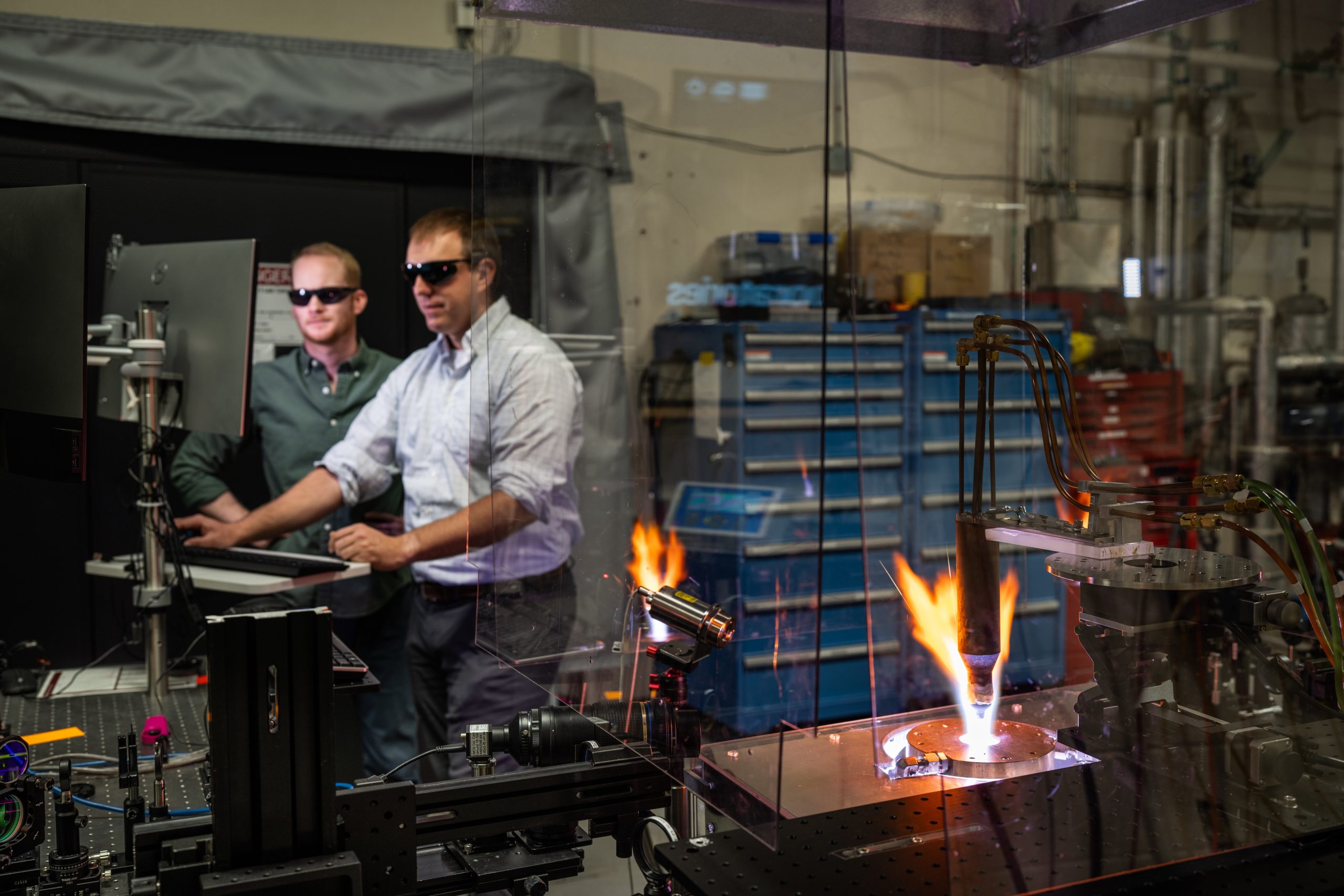
For example, the team used an inductively coupled plasma torch to study the chemical and physical changes in small samples of heat-shield materials as they burn up, or ablate. They recently shared their results in the American Institute of Aeronautics and Astronautics Journal. For this experiment, the researchers scorched materials with plasma hotter than the surface of the sun. This work was primarily done at the University of Texas at Austin, Wagner said.
To test larger slabs of potential heat shields, the team turned to Sandia's National Solar Thermal Test Facility, which uses sunlight concentrated by a field of mirrors to generate extreme temperatures. The team also used a hypersonic shock tunnel to mimic the aerodynamics of flying at Mach 10. The tunnel can produce both extremely high temperatures and Mach-velocity gas bursts, but only for a fraction of a second.
The researchers compared the results to advanced ablation models developed by collaborators at the University of Minnesota Twin Cities. Additional materials science data came from collaborators at the University of Colorado Boulder, University of Illinois Urbana-Champaign and Kratos Inc., Wagner said.
Building better, faster models
The modeling team, led by chemical engineer Scott Roberts, used data from the lab experiments to develop a computer model of the heat-shield material properties, aerodynamics and heat-transfer physics of a hypersonic vehicle in flight.
Then a team led by aerospace engineer Jon Murray took the results of the full-physics model to train a reduced-order model.
If the full-physics model is a bitmap version of an image - a file that contains data for each pixel - the reduced-order model is like a JPEG, which still shows the important features while compressing the less important areas, Murray explained. The big challenge was determining the best method to identify the most important features and the equations that best describe their behavior, he added.
Murray's team trained the reduced-order model on several sets of results from the full-physics model, using machine learning to identify the important features, he said. The resulting model was 90% accurate compared to the full-physics model for missions and vehicle designs similar to those trained upon, Wagner added.
The reduced-order model can simulate the response of a heat-shield material thousands of times faster. While the full-physics model can take days to produce results on a supercomputer, the reduced-order model produces results in seconds on a desktop computer, Murray said. This allows researchers to rapidly design vehicles for new missions or assess whether an existing design would work for a new mission.
"What we're trying to do is make it seamless to go from the full-physics model to this reduced-order model so that any time they make a change in the properties of the heat-shield material in the full model, we can incorporate that in a more or less automated retraining of the reduced-order model," Murray said.
Validating via flight tests
To demonstrate the credibility of both models, the team flew samples of the heat-shield materials on rockets.
"Flight tests are really important because they provide the actual environment you're trying to qualify these materials for," said aerospace engineer Katya Casper, who coordinated the flight testing. "While we do our best to replicate pieces of flight on the ground, we can't replicate everything at the same time. Flight gets you everything."
So far, the team has flown samples on two suborbital rocket launches through the Multi-Service Advanced Capability Hypersonics Test Bed program. These rockets host experiments from 10 to 20 research teams per mission, as each launch is expensive, she added.
For the test flights, the team used samples ranging from the size of a quarter to 4-inch-long wedges. Both sizes were outfitted with temperature sensors to track how hot the materials got during flight.
The flight test team also included sensors to study chemical changes that occurred during flight to validate the results from ground-based experiments. The first flight included an optical emission spectrometer, and the second flight included a laser absorption spectroscopy system developed in partnership with Purdue University and PSE Technology, Casper said.
Next, the team will test a new tile built with multiple material samples and temperature sensors on the nose of a reentry capsule scheduled to launch in summer 2026. This will be an Air Force Research Laboratory-sponsored test flight through the Prometheus program.
"This flight is exciting because if all goes well, we'll get the tile with the samples back," Casper said. "We'll get to see what it looks like and characterize the materials afterwards." This includes measuring how much material ablated away and studying the chemistry of the remaining material to add even more credibility to the models.
The project was funded by Sandia's Laboratory Directed Research and Development program.


