

<(From Upper Left) Professor Ja Yil Lee, Professor Gwangrog Lee, Professor Jejoong Yoo, (From Bottom Left) Ph.D candidate Subin Kim, Dr. Donghun Lee, Ph.D candidate Gyeongpil Jo>
DNA is the blueprint of the human body. However, tens of thousands of DNA lesions occur in our bodies every day. In particular, if "apurinic/apyrimidinic sites" (AP sites, damaged sites where one letter of DNA information has been erased) are not properly repaired, they can lead to cancer and aging. Finding these tiny damaged sites within the vast genome is as difficult as "finding a single needle in Seoul." Korean researchers have uncovered the secret of how a DNA repair enzyme rapidly searches for damaged sites by sliding along DNA.
KAIST (President Kwang Hyung Lee) announced on the 4th of June that a research team led by Professor Gwangrog Lee of the Department of Biological Sciences, together with Professor Ja Yil Lee's team at UNIST (President Jong Rae Park) and Professor Jejoong Yoo's team at Sungkyunkwan University (President Jibeom Yoo), has identified the precise molecular mechanism by which the DNA repair enzyme "APE1" (apurinic/apyrimidinic endonuclease 1, an enzyme that recognizes DNA damage sites and initiates repair) detects damaged DNA.
The research team tracked the movement of APE1 in real time by combining single-molecule FRET (smFRET, an analytical technique that observes the movement and structural changes of single biomolecules in real time), DNA curtain technology (a technique that aligns multiple strands of DNA to observe their interactions with proteins), and molecular dynamics (MD, a simulation method that calculates molecular movement using computers).
As a result, the team found that APE1 does not search DNA randomly, but instead uses a "one-dimensional diffusion" strategy (a method of searching by moving along the DNA strand), sliding along the DNA to find damaged sites.
This is similar to an intelligent inspection robot moving through a maze-like network of underground pipes beneath a huge city to detect a tiny leak. Instead of searching aimlessly from place to place, the enzyme moves efficiently along the "genomic highway" of DNA to quickly locate damaged sites.
In particular, the research team also found that the enzyme's flexible end region, known as an "intrinsically disordered region" (IDR, a protein segment that moves freely without a fixed structure), plays a key role in the DNA search process.
This intrinsically disordered region acts like a hook that holds onto DNA, helping APE1 remain on the DNA and move along it for a long time without falling off. In fact, when the research team removed this region, the enzyme's ability to find damaged sites decreased by more than fivefold.
The researchers also confirmed that magnesium ions (Mg²⁺, metal ions that assist various enzymatic reactions inside cells) are not merely auxiliary factors, but key elements that increase the efficiency of DNA search. Magnesium ions were found to stabilize the binding between APE1 and DNA, helping the enzyme move more effectively along DNA.
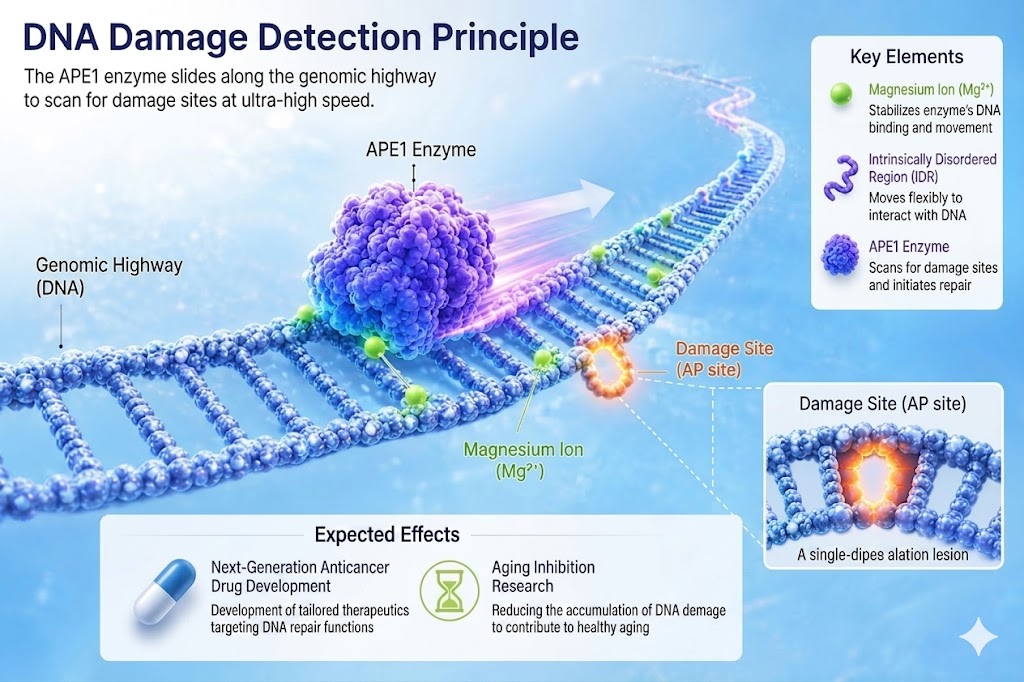
< Research Image (AI-Generated Image) >
Professor Gwangrog Lee of KAIST explained, "This study identified the mechanism by which a biomolecule rapidly searches for DNA damage through an intrinsically disordered region (IDR), and then operates precisely through a structured region," adding, "This principle could provide a key clue for developing next-generation anticancer drugs that disable DNA repair functions in cancer cells, as well as for research on suppressing aging." Professor Ja Yil Lee of UNIST emphasized, "This study is significant in that it revealed that an intrinsically disordered region, which moves flexibly without a fixed structure and interacts with various molecules, plays a key role in finding DNA damage sites."
This study, with KAIST Dr. Donghun Lee, UNIST doctoral student Subin Kim, and Sungkyunkwan University doctoral student Gyeongpil Jo as co-first authors, was published on May 14 in the world-renowned international journal Nucleic Acids Research.
※ Paper title: "APE1 Coordinates Its Disordered Region and Metal Cofactors to Drive Genome Surveillance," DOI: org/10.1093/nar/gkag479
This research was supported by the KAIST Grand Challenge 30 Project (KC30), the National Research Foundation of Korea's Core Synthetic Biology Technology Development Program, Mid-Career Researcher Program, Basic Research Laboratory Program, the Korea Drug Development Fund's Drug Development Foundation Expansion Research Program, the Institute for Basic Science (IBS), and the Institute of Information & Communications Technology Planning & Evaluation (IITP)'s Advanced AI Source Technology Development Program.


