
Whether it's neurons responding to electrical signals or plants stretching towards light, nature is filled with examples of biological materials that respond to their environment. Now, researchers want to develop new responsive materials for a wide range of applications, such as sensing, or low-energy technologies. However, achieving a balance of useful properties at the molecular level is challenging.
Published in Chemical Science, researchers at the Okinawa Institute of Science and Technology (OIST) have designed and synthesized new multi-functional compounds that change structure under UV light. Depending on the light conditions, the molecules reversibly switch between two stable forms through a ring-opening and ring-closing reaction. These molecular switches have a range of desirable properties, for example glowing with fluorescence after their structure changes, making it easy to see which state the molecule is in.
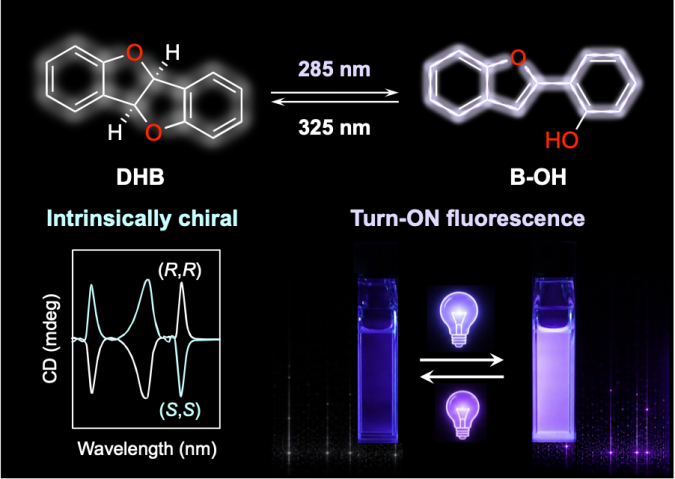
Professor Christine Luscombe, head of OIST's Pi-Conjugated Polymers Unit and senior author of this study, comments, "Optical and smart technologies require materials that respond to light and other external stimuli. By designing new molecular switches and understanding the mechanisms by which they change their structure and properties, this research provides new insights into the development of multifunctional photoresponsive materials."
In the paper, the team also demonstrated directionally-selective control of the ring-opening reaction, incorporating different side groups into the starting molecule to selectively make different products.
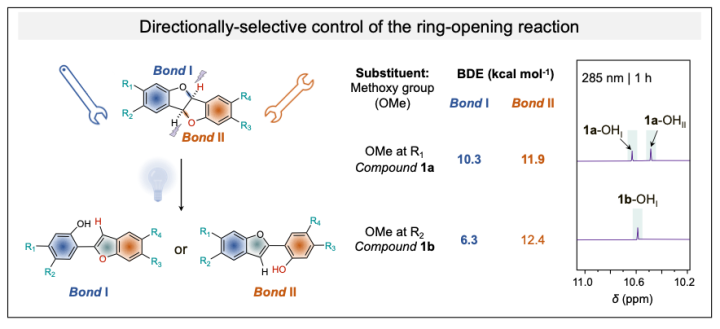
This study was supported by interdisciplinary collaboration between several OIST Units and Core Facilities members. First author Dr. Fathy Hassan comments, "By combining organic synthesis, computational chemistry, spectroscopy, crystallography, and advanced characterization techniques, we gained a deeper understanding of the structure, mechanism, and properties of the molecular switch."
The authors now plan to embed their molecular switches within larger polymers to create new materials. They hope to explore the potential applications of these in responsive and photonic systems.


