
Extreme heat is not only making cities less liveable; it is also reshaping who can afford to live where. The highest levels of vulnerability to climate gentrification are no longer found in the urban core, but in the metropolitan periphery.
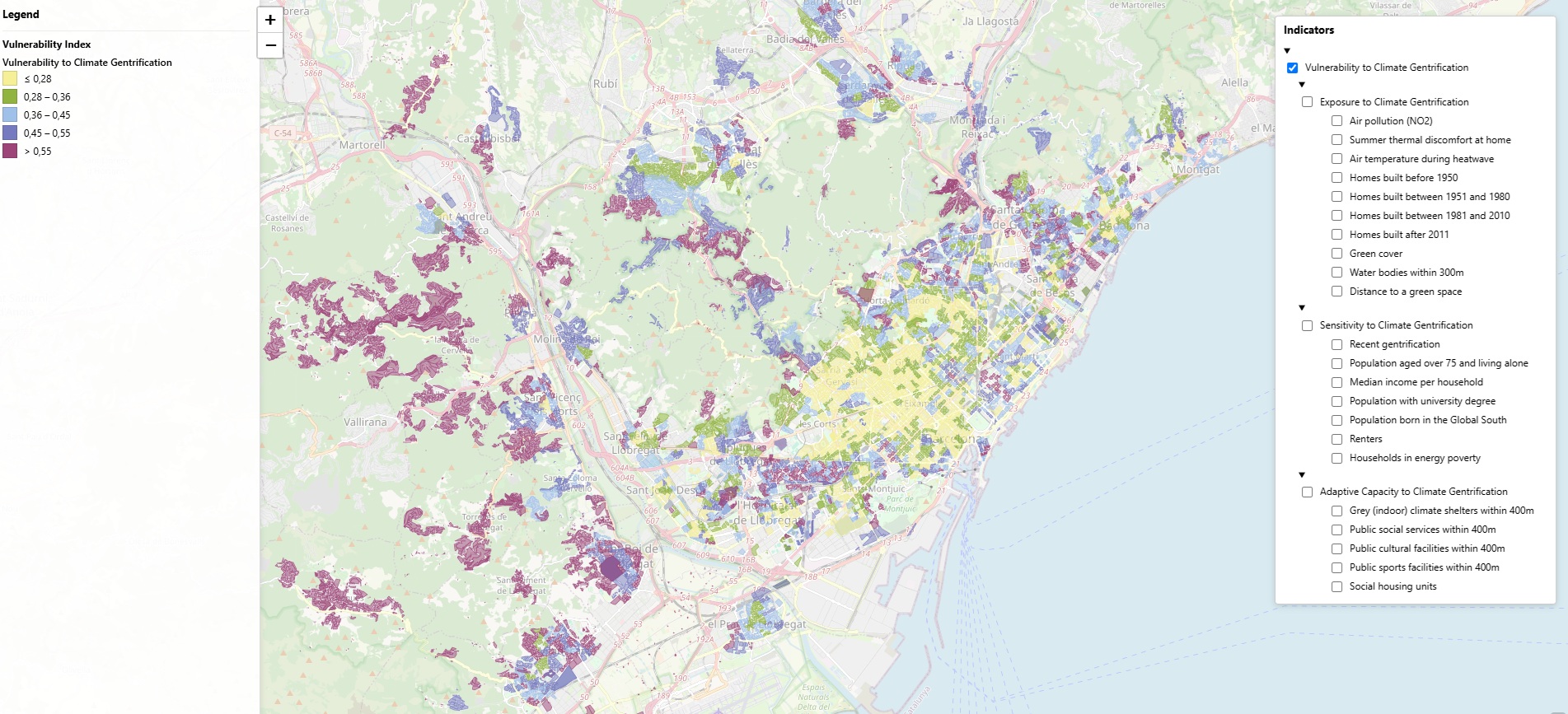
Researchers at ICTA-UAB have published the first freely accessible public tool that allows users to explore, neighbourhood by neighbourhood and block by block, vulnerability to climate gentrification across 36 municipalities in the Barcelona metropolitan area.
To help anticipate this process, researchers at the Institute of Environmental Science and Technology of the Universitat Autònoma de Barcelona (ICTA-UAB) have developed the first metropolitan climate and housing vulnerability index for Barcelona, with data that can be explored street by street across 36 municipalities.
The ClimateJusticeReady project team, led by the Barcelona Lab for Urban Environmental Justice and Sustainability (BCNUEJ) at ICTA-UAB, has just launched an open-access platform featuring the first climate gentrification vulnerability index for the Barcelona metropolitan area, with data available at census tract level, corresponding almost to a single city block. ClimateJusticeReady, led by Isabelle Anguelovski and Amalia Calderón-Argelich, with analysis by Lisa Hannuschke, was carried out in collaboration with the Sindicat de Llogateres de Catalunya, a civic organisation that defends tenants' rights, and the Technical Project Management Section of the Climate Change and Air Quality Office of the Barcelona Metropolitan Area (AMB).
The platform provides public access to dozens of environmental, social and housing indicators for every census tract across 36 metropolitan municipalities. This is the first time that this level of detail and this combination of variables—heat exposure, access to green spaces, social vulnerability, year of building construction, and public facilities—have been made available in a single place, in a visual and immediately accessible format.
Any neighbourhood association, municipal technician or resident can access the platform, search for their neighbourhood and see how it compares with others. Until now, obtaining the information provided by these data required combining multiple administrative sources; now it can be consulted in seconds.
The surprising finding: the risk is not where we thought
The index results point to a reality that is quite unexpected for the researchers. The most vulnerable areas for climate gentrification are not the hottest and most established urban centres, where gentrification processes generally occur, but rather the metropolitan periphery: greener, less densely populated, well-connected municipalities that have historically remained outside the focus of speculation or commercial and tourism-driven gentrification. Precisely because of these characteristics (being cooler, less dense, less polluted, having better-quality buildings, and being more affordable), they could become the new destination for those seeking to escape the heat and high prices of the city centre. Without policies to anticipate this shift, the same inequalities are likely to be reproduced in new areas. Particularly vulnerable to climate gentrification are several municipalities on the metropolitan periphery, including Badia del Vallès, Sant Adrià del Besòs, Castelldefels, Valldoreix (in Sant Cugat del Vallès), as well as parts of Sant Boi de Llobregat and Torrelles de Llobregat.
Climate gentrification: a concept for understanding what is already happening
There is growing discussion about how Barcelona's high housing prices are shifting demand towards nearby municipalities in the metropolitan area. The researchers point out that there is another factor that could further intensify this process: adaptation to climate impacts such as heat and flooding.
Climate gentrification describes the process by which municipal investment in heat adaptation infrastructure, such as green spaces or the restoration of waterways, coastal areas or buildings, can ultimately increase housing costs in these neighbourhoods and displace the vulnerable populations living there. The phenomenon has been documented in cities such as Boston and Miami (linked to frequent flooding and sea-level rise), and this project is among the first to examine it systematically in the European Mediterranean context.
"It is important to consider that, as climate change brings us longer and more intense heatwaves in homes that are not prepared for them, people's priorities may change. Areas where gentrification has not previously been part of the conversation may now become highly attractive from an environmental and thermal comfort perspective," explains Amalia Calderón Argelich. "The problem is that this could happen in municipalities that are not prepared to manage everything it may entail in terms of social inequalities and displacement."
About the project
ClimateJusticeReady is a research project by BCNUEJ-ICTA-UAB funded by the European Research Council. The index results have been published in the Journal of City Climate Policy and Economy. The platform, maps and project materials are available at: www.bcnuej.org/feature-climatejusticeready


