
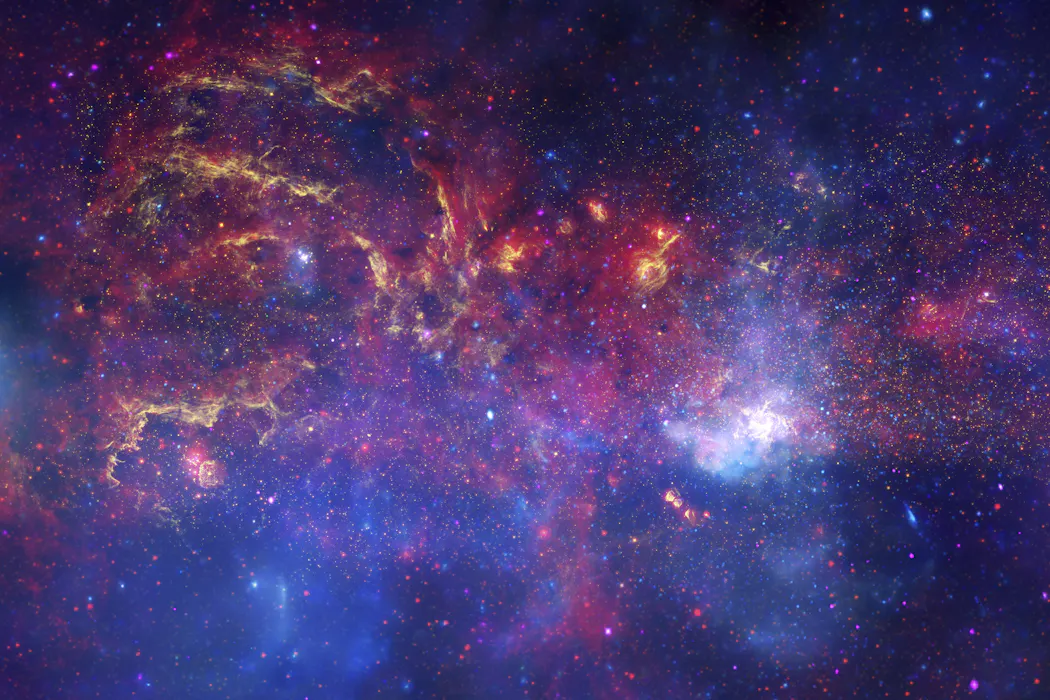
Vasily Belokurov is one of three winners of the 2026 Kavli Prize in Astrophysics. The award is for "uncovering the fossil evidence of past mergers proving that the Milky Way galaxy" was built through the continuous collision and merging of smaller objects.
No matter the time or vantage point, from a pre-Neolithic cave to a post-lockdown London high-rise, the predictability of the night sky has always been humanity's symbol of permanence and reassuring stability.
Yet this apparent calm is deceptive. Our galaxy, the Milky Way, emerged from chaos and turbulence , and its constellations are full of migrants, exiles and survivors. Right now, it has begun to stretch and distort again , pulled by a massive companion and heading for an inevitable collision.
How can I be so sure? As a galactic archaeologist , my job is to reconstruct the past of our galaxy and read the signs of its future.
Instead of digging through soil, I use the laws of dynamics and stellar evolution to sift through hundreds of millions of stars - searching for the most ancient and chemically peculiar among them, interpreting their orbits and piecing together the events that shaped the Milky Way. One ancient encounter left scars so deep that, billions of years later, they still define the galaxy around us.
I want to understand what governs the lives of these massive cosmic systems: which changes are nature - the slow internal evolution of a galaxy disc - and which are nurture, imposed by collisions and mergers.
Questions about the source of dark matter underpin it all. This is the invisible substance whose gravity holds galaxies together, but whose true identity remains one of the greatest unsolved puzzles in astrophysics.
The Milky Way is the one galaxy where stellar motions can be measured in extraordinary detail. This allows cosmologists including myself to construct our most precise map yet of dark matter: how far it reaches , how dense it is around the Sun , what shape it has and how smooth or lumpy it may be . If we can build this map in enough detail, we may begin to understand not just where dark matter is, but what it is.
A cataclysmic collision
Our work has been transformed by a revolution in open sky surveys. From 2000, the Sloan Digital Sky Survey showed what becomes possible when vast astronomical datasets are made public, enabling discoveries far beyond the goals for which the survey was first built.
And since 2014, Gaia, the European space telescope , has taken this transformation to another level by mapping the positions and motions of nearly 2 billion stars, turning the galaxy into a vast archaeological record. No ruins, no shards and no bones - only stars that hold the clues.
The clearest giveaway that something cataclysmic took place long ago in our galaxy is the migrants we observe: stars that were not born in the Milky Way.
While native stars mostly travel together, circling the galactic centre in the great rotating flow of the disc, migrants cut across that order. They slide past the locals, plunge into the inner galaxy, then fly back out to its outskirts, again and again.
These unusual orbits go hand-in-hand with unusual chemistry. Most of the migrant stars are less enriched in heavier elements than the locally born population. Their chemical composition is a sign of a slower rate of evolution that is typical of a dwarf galaxy.
This makes the migrants doubly valuable. They are both fossils of the Milky Way's violent past, and probes of its outer regions, travelling where the local stars rarely go.
How the Milky Way was rewired
One of the central ideas in the theory of cosmic structure formation is that galaxies grow hierarchically. Smaller galaxies fall into larger ones and are torn apart , leaving their stars behind as migrants.
In the Milky Way, the largest ancient structure of this kind is known as Gaia-Sausage-Enceladus . It is the remains of a vanished galaxy that collided with our own between 8 and 11 billion years ago (the "sausage" refers to a pattern in its stars' motions).
The Milky Way also did not go through that crash unscathed. The collision rewired and reshaped it.
Some of these changes are easily visible in the data. Stars from the old disc were splashed into our galaxy's halo , becoming exiles in the place where they were born. A new posse of star clusters were also acquired.
At the same time, we think something even more momentous was taking place. The encounter changed the orientation of the Milky Way's disc , and its alignment with the dark matter halo .
While dark matter is too diffuse to dominate our Solar System , in the outer galaxy it is the main gravitating mass - moving, streaming and, in the standard picture, clumping into a hierarchy of lumps .
Around the Milky Way, this dark matter forms a vast halo, much larger than the luminous part of our galaxy. We often imagine this halo as a sparse, round cloud, but Gaia has helped show this picture is too simple .
The dark halo can be stretched out of shape by a major encounter. Like a ship beginning to list, the Milky Way started to lean - not suddenly, not visibly, but over billions of years.

A new galactic dance
Unusually compared with many galaxies of similar mass, the Milky Way was allowed ample time to recover from the shock of the "sausage merger". No other cosmic cataclysm appears to have shaken our Galaxy since, letting it settle into a quiet, uneventful life. That is, until now.
The Large Magellanic Cloud (LMC), currently our galaxy's most massive companion, is already pulling at the Milky Way, disturbing its halo again. In an echo of what happened some 10 billion years ago, the Milky Way is being drawn into an accelerating dance with this neighbouring dwarf galaxy, recoiling in response to the LMC's approach.
This is a dance that only one galaxy is likely to survive intact. A new chapter of migration, survival and adaptation has begun.
None of this spoils the beauty of the night sky - it deepens it. The calm band of light above us is not a symbol of permanence, but the visible reminder of a long survival.
The Milky Way has been broken, rebuilt and is now being disturbed again. Its stars remember the past; their motions reveal the future. What looks eternal is, in truth, a moment in a much longer story.

Vasily Belokurov has received funding from the European Research Council, the Leverhulme Trust, and the Science and Technology Facilities Council.


