Catching a glimpse into the lives of elusive animals, by pinpointing their frequented latrines
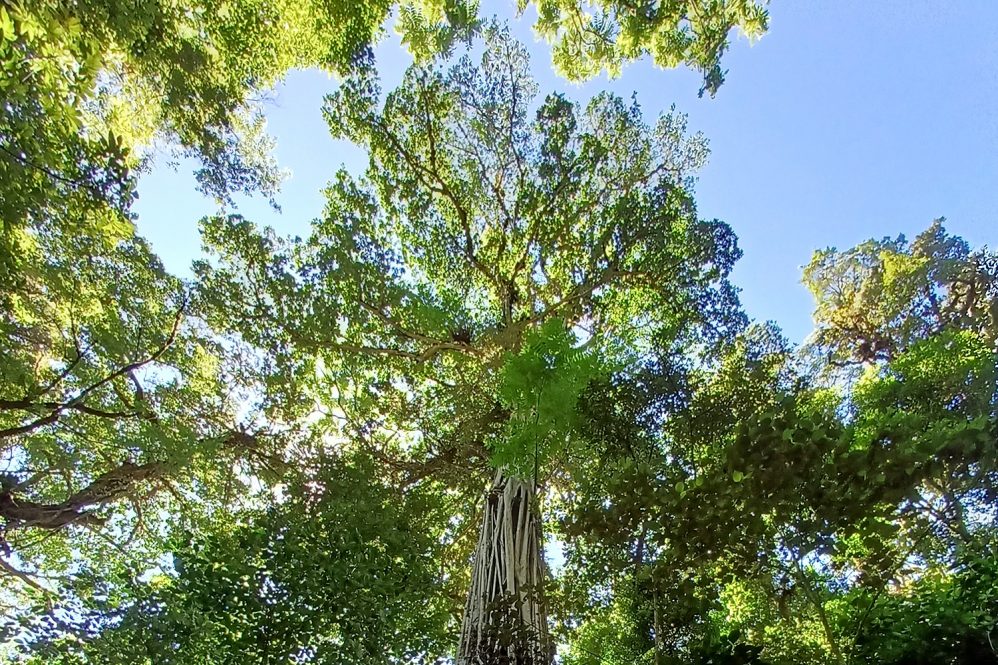
Quirós-Navarro noticed that the strangler fig, named for its unique growth habit, acts as a communication hub and popular pit stop location in the canopies of Costa Rica's cloud forest. (Contributed photo)
In his time spent it the lush canopies of Costa Rica's cloud forest, UConn Department of Ecology and Evolutionary Biology Ph.D. student Jeremy Quirós-Navarro has worked as an arborist, helped place camera traps, collected plant samples, and trained others how to climb, all while observing the amazing wildlife of this towering and unstudied ecosystem. Over time, Quirós-Navarro noticed an interesting pattern in the habits of the canopy animals involving their choice of locations to take care of their latrine needs. These findings are published in Ecology and Evolution.
Though he says he's not an adrenaline junkie, Quirós-Navarro says this challenging work is not for the faint of heart, and thought impossible by some. Climbing 130 to almost 200 feet (40 to 60 meters) above the forest floor into treetop ecosystems requires specialized equipment and knowledge. This means there are not many others conducting research like this, and explains why so much about these ecosystems remains unknown. Quirós-Navarro explains this study is the result of observations collected over time from 169 trees representing 29 different species.
"One of my biggest questions was how mammals use the space. On the ground it is easy to tell where the mammals walk because you can find the path," says Quirós-Navarro. "For example, in the tropics, tapirs make paths in the understory that other animals use for easier travel. I wondered if mammals in the canopy ever come to the ground and how they communicate with each other."
The locations of latrines give important insights into animal activity, including communication, and Quirós-Navarro noticed this intriguing pattern of animals frequenting certain trees for their bathroom breaks. After observing the same pattern over and over again, he was surprised to find not only that multiple species use the same latrine in this canopy ecosystem, but that the latrines were localized in just one species of tree, the strangler fig (Ficus tuerckheimii).

The ominously named strangler fig is so called due to its growth habit. Quirós-Navarro explains the fig wraps itself around a host tree and, as the fig grows, it squeezes the life out of the host tree, which after dying, rots away, leaving a hollow, lattice-wrapped cylinder. The trees grow to eclipse neighboring trees while their branches grow horizontally to form a platform where the latrines are frequently located. Quirós-Navarro thinks the tree's unique architecture has something to do with the decision to establish latrines there.
"I was thinking there was a pattern and I showed it to my friend and co-author biologist Tim Chamberlain," he says. "Then he started looking for this in strangler figs, because they live from Florida to Colombia and surprisingly, he climbed a strangler fig in Honduras and found a multi species canopy latrine."
They decided to continue this project and over the years, and especially along rivers, Quirós-Navarro says now it is harder to find a strangler fig without a multi-species latrine.
"They are always in the same tree species, even if they are in a different mountain range than the one we used for the camera deploying, it doesn't matter but they are always there," says Quirós-Navarro.
The next step in the research is to build a network analysis to study the connectivity of the trees along the river to better understand the movement of the animals. Quirós-Navarro says that if you think about how humans communicate, a logical place for connecting is a bridge that links the two locations. Since strangler figs connect both sides of the forest along a river, this could be a reason they serve as such popular pit stop sites.
These findings lend important new insights into the inhabitants of this under-studied ecosystem. Quirós-Navarro says that in all his years of placing camera traps in the canopy, the maximum number of species he had seen on one camera was four, yet in the communication hubs of the strangler fig latrines, he has spotted 18 different species interacting in a single tree, and also gleaned exciting information about some of the canopy's most elusive species.
"For example, sloths climb down trees and poop on the ground. This is a mystery for ecology, because why would they put themselves at risk like this? With this research, we found that they also use canopy latrines. We also saw several species of opossums, ant eaters, and an arboreal felid called the margay, which is one of the most endangered species that is also very difficult to detect. The latrine is a good place to study them because they seem to come once a month."
Though his passion was originally in studying the plants, Quirós-Navarro hopes to continue to study the roles the strangler fig plays for the ecosystem, including studying the interaction between animals and plants. Canopies are nutrient-poor places, and for that reason, plants called epiphytes have developed special adaptations to take the nutrients from the air to thrive in these locations. Quirós-Navarro says researchers are interested in how mammals that visit these latrines serve as an input of nutrients into the canopy. Epiphytes including ferns and orchids are abundant around the latrines but many other types of plants, including small trees grow here, possibly due to the seeds deposited via the latrine's visitors.
Quirós-Navarro hopes to study how these trees connect the canopy and the rolls they play in the ecology of different mammals.
"One of my goals is to see if the latrines are also being used by the tree as a kind of mutualism, where the mammals use the tree as their communication tower and the tree is taking nutrients from those using the latrine."