
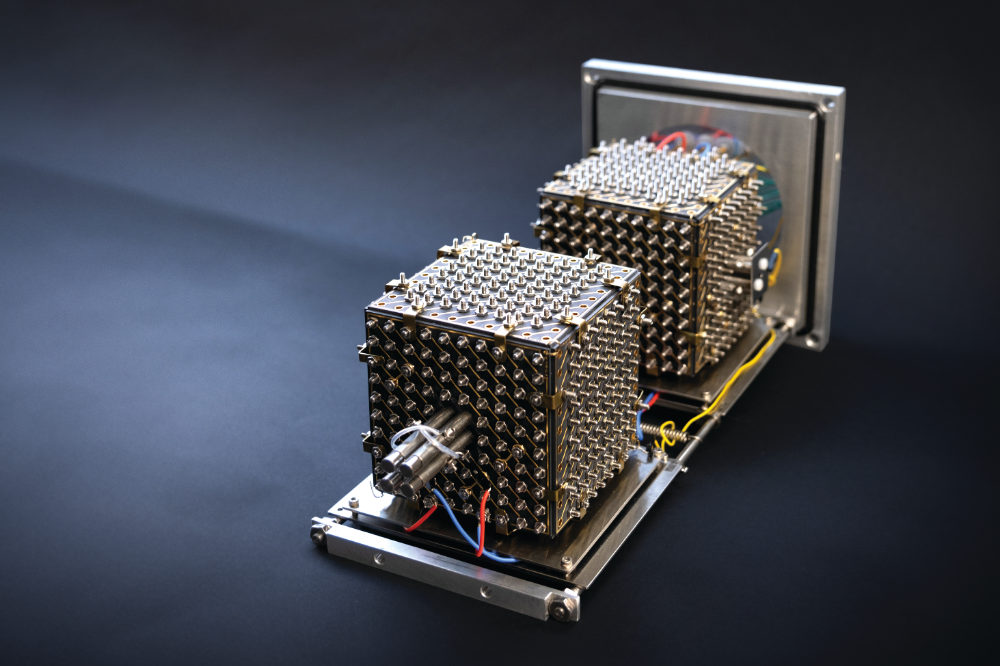
The new MultiQ-IT prototype can cool, trap, filter, and redirect over a billion ions simultaneously, dramatically improving dynamic range and signal-to-noise. (Credit: Lori Chertoff)
Mass spectrometry is already a powerful tool for determining what kind and how many molecules are present in a given sample. But most instruments still analyze their molecules one or just a few at a time, an approach that is inefficient and costly, and in which rare, but significant molecules can easily fall between the cracks.
A more powerful version of the technology could one day allow scientists to read the full molecular contents of a single cell, track thousands of chemical reactions at once, and ultimately accelerate efforts like drug development.
Now, a new study describes the first big step in that direction by producing a prototype, dubbed MultiQ-IT, that's capable of handling vast numbers of molecules at once. The findings offer a blueprint for faster, more sensitive instruments that could position mass spectrometry for the kind of transformation that reshaped genomics and computing.
"What revolutionized DNA sequencing wasn't any change in the underlying chemistry. That's remained fundamentally the same," says Brian T. Chait, Laboratory of Mass Spectrometry and Gaseous Ion Chemistry at Rockefeller. "It was the ability to run so many chemical reactions in parallel, which took genome sequencing from a billion-dollar effort to something that costs around $100. The same thing happened in computing with GPUs. And that's what we're trying to do with mass spectrometry."
A massive bottleneck
Mass spectrometry was invented around 1913 and has since become one of biology's most powerful analytical tools. The technology allows scientists to identify and quantify molecules by ionizing them, or giving them an electric charge, and measuring their mass-to-charge ratio. But despite its sophistication, most mass spectrometers still do this sequentially, one or just a few ion species at a time, often lacking the exquisite sensitivity needed to identify rare molecules in complex biological samples.
"It's a wonderful technique-you can do unimaginably wonderful, analytical things with it," Chait says. "But I was always a little frustrated by its limitations. I knew, in my heart, it could be better."
If it were, it could transform single-cell proteomics as well as metabolomics, burgeoning fields that aim to identify and quantitate the complete set of proteins or metabolites in a single cell. Unlike DNA, these molecules cannot be amplified, and the most abundant species may be millions of times more prevalent than the rarest. Mass spectrometry is already proving useful in these applications, but without far greater ability to detect faint signals against an overwhelming background of more abundant species, it will fall well short of its full potential.
Chait and colleagues suspected that the only way to overcome this limitation would be to usher the century-old technology through the so-called "massive parallelization" that once transformed computing and genomics. In computing, researchers discovered that dividing large tasks into many smaller ones and processing them simultaneously-using graphics processing units, or GPUs-dramatically increased performance. DNA sequencing followed a similar path, resulting in relatively low-cost platforms that analyze millions of reactions at once.
"It was a very obvious idea," says Andrew Krutchinsky, a senior research associate in the lab. "But how to do it with mass spectrometry wasn't obvious."
Toward massively parallel processing
The idea for the MultiQ-IT grew out of decades of research into how molecules move in and out of a cell's nucleus through hundreds of tiny gateways called nuclear pore complexes. Chait and colleagues had observed how the cell spreads the work across many parallel openings, instead of forcing traffic through a single channel. The team wondered whether mass spectrometry could be redesigned along these lines.
The result was a new ion-trapping chamber designed to replace the core component of a conventional mass spectrometer. The cube-shaped device is lined with hundreds of small, electrically controlled openings. Inside, ions are slowed by multiple collisions with residual gas molecules and allowed to move randomly through the chamber, where the system can filter, hold, and redirect many populations at once instead of analyzing them one by one. The team scaled the design from six openings to more than 1,000, testing how efficiently ions could be confined and sorted, and demonstrated that a single incoming stream could be split into multiple parallel streams for simultaneous analysis.
Its performance was striking. At any given moment, a 486-port version of MultiQ-IT could hold up to ten billion charges, roughly a thousand times the capacity of conventional ion traps.
By allowing abundant background molecules to leak out while retaining rarer, information rich ones, the system improved signal-to-noise ratios by as much as 100-fold, revealing proteins that had been undetectable. To achieve this, the researchers applied a small electrical voltage barrier across the trap's exits: singly charged ions had enough energy to escape, while multiply charged, biologically important ions remained confined. In their 1,134-port design, just 39 open ports were enough to reach half maximum efficiency for this depletion, echoing how cells use a limited number of pores to similar effect. The team also found that parallelization addressed a physical constraint: packing billions of like-charged particles into a small space creates intense electrical repulsion, but distributing them across many channels reduced this repulsion in these channels..
This increased sensitivity demonstrated by their prototype could for example lead to improved detection of low abundance crosslinked peptides, which are proving very useful for mapping the structures of large protein complexes. "The least abundant things can be more important than the more abundant things," Krutchinsky says.
For now, MultiQ-IT is less a finished commercial instrument than a demonstration of what is possible. The researchers see their role as establishing the physical blueprint that could one day be scaled into robust clinical and analytical tools.
"There was a lot of development between the discovery of a reaction for sequencing DNA and modern genomics; decades between the first transistor and putting a billion transistors on a chip," Chait says. "In both cases, someone first had to show it could be done, and then industry took over. I think we've shown one way mass spectrometry can be done more efficiently."


