
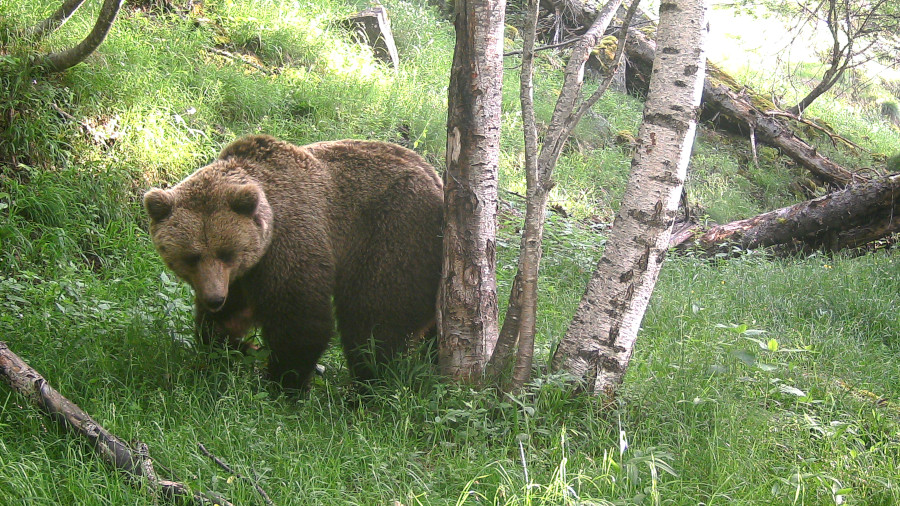
The European project LoupO Coexistence was recently launched with the aim of favouring a cross-border conservation of the biodiversity of the Pyrenees in France, Spain and Andorra. The project includes the monitoring and management of brown bear (Ursus arctos) and wolf (Canis lupus) populations, and the study of how the inhabitants of the Pyrenees view these two species.
The LoupO project, with a total budget of 1,953,714.67 euros, is 65% co-financed by the European Regional Development Fund (ERDF) through the INTERREG V-A Spain-France-Andorra Programme (POCTEFA 2014-2020), a European programme of territorial cooperation created to promote the sustainable development of the border territory between the three countries. The new project will last for the next three years and is meant to complete and continue the cross-border monitoring that is already being carried out for the two species. It also aims to have an impact on aspects such as coexistence and the promotion of preventive actions.
The LoupO Coexistence project is structured around three main lines of action: monitoring, prevention and coexistence. The first action will consist in monitoring brown bear and wolf populations in the Pyrenees through the development of innovative and non-invasive genetic and ecological techniques, such as artificial intelligence and advanced genomics. Among other aspects, artificial intelligence will be used to improve the identification of specimens, new molecular markers will be used to more precisely determine the parentage and hybridisation of new individuals, their diet will be studied, and their health control will be improved.
The second action will consist in minimising the number of attacks on extensive livestock farming and beekeeping in mountain areas through the application of new and efficient prevention techniques, in order to reduce social tension. In this sense, actions such as the use of guard dogs, the training of shepherds and the publication of specific manuals on livestock management will be promoted; the use of acoustic deterrents will be studied for application in circumstances of high predation pressure, and measures will be proposed in the attack assessment system or in conflict mediation to improve coexistence between both species and the primary sector.
Finally, the views on both species among the local human population of the Pyrenees will be studied to determine the degree of acceptance of both carnivores, through the organisation of forums, the exchange of experiences between the different actors, and specific studies.
In summary, the LoupO Coexistence project aims to promote understanding and mediation in the Pyrenees, providing government organisations and local actors with tools to manage and conserve biodiversity in a mountain region marked by human activity.
A cross-border partnership
The LoupO Coexistence project is made up of partners in Spain: the Government of Catalonia (through its General Directorate of Environmental Policies and Natural Environment of the Ministry for Territory, Housing and Ecological Transition, the General Directorate of Rural Agents of the Ministry for Interior and Public Security, and Forestal Catalana, S. A., company affiliated to the Ministry for Agriculture, Livestock, Fishing and Food) and the Universitat Autònoma de Barcelona (UAB, through its Department of Animal and Food Science and Department of Geography); France: the French Office for Biodiversity (OFB), the Pastorale Pyrénéenne, and the genetics laboratory Antagene. Also participating in the project, albeit without funding from the ERDF, are the Government of Andorra, the Conselh Generau d'Aran, the Government of Aragon, the Direction Régionale de l'Environnement, de l'Aménagement et du Logement d'Occitanie (DREAL Occitanie), and the Federació de Reserves Naturals Catalanes. The project will be coordinated by Dr Natalia Sastre, researcher of the Veterinary Service of Molecular Genetics at the Department of Animal and Food Science, UAB.
The Pyrenean brown bear and wolf form part of the natural heritage of Spain, France and Andorra
The protection of both species is regulated by the European Union and forms part of the objectives of the EU Biodiversity Strategy for 2030, integrated into the European Green Deal. Both species are transboundary in nature: the bear has a well-established breeding population in the central Pyrenees (Haute-Garonne, Ariège, Vall d'Aran and Pallars) and an incipient breeding population in the western Pyrenees. The wolf is present occasionally, with dispersing specimens detected mainly in the Pre-Pyrenees and the central and eastern Pyrenees. In this easternmost area of the mountain range, the first breeding pair was established in 2025 after a century of absence.


