
A stable "exceptional fermionic superfluid," a new quantum phase that intrinsically hosts singularities known as exceptional points, has been discovered by researchers at Institute of Science Tokyo. Their analysis of a non-Hermitian quantum model with spin depairing shows that dissipation can actively stabilize a superfluid with these singularities embedded within it. The work reveals how lattice geometry dictates the phase's stability and provides a path to realizing it in experiments with ultracold atoms.
Investigating Fermionic Superfluidity in Non-Hermitian (NH) Quantum Systems
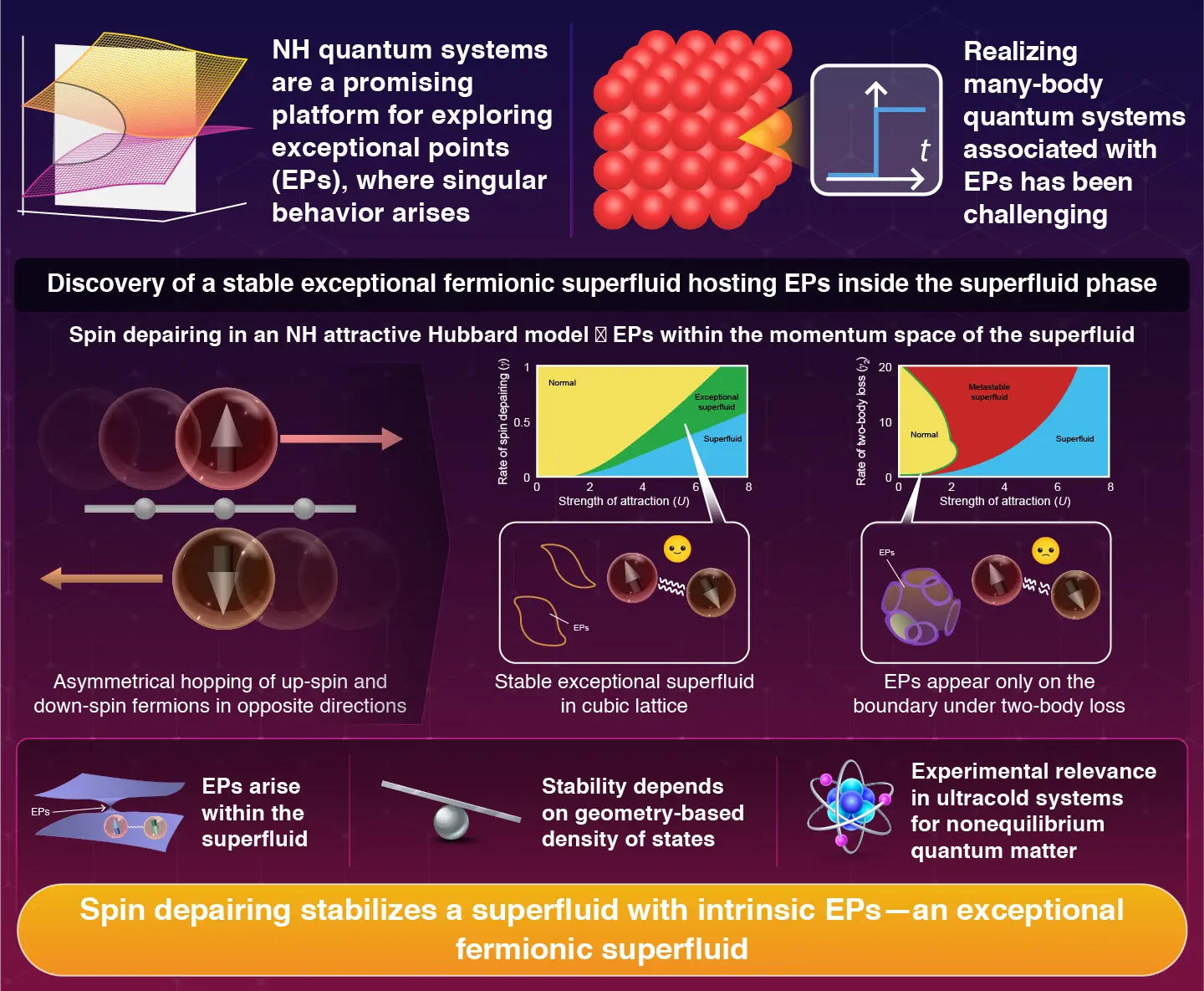
In the quantum world, open quantum systems are those where particle loss and directional asymmetry are fundamental features. These systems can no longer be described by conventional mathematics. Typically, quantum systems are represented by matrices that satisfy a condition called Hermiticity, which guarantees real and observable energy levels. However, when particles can leak away or travel in biased directions, this Hermiticity breaks down. Systems governed by such unconventional matrices are known as non-Hermitian (NH) systems. These NH systems can host exceptional points (EPs), which are singularities where both the energy levels and the corresponding quantum states merge. EPs, which usually occur near the boundaries, have been linked to enhanced laser responses, unusual Fermi surfaces, and nonequilibrium phase transitions.
Now, researchers at Institute of Science Tokyo (Science Tokyo), Japan, have discovered a stable superfluid that inherently hosts EPs. The study, published in the journal Physical Review Letters on December 23, 2025, advances the field by showing how EPs can emerge deep inside a strongly interacting phase rather than only near its boundary.
The study was led by Associate Professor Akihisa Koga, and included graduate student Mr. Soma Takemori as the corresponding author and Assistant Professor Kazuki Yamamoto, all affiliated to the Department of Physics at Science Tokyo.
"We studied the NH attractive Hubbard model to find that spin depairing stabilizes the superfluid state unique to the NH system, which we refer to as the exceptional fermionic superfluidity. This phase is characterized not only by a finite order parameter but also by the emergence of EPs in the momentum space. This is in stark contrast to the conventional NH superfluidity," says Koga.
To uncover this new quantum phase, the researchers focused on a specific form of dissipation called spin depairing, where particles with opposite spins preferentially hop in opposite directions (asymmetric hopping). They examined an NH version of the attractive Hubbard model, a standard theoretical framework used to describe strongly correlated particles and phenomena such as superfluidity. By incorporating spin-resolved asymmetric hopping and applying an NH extension of the Bardeen-Cooper-Schrieffer theory, they analyzed the system's effective density of states in the complex energy plane and traced the origin of the unusual superfluid phase.
Conventionally, EPs were thought to appear only at the boundary where a superfluid collapses. In contrast, the newly discovered exceptional fermionic superfluidity features EPs that coexist inherently with a stable, finite superfluid order parameter. The researchers found that the spin-depairing mechanism actively stabilizes this unique superfluid phase of the NH system. Their results show that dissipation can constructively shape a robust quantum phase with EPs.
The study further revealed that the underlying lattice geometry dictates the stability of the phase and the dimensionality of the EPs. On a square lattice, even an infinitesimal attractive interaction induces a robust exceptional superfluid. On a cubic lattice, however, strong spin depairing can destroy it. The EPs appear as extended exceptional lines in three dimensions and as isolated points in two dimensions, following a dimensional rule distinct from other NH systems.
These findings show that exceptional fermionic superfluidity is an intrinsic and stable feature of the NH system and provide new insights into a previously inaccessible regime of quantum matter. This phase is also expected to be experimentally realizable in ultracold atomic gases, such as lithium-6 or potassium-40, where atoms are trapped by lasers and cooled to ultralow temperatures. Such platforms allow precise control of particle loss, making them ideal for testing the role of EPs in many-body quantum systems. As Koga concludes, "Our discovery represents a new phenomenon expected to be experimentally verified in ultracold atomic systems, opening up a new frontier in the study of nonequilibrium strongly correlated quantum matter."
Reference
- Authors:
- Soma Takemori1*, Kazuki Yamamoto1, and Akihisa Koga1
*Corresponding author
- Title:
- Spin-Depairing-Induced Exceptional Fermionic Superfluidity
- Journal:
- Physical Review Letters
- DOI:
- 10.1103/ntjf-zb2v
- Affiliations:
- 1Department of Physics, Institute of Science Tokyo, Japan


