
A new model to predict how language changes over time has been developed by a statistical physicist at the University of Portsmouth.
The model is a step towards understanding the 'statistical physics of language', a scientific theory which borrows ideas from the physics of interacting particles to explain how words, accents and dialects spread, shift and disappear across regions and generations, and how they might change in future.
James Burridge , Professor of Probability and Statistical Physics, from the University's School of Mathematics and Physics , said: "Just as meteorologists use mathematical models to forecast tomorrow's weather, the same kind of thinking can be applied to language.
"Where you are affects how you speak and if you map how people use certain words, you see clear geographic patterns - just like a weather map. However, the physics of language is closer to crystals and magnets than the atmosphere.
"Language change can seem mysterious, but my research argues that as well as being driven by individual human behaviour it may also obey some of the same broad rules that govern physical systems like magnets, bubbles, and fluids."

A woodlouse or roly-poly?
The new model tracks how particular ways of speaking, such as regional pronunciations or locally preferred words, rise and fall in popularity across different communities and time periods.
To build the model, Professor Burridge drew on ideas from statistical physics, the branch of science used to describe the behaviour of large, complex systems.
Professor Burridge tested his approach against large-scale survey data on American dialects collected by the Cambridge Online Survey of World Englishes, created by Bert Vaux, a professor of linguistics at the University of Cambridge.
He tracks why one region says soda while another says pop and why some names for a woodlouse spread while others retreat.
In 1950, the term roly-poly for a woodlouse was largely confined to a relatively small group of speakers in the American South. By 1995, the term had spread dramatically, becoming almost universal across much of the United States.
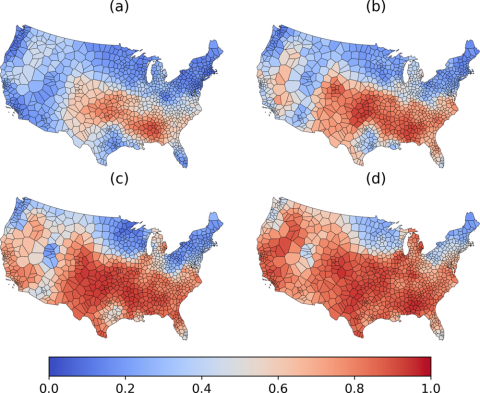
The share of people (grouped by birth year) who use the term roly poly. Panels show results for those born around (a) 1950, (b) 1965, (c) 1980, and (d) 1995.
This shift highlights how quickly a once-local expression can diffuse and become widely adopted over time.
The results demonstrate that the model can accurately capture the kinds of sweeping linguistic shifts seen across the United States during the 20th century.
In one of Professor Burridge's previous papers , he showed that in England the word splinter spread north from southern England, where it became the standard form, but this spread did not reach the far northeast. There, the local variant spelk has persisted, helped by regional isolation and strong local usage.
Professor Burridge said: "Splinter is used across almost all of England, except around Newcastle, where people still say spelk. Although Newcastle itself is densely populated, it is surrounded by more sparsely populated areas, which helps the local form hold its ground and prevents splinter from taking over.
My research suggests that language may be much more law-like than it first appears. Beneath the creativity and messiness of human speech, there may be hidden statistical forces shaping how we all end up talking.
James Burridge, Professor of Probability and Statistical Physics
"My research suggests that language may be much more law-like than it first appears. Beneath the creativity and messiness of human speech, there may be hidden statistical forces shaping how we all end up talking.
"For physicists like me, this is particularly exciting, as it suggests that the elegant tools of statistical field theory may help explain not just the natural world, but patterns in human communication as well."
A key finding is that the model has a natural "horizon" - a window of time over which reliable predictions about language change can be made, beyond which uncertainty grows too large, much like long-range weather forecasts become less reliable the further ahead they look.
This paper provides a principled foundation for predicting the future of language, offering new insights into how cultural and social dynamics shape the way we communicate. The findings could have applications in linguistics, sociology, and even technologies that rely on understanding human language change.
It was published in the American Physical Society journal .


