
Researchers at Columbia University have identified a switch that turns on the rapid production of blood cells in emergency situations, a finding that could help researchers uncover new treatments for aging and some of the most difficult-to-treat blood cancers.
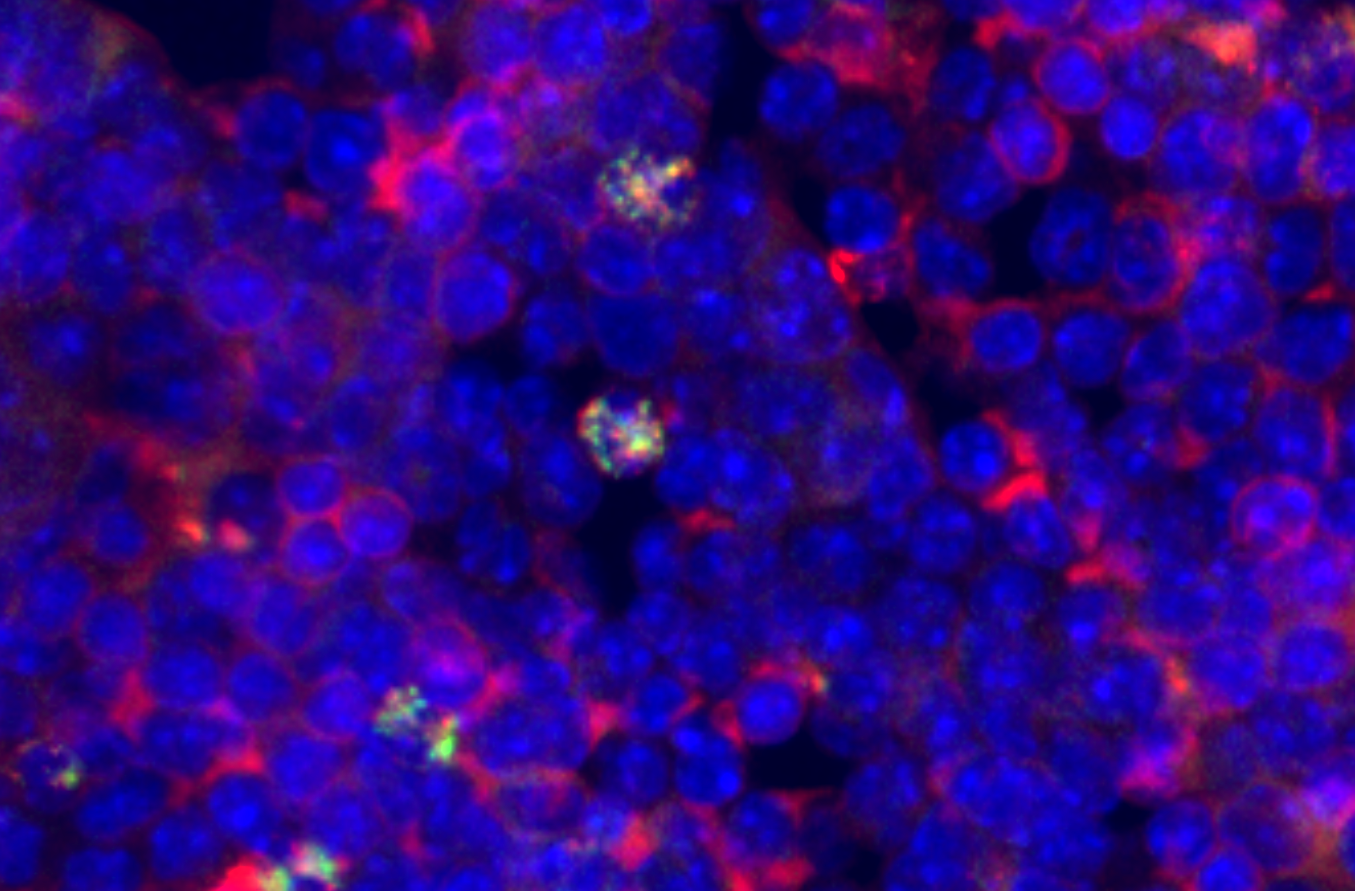
Hematopoietic stem cells (white), which produce all blood cells in the body, seen alongside blood cells (blue and red) in the bone marrow. Photo credit: Brian Heubel, Passegué laboratory, Columbia Stem Cell Initiative.
Called emergency myelopoiesis, the process is essential in creating an army of immune cells to fight off invading viruses and bacteria. It also kicks in after a traumatic injury or surgery, creating the white blood cells needed to repair the damage, and after a variety of other insults.
But when the emergency system doesn't wind down or turns on for no reason, white blood cell production start malfunctioning and inflammation becomes rampant. Overactive emergency myelopoiesis is thought to drive inflammation that accelerates aging and is believed to contribute to the development of cancer.
"The blood system bathes the entire body and it's clear that turning off runaway emergency myelopoiesis could be an important way to treat many conditions," says Emmanuelle Passegué, director of the Columbia Stem Cell Initiative, who led the study with her associate research scientist James Swann and colleague Raul Rabadan, director of the Program for Mathematical Genomics in the Department of System Biology, and his team.
The finding of the on switch means that turning off emergency myelopoiesis could be an easier task than previously thought.
"Various different insults can turn on the emergency system, and many people thought that each could work through a different mechanism," says Passegué. "It would be a daunting task to develop a therapy specific for each.
"What James found is that there are common molecular pathways used by all insults, or only one switch, that turns on emergency myelopoiesis, which may accelerate the discovery of inhibitors."
Connections to blood cancer
The team's discovery of the single switch is also illuminating how emergency myelopoiesis is connected to a deadly blood cancer, acute myeloid leukemia.
Swann found that cells from many AML patients contain a signature that shows the emergency system has been turned on, and patients with that signature have a worse prognosis.At this point, we haven't identified drug targets, but that's the next step of this work.
"It suggests emergency myelopoiesis has been hijacked in AML to produce more severe disease," says Passegué. "At this point, we haven't identified drug targets, but that's the next step of this work."
The power of collaboration
The discovery of the solo on-switch for emergency myelopoiesis was only made possible by the rise of single cell RNA sequencing, which gives a snapshot of what every individual cell is doing in response to a challenge, as well as new computational tools to analyze tens of thousands of cells.
"There's a huge wealth of data collected from these cells by our lab and others over the years, and I thought that somewhere in that data we would find signatures that mark how these cells were turned on," Swann says.
Working with computational scientists Jun Hou Fung and Ziwei Chen from the Rabadan lab, Swann first had to create a unified classification system, called HemaScribe, to identify each cell based on its RNA transcripts. Swann then used the standardized cell data to build a map (called HemaScape) that predicts how the cells are interconnected as they develop from a stem cell into different types of mature blood cells.
It took the two groups working together to build the predictive maps. "It really required both the expertise of the computational scientists and our biological understanding of the process to get a map that could make testable predictions but also accurately capture what we already know about these cells," Passegué says.
With this map, Swann and Passegué could then see how emergency myelopoiesis alters the blood cell system, revealing the single activation switch.With these tools in hand, researchers will also be able to apply AI to predict interesting drug targets and uncover new biology hidden within big datasets. That's where the power of these tools will really reveal themselves.
"At the start of my PhD, somebody told me, "Learn to code, because it will be important." And I thought, "Ridiculous advice. I'll never need to do that." But there is huge potential in these large data sets, and being able to analyze them yourself is becoming more important," says Swann (who took the advice).
Swann and Passegué have made HemaScribe and HemaScape freely available to the research community, who have already started using them to accelerate their own research.
"With these tools in hand, researchers will also be able to apply AI to predict interesting drug targets and uncover new biology hidden within big datasets," says Swann. "That's where the power of these tools will really reveal themselves."
"We are now very excited to adapt them to the study of blood aging and and how we can help restore normal immune cell production", says Passegué.


