
Raman optical activity, long thought to require chiral molecules or magnetic order, has been demonstrated in an achiral, nonmagnetic crystal by researchers at Institute of Science Tokyo. The effect arises through ferroaxial order, a coordinated rotation of atoms within the lattice, and is detected using circularly polarized Raman spectroscopy. These findings show that optically inactive materials can also display chirality-like optical responses and expand the scope of optical techniques for discovering new materials.
Ferroaxial Order Enables Optical Activity in an Achiral Crystal
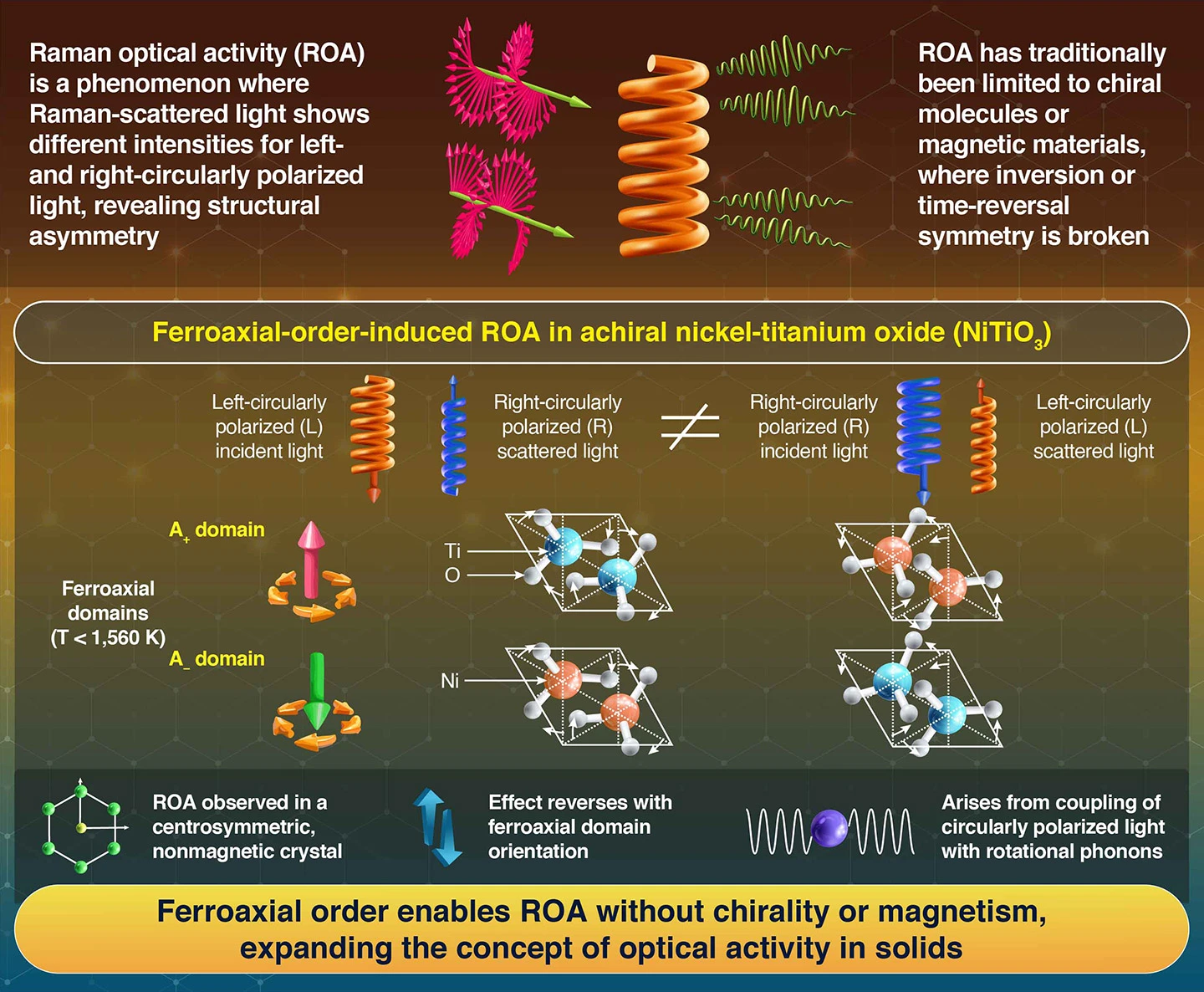
In nature, molecules can be divided into two categories based on their symmetry: chiral and achiral molecules. Chiral molecules are not identical to their mirror images, much like left and right hands. Achiral molecules, in contrast, are identical to their mirror images and therefore do not possess a definite handedness. Light offers a way to distinguish between these two types. When light interacts with a chiral molecule, the response depends on its handedness. For example, chiral molecules absorb left- and right-circularly polarized light to different extents, a phenomenon known as circular dichroism. They also scatter these two types of light with different intensities, an effect called Raman optical activity (ROA), which is widely used to identify chirality. ROA has long been associated only with chiral molecules or with materials that have magnetic order, where inversion or time-reversal symmetry is broken.
However, a new study by researchers at Institute of Science Tokyo (Science Tokyo), Japan, shows that this is not always the case. The research team was led by Professor Takuya Satoh from the Department of Physics, School of Science, Science Tokyo, together with graduate student Gakuto Kusuno from Science Tokyo, Professor Tsuyoshi Kimura from The University of Tokyo, Japan, and Associate Professor Hikaru Watanabe from Hokkaido University, Japan. The study was published in Physical Review Letters on May 19, 2026, and was selected as an Editors' Suggestion.
The researchers found that ROA can also occur in a material that is neither chiral nor magnetic. Instead, the effect arises from a separate class of structural property known as ferroaxial order, which manifests as coordinated rotational distortions of atoms in a preferred direction, even though the crystal, as a whole, remains achiral and centrosymmetric. This ordered rotation introduces an internal directional property, known as an axial vector, which can interact with light in a chirality-like way.
"We demonstrated for the first time that ROA can arise in a centrosymmetric and nonmagnetic crystal, overturning the conventional view that ROA requires either structural chirality or magnetic order," says Satoh.
The researchers uncovered this unexpected form of ROA in nickel titanium oxide (NiTiO3) crystals, which are both centrosymmetric and nonmagnetic. Using circularly polarized Raman spectroscopy, they observed a clear difference in the intensity of scattered light between left- and right-circularly polarized light. This is a key signature of ROA, even though the material itself is not chiral.
They also found that this effect depends on the orientation of the crystal. When measurements were taken from opposite sides, the direction of the intensity difference reversed. This showed that the effect is linked to the direction of the internal rotational order rather than to chirality.
By combining experiments with theoretical calculations, the researchers showed that this behavior arises from the interaction between the crystal's vibrations and its electronic structure. The effect is especially strong at a wavelength of 785 nm, where the light is in resonance with the electronic transitions in the nickel ions, strengthening its interaction with certain vibrational modes of the crystal.
This discovery changes how scientists understand optical activity in materials. It shows that effects similar to chirality can emerge from structural order, even in materials that were previously thought to be optically inactive. "The findings expand the concept of chirality and open new avenues for materials discovery and optical measurement techniques," says Satoh.
Reference
- Authors:
- Gakuto Kusuno1, Takeshi Hayashida2,3, Takayuki Nagai2, Hikaru Watanabe4,5, Rikuto Oiwa6,7, Tsuyoshi Kimura2, and Takuya Satoh1,8


